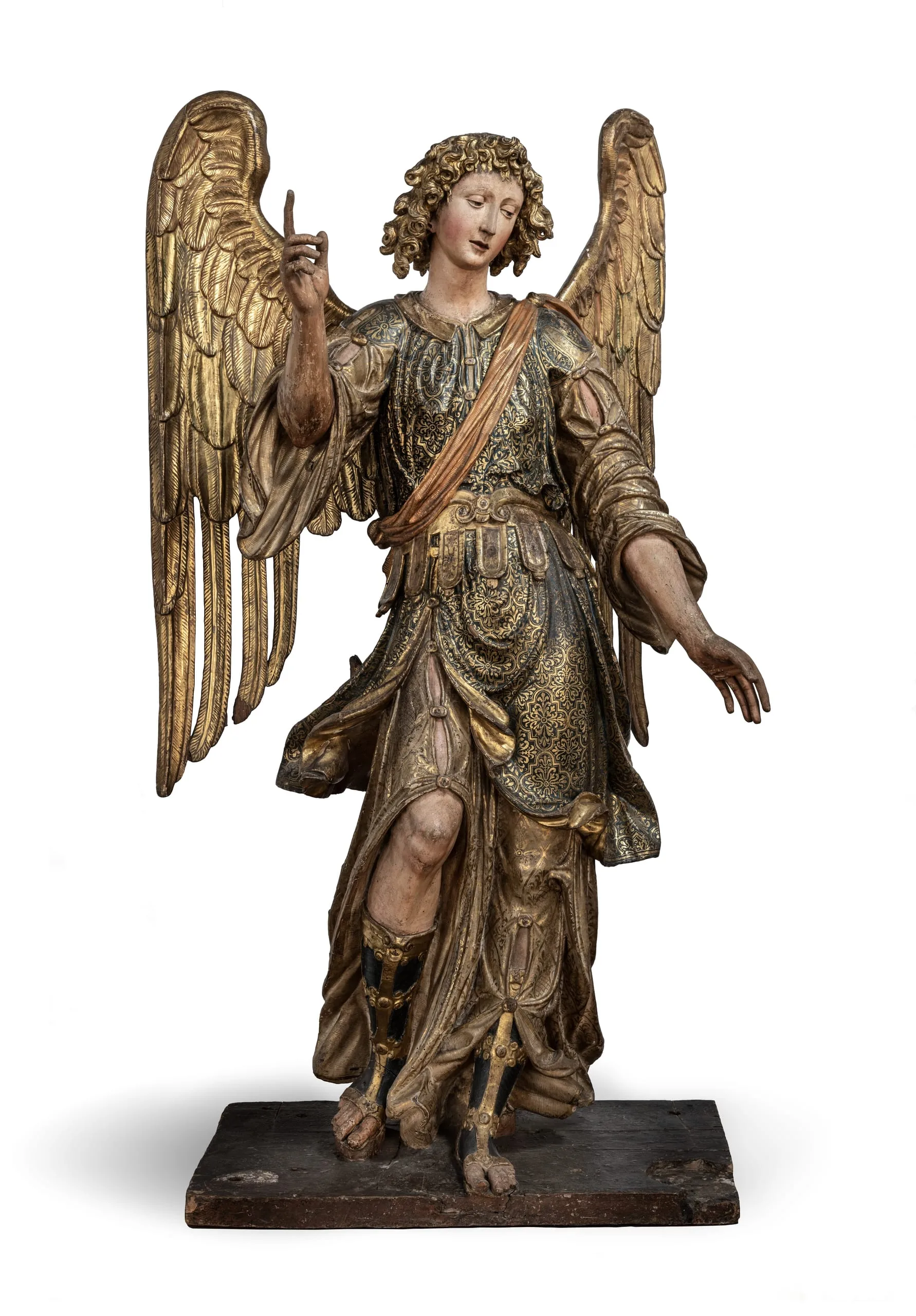
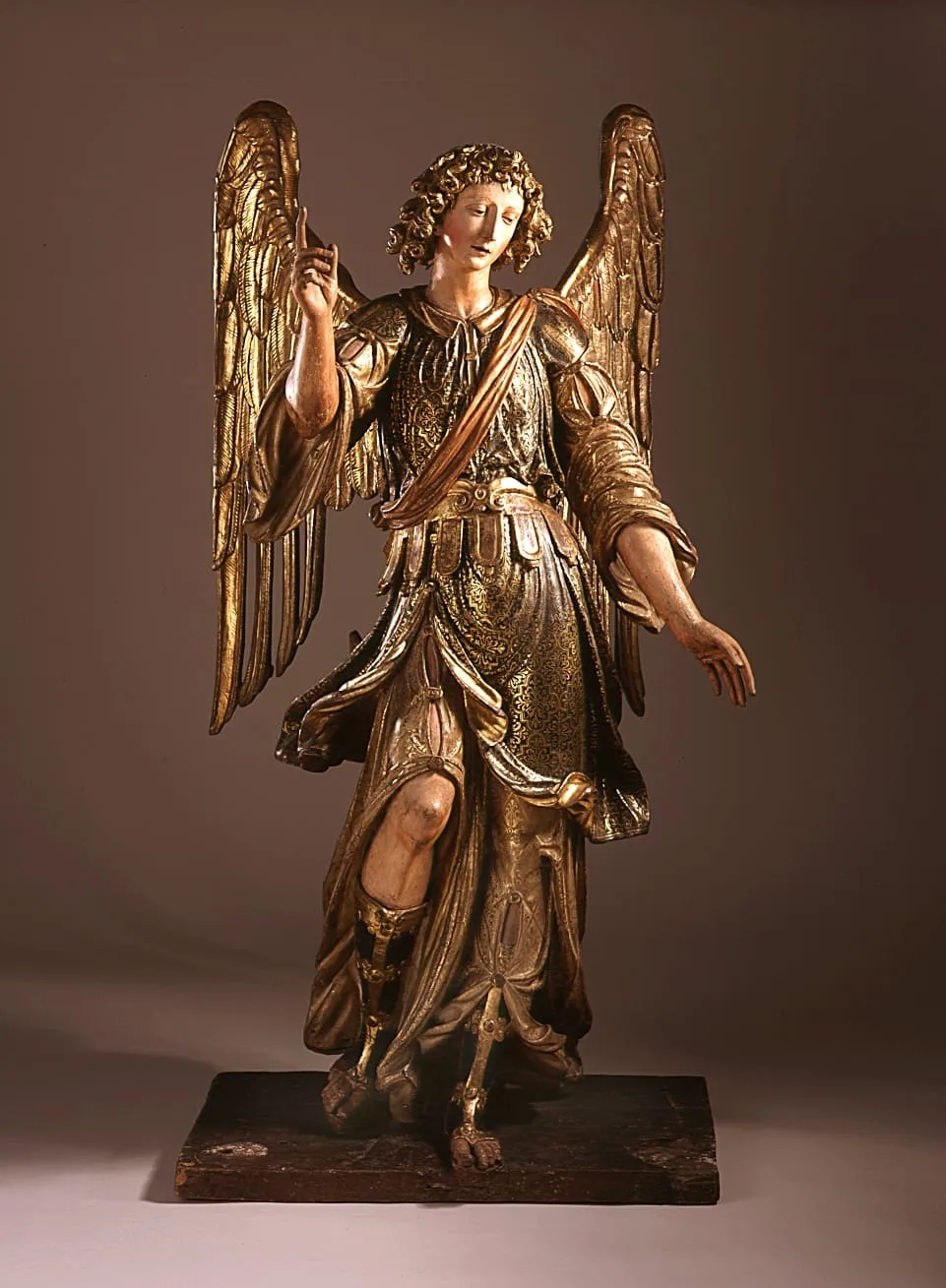
This polychrome and gilded wood sculpture by an unknown Neapolitan artist depicts the archangel Raphael, who was often venerated as a protector of sailors and travelers. He is depicted in motion, one knee and foot lifted, and he raises his right arm and hand, an index finger extended in blessing. The sculpture’s movable wings have been attached with hinges, and it has been finely carved to emphasize the many folds of the draperies. The angel is also in an excellent state of preservation. The polychrome appears to be original, as does the brocade pattern on the tunic, which was produced by painting over the gilded surface, then scratching through the paint to reveal the gold leaf below.
There is an indentation in the base of the sculpture indicating that it was once accompanied by another figure, probably Tobias. According to the Old Testament apocryphal book of Tobit, Tobias was sent by his blind father to conduct business in a distant city. The archangel Raphael, in the guise of a mortal man, was sent by God to assist the youth through various tribulations and see him safely home with a cure for his father’s blindness. In sixteenth- and seventeenth-century Italy, where sons commonly traveled on family business, a representation of Tobias and the Angel was often commissioned as a pledge or thanksgiving for a son’s safe return.
When this sculpture was produced, at the end of the sixteenth century, Naples was under the rule of the Spanish Habsburgs and was a prosperous center of religious and artistic activity. Major patrons included the Spanish viceroys, the Catholic Church, religious orders, and the local nobility, all of whom supported both monumental and smaller-scale sculpture. While the specific circumstances of its production are unknown, this angel may have been displayed initially in the chapel of a church or confraternity or in the devotional space of a private palazzo. At least four comparable sculptures of the archangel Raphael produced in Naples have been documented. Two remain in their original settings—the Neapolitan churches of San Domenico Maggiore and the Gesù Nuova—and two are in the National Museum of Sculpture in Valladolid, Spain, transported there when Naples was still under Spanish rule.