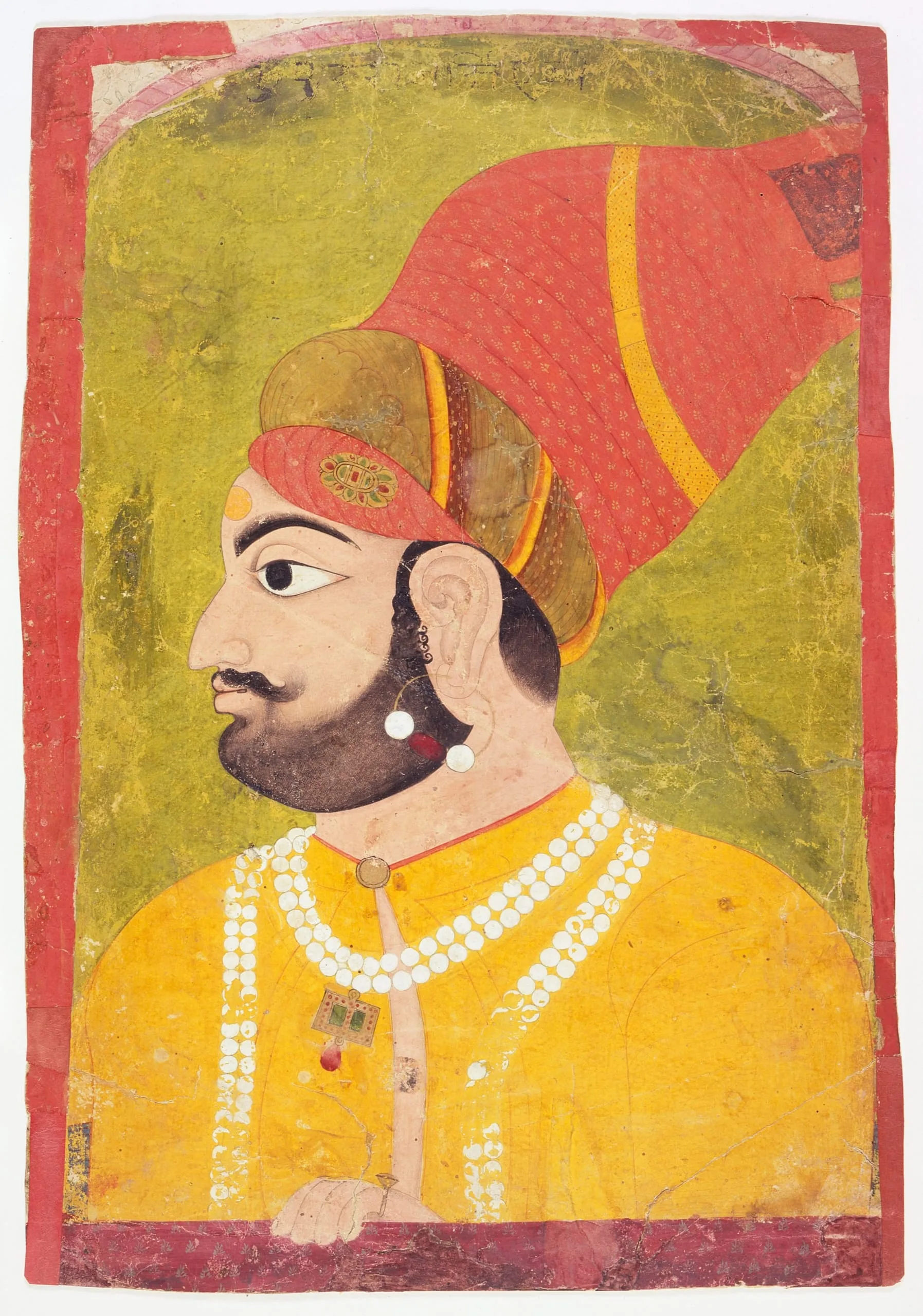
Prince Raj Singh of Bikaner (1744-1787) was the second son of Maharaja Gaj Singh (r. 1746-1787). Located in the Thar Desert of Rajasthan in a region called Jangladesh, Bikaner was founded in 1488 by Rao Bika Rathore (r. 1472-1504). Although Rao Bika was a son of Rao Jodha Rathore of Marwar (r. 1438-1489), he wanted to establish a separate kingdom of his own. The early rulers of Bikaner were concerned with consolidating territory and subduing local rivals. Eventually, the sixth ruler of Bikaner, Raja Rai Singh I (r. 1571-1612), formed matrimonial and military alliances with the Mughal Emperors Akbar (r. 1556-1605) and Jahangir (r. 1605-1627), which led to Bikaner’s rise as a powerful and important Rajput principality. Under its later rulers, however, Bikaner was torn by internal strife. Raj Singh succeeded his father to the throne as Maharaja Raj Singh II in 1787, but ruled for less than a month before being poisoned by his stepmother, the wife of Surat Singh, the fifth son of Gaj Singh. This portrait was likely painted by a Jodhpur artist in circa 1775-1785 while the prince was in exile there until 1785 following a quarrel with his father. The distinctive towering turban was a popular style at the Jodhpur court in the late 18th and early 19th century. Two devanagari inscriptions on the front and the reverse identify the subject as Kunwar (Prince) Raj Singh of Bikaner. A comparable portrait of Prince Raj Singh is in the Royal Ontario Museum, Toronto (2022.49.22).