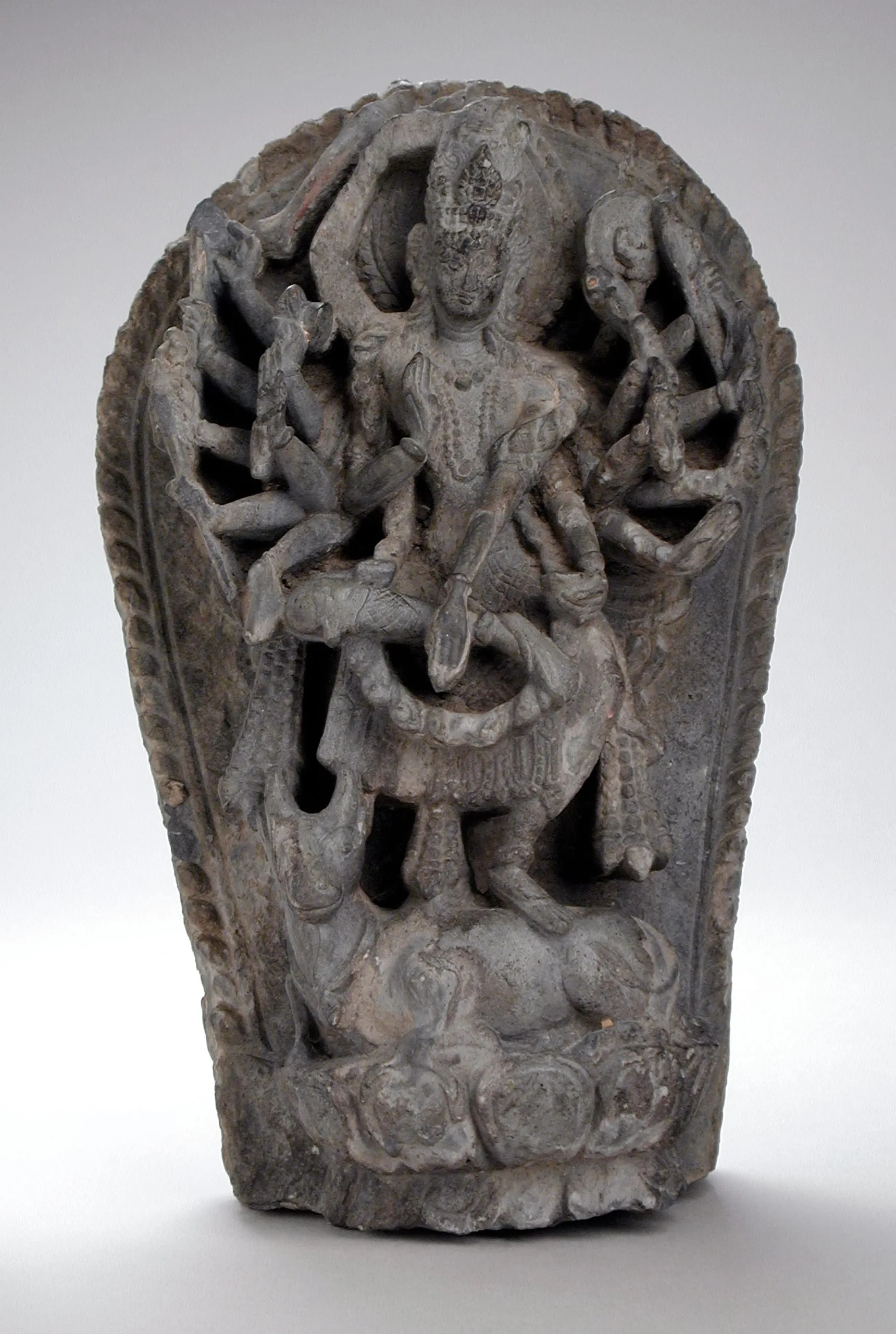
The Hindu god Shiva is represented here as the cosmic dancer whose dance engenders the creation of the universe. Shiva performs in the charming (lalita) dance posture with his hip thrust to the left. He stands on his left leg with his right leg raised and held horizontal. The lalita dance is one of the 108 dance postures described in texts such as the Natyashastra (200 BCE-200 CE) and the south Indian agamas (religious scriptures that have come down as tradition). Contrary to the better known southern Indian representations of Shiva dancing as Nataraja on the dwarf of ignorance, Apasmara Purusha (see M.75.1), in eastern Indian, Bangladeshi, and Nepalese images he dances on his bull mount, Nandi. This iconographic form is known as Nartteshvara or Nritteshvara (Lord of Dance).
Shiva is crowned, nimbate, and exalted by a flaming aureola (prabhavali). He wears copious jewelry, including a long garland of severed skulls (mundamala), and a Newari flaring skirt (tapalan). The divine dancer has eighteen arms carrying his conventional attributes, although some are now damaged. His principal right hand displays the gesture of reassurance (abhaya mudra), while the principal left hand points to his dancing right foot (see also M.75.1). Nandi is alert and seated on a lotus base. See also M.82.42.4, M.87.105, and M.90.166.