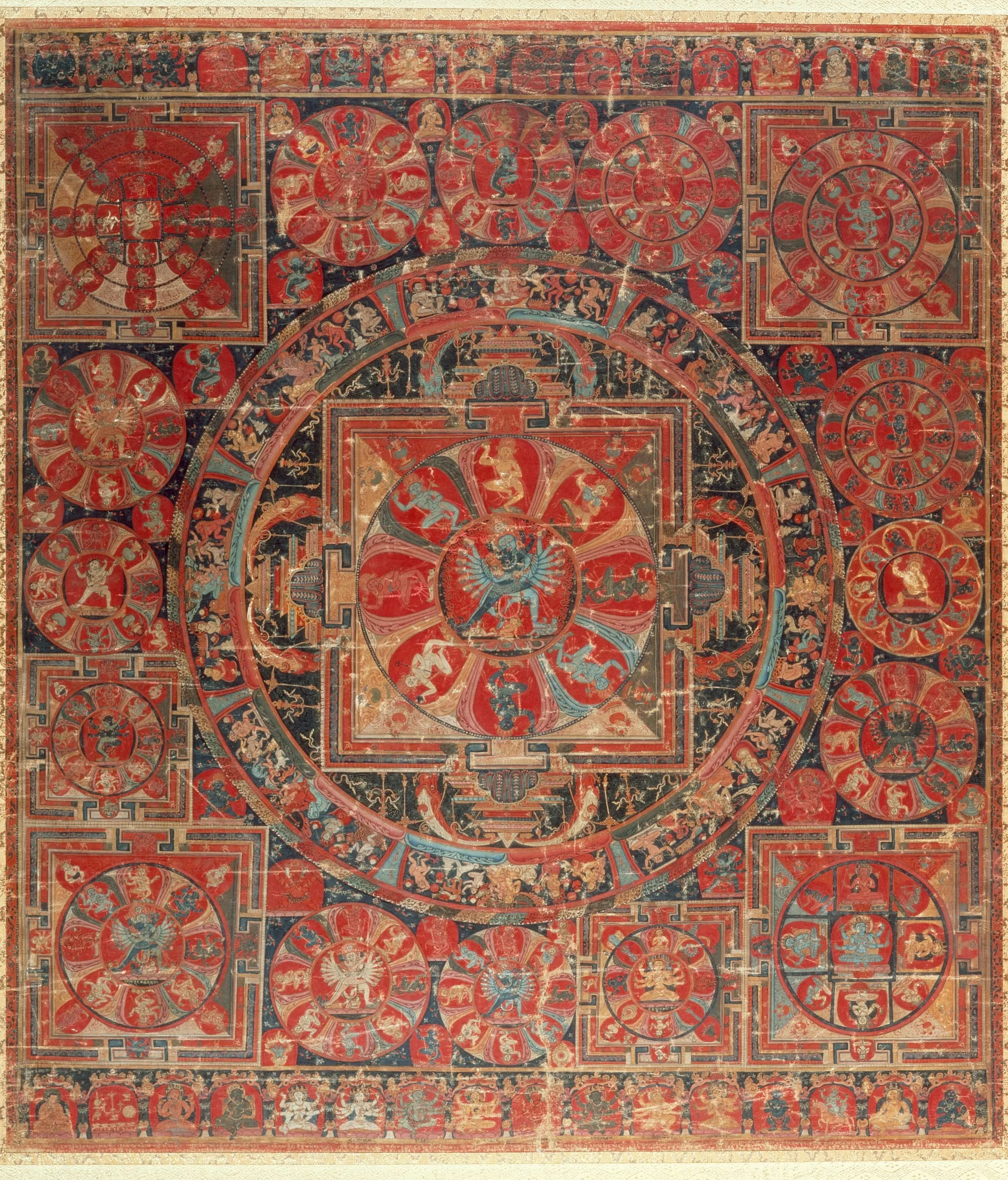
In this complex painting created as an aid to meditation, sixteen different mandalas dedicated to the deity Hevajra, the personification of the Hevajra Tantra, surround a central mandala. In the center, Hevajra dances in ecstasy while embracing his consort Nairatmya, who symbolizes wisdom (prajna). Hevajra is depicted as a cosmic god with eight heads and sixteen arms, each of which holds a skull-cup containing an animal or deity. The four enemies of enlightenment who Hevajra tramples beneath his feet are the Hindu gods Brahma, Vishnu, Shiva, and Indra. On the eight petals of the central lotus are dancing figures of the goddesses who emerge from the union of the principal pair: Gauri, Chauri, Vetali, Ghasmari, Pukkasi, Savari, Chandali, and Dombini. Outside of the ring of female deities are the four "gates to the palace." All the mandalas are conceived of as a palace symbolizing knowledge (jnana). The outer circle of the central mandala depicts the eight cemeteries or cremation grounds.
The mandalas are from the Vajravali, a manual of Tantric liturgy written in circa 1101-1108 by the Indian monk Abhayakaragupta (1084-1130). The literature of the Hevajra Tantra forms the basis for the Path and Fruition (Tibetan: lam-`bras) teachings of the Great Adept Virupa and is an important part of the Sakyapa tradition of Tibetan Buddhism.
The inscription along the bottom of this thangka states that it was commissioned by a Sakyapa monk, Lama Gyalsen, who is depicted making offerings to Hevajra in the lower left corner, in honor of the great Sakyapa monk Lama Jamyang:
This [thangka] which proceeds from the vow of the All Knowing Lama Jamyang and the cycle of Tantras of Samvara, Hevajra, Kalachakra, Vajrabhairava, and Vajrapani was produced as an inner visual support for the teacher himself [Lama Jamyang] by the monk Gyalsen. The head of the craftsmen was Gyalpo Palseng. By seeing this¼ when the teacher attains complete fulfillment, may all beings attain enlightenment.