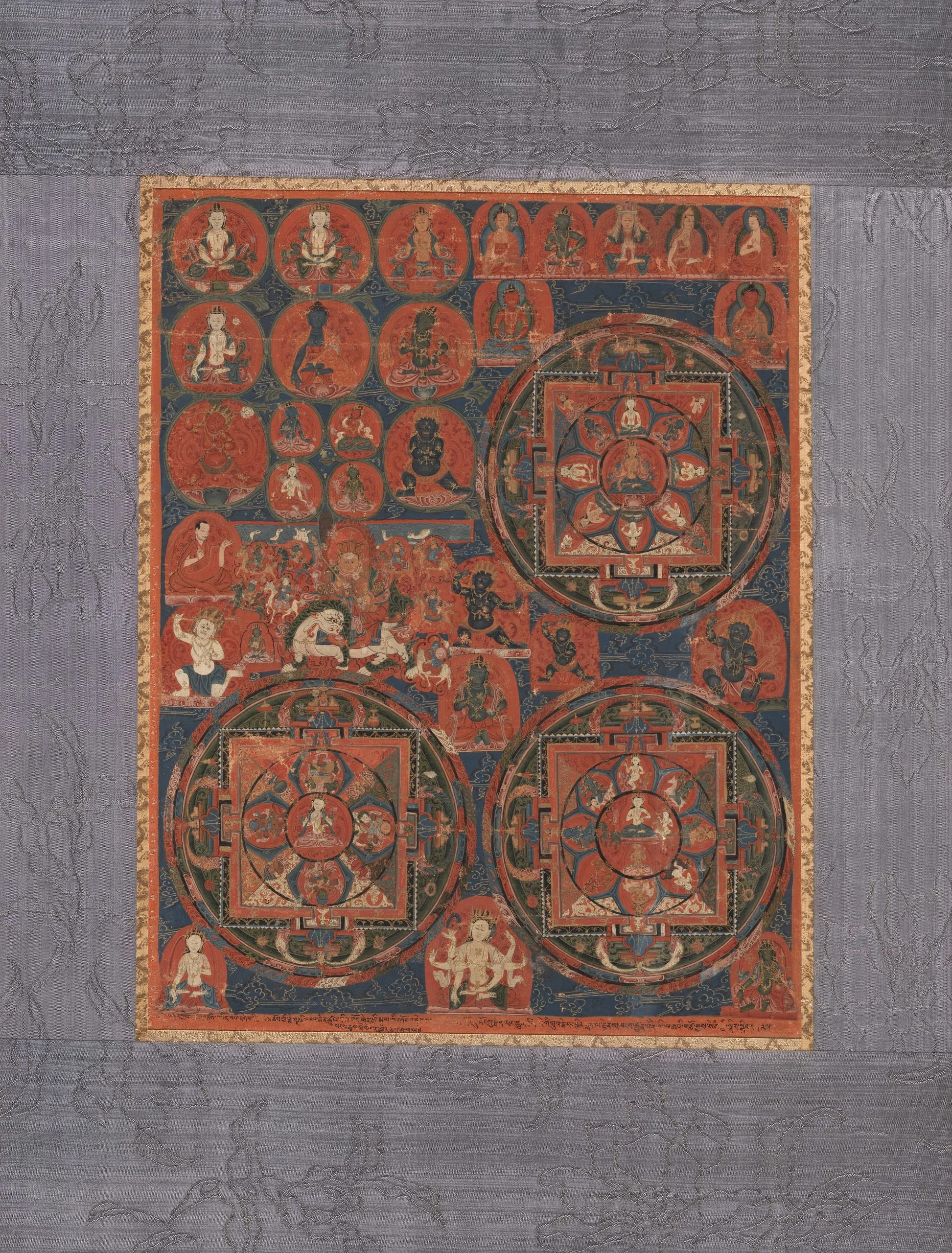
This atypical Tibetan thangka painting has an asymmetrical composition featuring three mandalas and numerous red aureoles or roundels connected by a scrolling vine. They contain various Buddhas, bodhisattvas, Buddhist protective deities (dharmapala), meditational deities (yidam), and monks belonging to diverse liturgical cycles. The upper mandala is devoted to Amitayus, the Buddha of Eternal Life (see also M.77.19.14, M.83.253, and M.84.32.5). Both lower mandalas are centered on the primordial teacher Vajrasattva (Adamantine Being). In the center-left section of the painting, Vaishravana, the Buddhist god of wealth, directional guardian of the North (dikpala), and dharmapala, rides his snow-lion mount. He carries his banner standard (dhvaja) and wears a padded textile armor overcoat and a red fan-shaped hat topped by a gold finial. He is accompanied by his troupe of eight Generals, the Lords of the Horses (ashvapati), each wearing Mongolian garb and riding within a storm cloud. The group appears to be moving toward, or perhaps conjured up, by a seated monk wearing red robes and holding his hands in explication gestures. Pratapaditya Pal has suggested that the monk may represent the Lama Tshulgyi Özer mentioned in the Tibetan inscription in the lower border. (Pal 1990, 323) The inscription reads, This mandala, one of a series [of twelve], was dedicated by Gyaltsen Özer for the cleansing of his sins, those of his father and mother, and all creatures. It prays that the learned Lama Tshulgyi Özer may attain fulfillment of his wishes. (Translation by H. E. Richardson.)