- Title
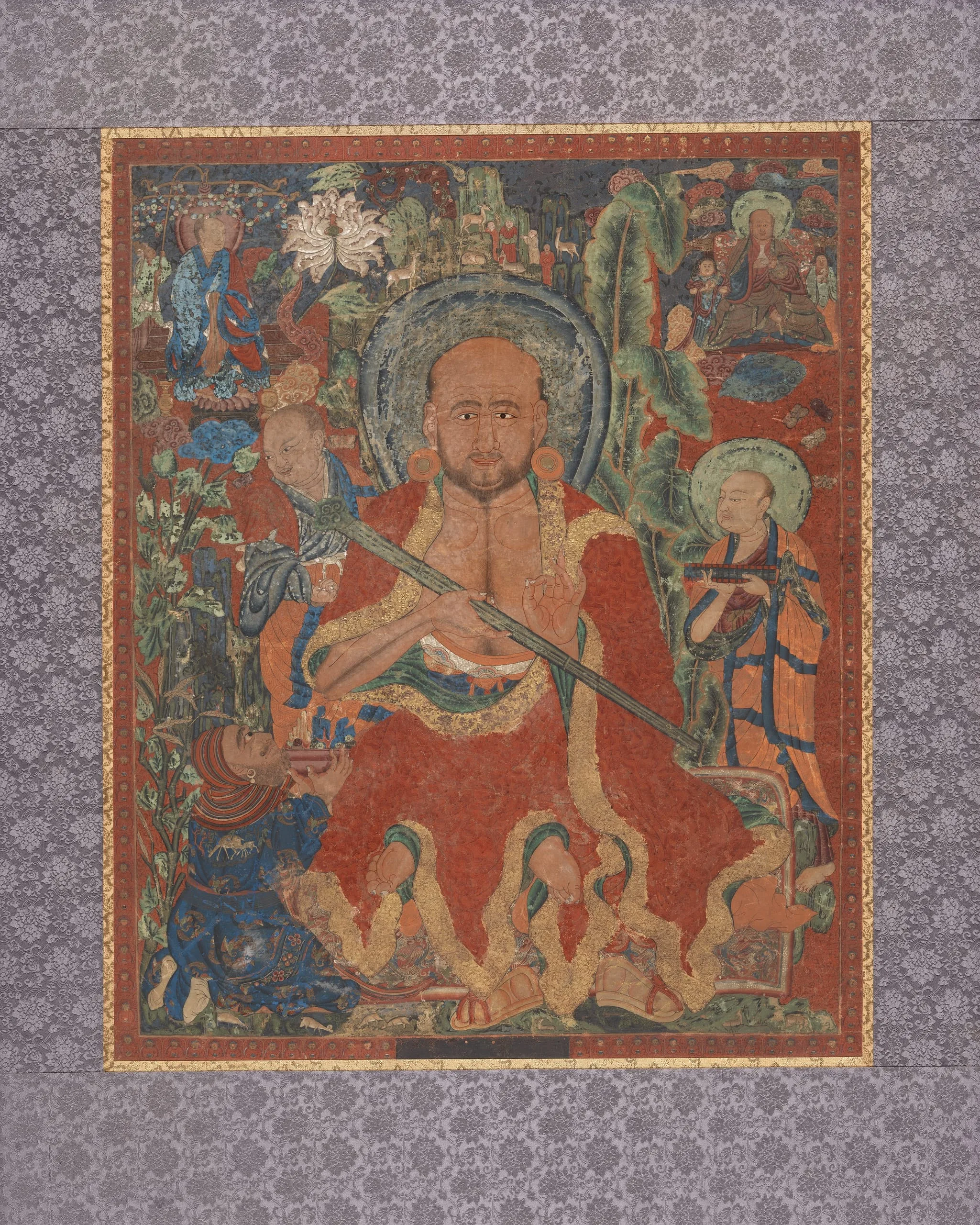
- Arhat Chudapanthaka (?) with Attendants
- Date Made
- circa 14th century
- Medium
- Mineral pigments and gold on cotton cloth
- Dimensions
- 25 1/2 x 21 1/4 in. (64.77 x 53.98 cm)
- Accession Number
- M.77.19.9
- Curatorial Notes
In both Theravada and Mahayana Buddhism, the arhats are believed to have been the Buddha Shakyamuni’s original disciples, and to attained enlightenment through their own efforts. They were endowed with exceptional prajna or transcendent wisdom. Functioning much like saints, their role was to protect the Dharma, or Buddhist teaching, until the coming of Maitreya, the Buddha of the Future. This Tibetan painting depicts an arhat, possibly Chudapanthaka, with attendants in a landscape dominated by a Chinese-inspired blue-and-green color scheme.
Chudapanthaka was from a Brahmin family. He had a severe learning disability and could not memorize the Buddhist scriptures. The Buddha Shakyamuni mentored him and gave him menial chores to do at the monastery while he tried to improve his cognitive skills. Eventually, as he developed wisdom and compassion, he became a revered disciple.
- Selected Bibliography
- Pal, Pratapaditya. Art of Tibet. Los Angeles; Berkeley, CA: Los Angeles County Museum of Art; University of California Press, 1983.
- Kossak, Steven M., and Jane Casey Singer. Sacred Visions: Early Paintings from Central Tibet. New York: Metropolitan Museum of Art, 1998.
- Rhie, Marylin M. and Robert A.F. Thurman. Wisdom and Compassion: The Sacred Art of Tibet. New York: Tibet House, 1991.
- Chakraverty, Anjan. Sacred Buddhist Painting. New Delhi: Lustre Press Pvt. Ltd., 1998.
- Beguin, Gilles. Dieux et Demons de l'Himalaya: Art du Bouddhisme Lamaique. Paris: Grand Palais, 1977.
- Pal, Pratapaditya. The Art of Tibet. New York: The Asia Society, Inc., 1969.
- Meister, M. W. "The Arts of India and Nepal." Oriental Art 14 (2): 109 (1968).
- Pal, Pratapaditya; Dehejia, Vidya; Slusser, Mary Shepherd; Fisher, Robert E.; Brown, Robert L. Arts of Asia 15 (6): 68-125 (November- December 1985).
- Pal, Pratapaditya. Art of Tibet. Expanded edition. Los Angeles: Los Angeles County Museum of Art, 1990.
- Rosenfield, John. The Arts of India and Nepal: The Nasli and Alice Heeramaneck Collection. Boston: Museum of Fine Arts, Boston, 1966.
- Fisher, Robert E. Art of Tibet. London: Thames and Hudson, 1997.
- Xingyun, editor. Encyclopedia of Buddhist Arts. Los Angeles: Buddha's Light Publications USA, 2018.
- Little, Stephen, Tushara Bindu Gude, Karina Romero Blanco, Silvia Seligson, Marco Antonio Karam. Las Huellas de Buda. Ciudad de México : Instituto Nacional de Antropología e Historia, 2018.
- Little, Stephen, and Tushara Bindu Gude. Realms of the Dharma: Buddhist Art across Asia. Los Angeles: Los Angeles County Museum of Art, 2025.