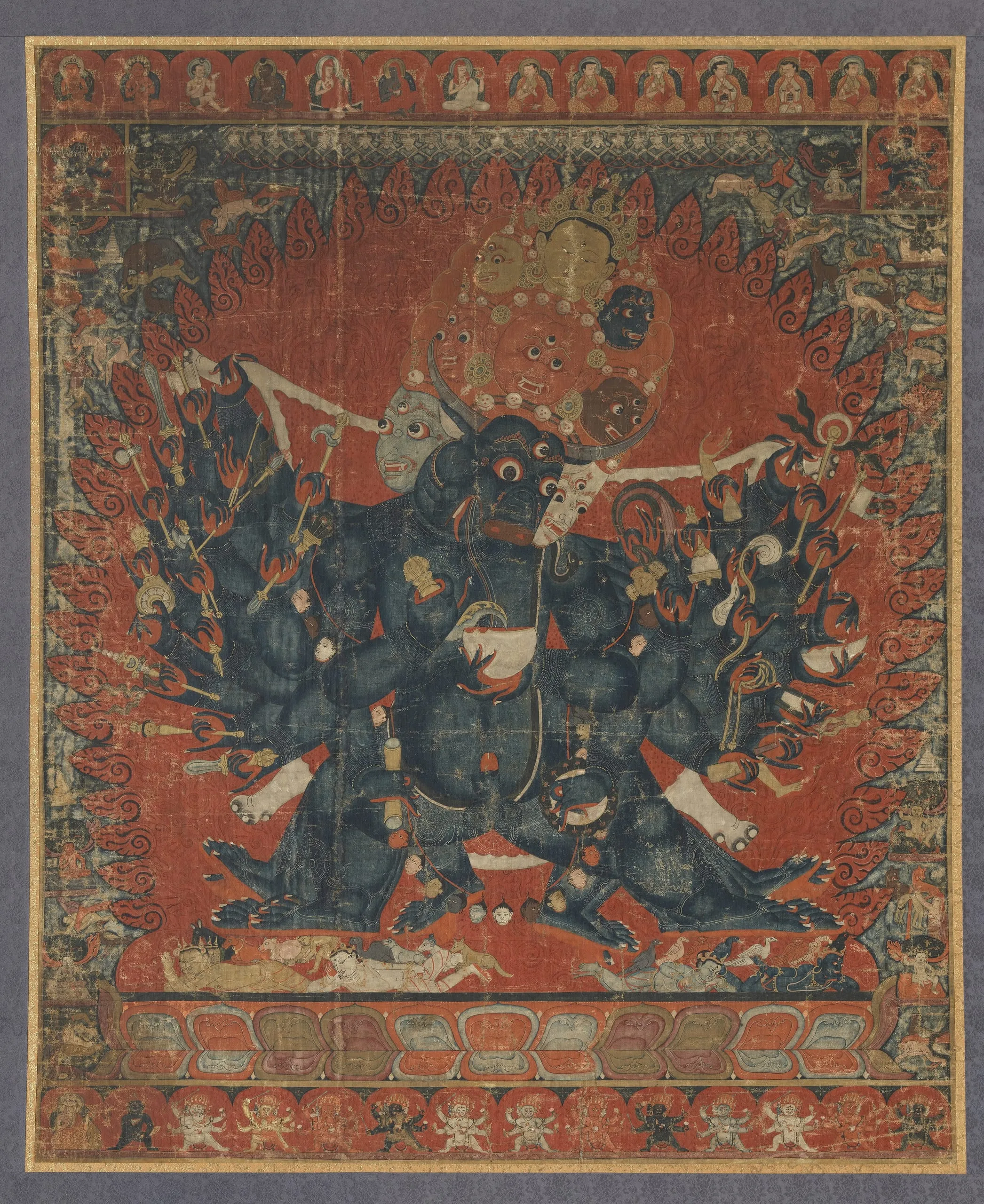
This powerful painting depicts Yamantaka (he who puts an end to Death), a wrathful manifestation of Manjushri, the Bodhisattva of wisdom. Yamantaka, also known as Vajrabhairava, is depicted here as a single figure in the form known as the "Lone Hero." He is also often shown in union with his consort Rolangma.
Yamantaka is dark blue in color and has nine heads, thirty-four arms and sixteen legs. His main head, like that of death (Yama) is a buffalo, while his uppermost head is that of Manjusri. He wears ornaments made from human bones, a poisonous serpent around his neck, and a garland of fifty-one freshly severed human heads. He holds a skullcap in front of him, and stretches an elephant skin across his back. Underfoot he tramples upon eight Hindu deities, eight mammals, and eight birds. Outside of his flaming areola are depicted the eight cemeteries or cremation grounds symbolic of the eight-fold conscious activities that Tibetan Buddhists believe keep us bound to life, and hence to death. The religious masters and lamas of the Sakyapa sect who have been initiated into Yamataka’s mysteries are shown in a row along the top of the painting. In the lower left corner is a seated monk, very likely the patron who commissioned this painting. To the right is a black form of Kubera, the deity who dispenses wealth, and twelve additional manifestations of Yamantaka.
The stylistic similarity of this painting to the Nepalese style murals in the Kumban stupa at Gyantse and other Nepalese style works in the Tsang region of central Tibet supports a 15th-century date and central Tibetan origin by a Nepalese trained artist.