- Title
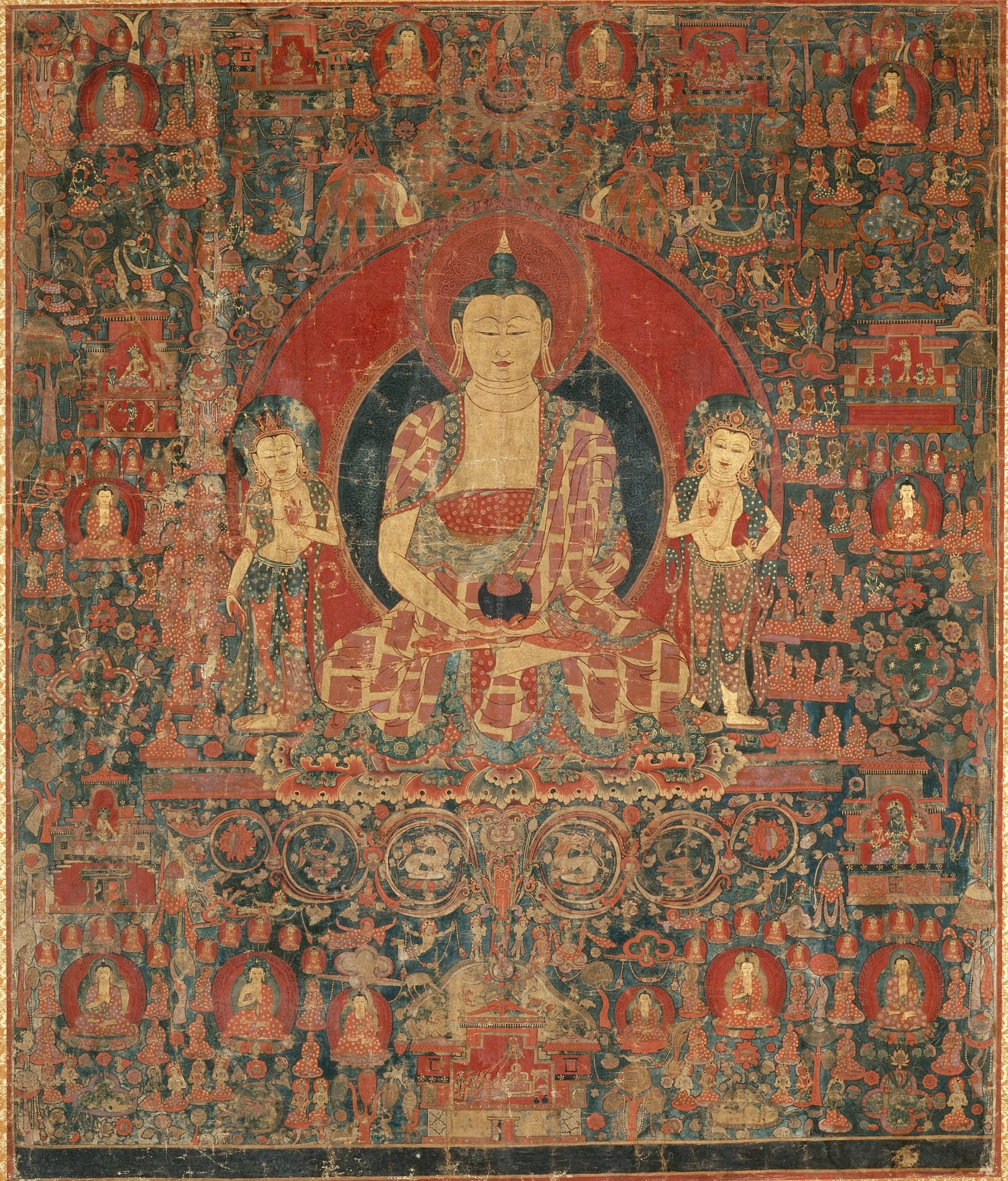
- The Jina Buddha of Infinite Light (Amitabha) in His Pure Land Paradise (Sukhavati)
- Date Made
- 15th century
- Medium
- Mineral pigments on cotton cloth
- Dimensions
- 41 1/2 x 34 in. (105.4 x 86.4 cm)
- Accession Number
- M.77.19.12
- Curatorial Notes
In the center of this painting, Amitabha, the transcendental Jina Buddha of Infinite Light, sits in the meditation posture (padma asana) on a lotus throne growing out of the cosmic ocean. He has elongated earlobes symbolic of his renunciation of the material world and the cranial protuberance (ushnisha) emblematic of his omniscience, which is surmounted by a golden finial. He wears a patchwork monk’s robe with decorative borders over both shoulders. His hands are placed in his lap in the gesture of meditation (dhyana mudra) and hold a mendicant’s begging bowl. He is flanked on his companion bodhisattvas standing within his red aureole (prabhavali). On his right is Avalokiteshvara (the Lord who gazes down [with compassion]), who holds his right hand in the gesture of charity (varada mudra) and his left hand in the gesture of discourse (vitarka mudra). On his left is Mahasthamaprapta (arrival of the great strength), who holds a thunderbolt (vajra) in his right hand and a ritual bell (ghanta) in his left hand resting on his waist. Surrounding the triad is a rich tableau representing the Pure Land Paradise (Sukhavati) with various monks and bodhisattvas listening to the divine discourse, elegant pavilions, and trees bedecked with jewels and garlands.
See also the related paintings M.81.90.3 and M.77.19.13.
- Selected Bibliography
- Pal, Pratapaditya. Art of Tibet. Los Angeles; Berkeley, CA: Los Angeles County Museum of Art; University of California Press, 1983.
- Beguin, Gilles. Dieux et Demons de l'Himalaya: Art du Bouddhisme Lamaique. Paris: Grand Palais, 1977.
- Pal, Pratapaditya, ed. Aspects of Indian Art: Papers Presented in a Symposium at the Los Angeles County Museum of Art. Leiden, The Netherlands: E.J. Brill, 1972.
- Pal, Pratapaditya. Art of Tibet. Expanded edition. Los Angeles: Los Angeles County Museum of Art, 1990.
- Rosenfield, John. The Arts of India and Nepal: The Nasli and Alice Heeramaneck Collection. Boston: Museum of Fine Arts, Boston, 1966.
- Little, Stephen, and Tushara Bindu Gude. Realms of the Dharma: Buddhist Art across Asia. Los Angeles: Los Angeles County Museum of Art, 2025.