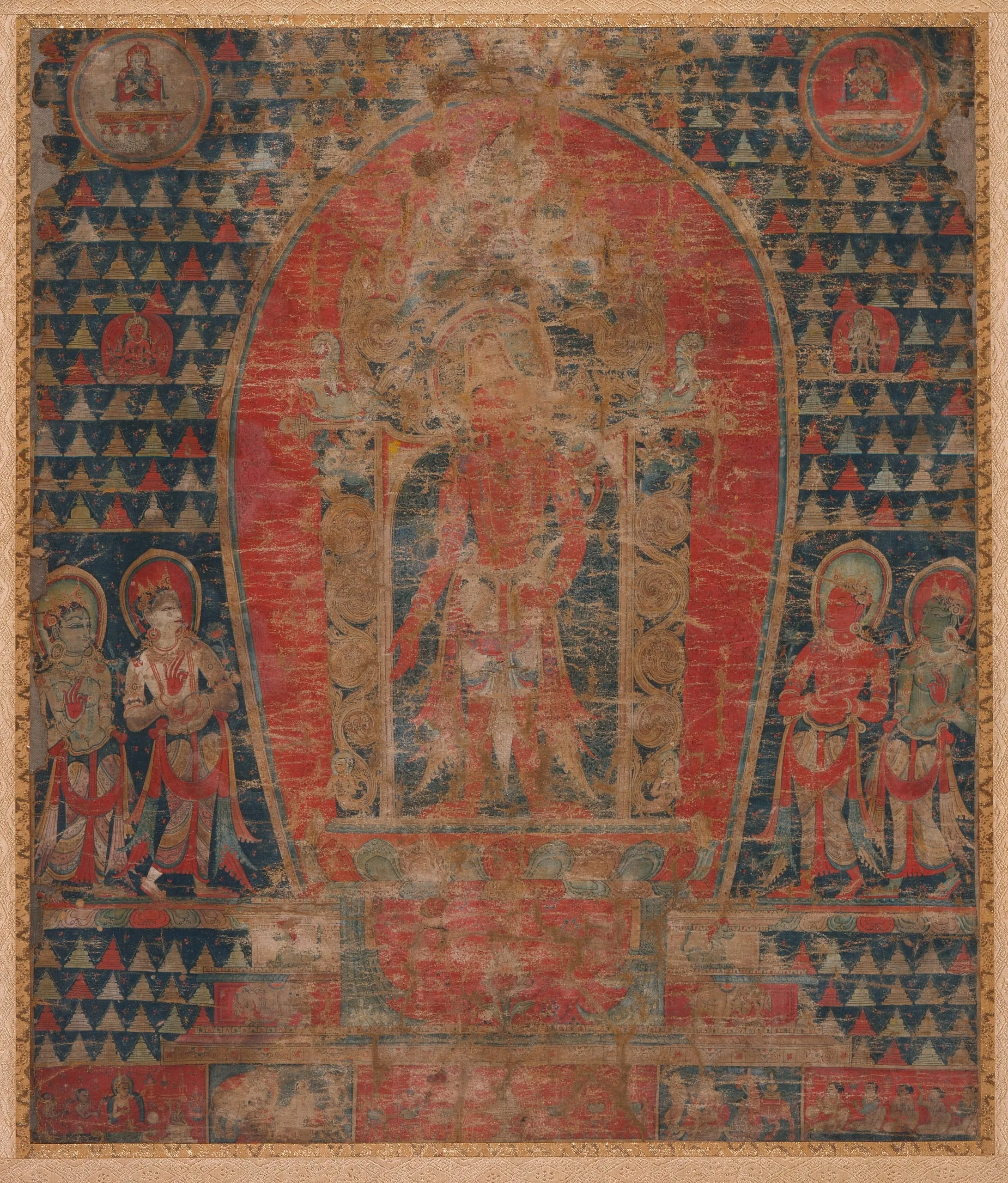
In the center of the painting is a large shrine with an elaborate archway replicating the renowned gilt copper alloy repoussé metalwork of Nepal (see M.85.279.6). An image of the Bodhisattva of Compassion, Avalokiteshvara, stands under the arch. He has red skin, a single head, and two arms. He holds a lotus in his left hand. His right hand is extended in the gesture of charity (varada mudra). Flanking Avalokiteshvara are four emanations of the goddess Tara differentiated by skin color. In the rondels in the upper left and right corners respectively are the moon god Chandra and the sun god Surya. Enshrined multi-armed figures in the 2 o’clock and 10 o’clock positions are emanations of Avalokiteshvara. In the lower left corner, a Buddhist monk performs a ceremony propitiating Avalokiteshvara and the Taras. In the central panel, various ritual vessels are displayed on stands. Flanking the central panel, two figures in peril are appealing to Avalokitesvara for protection. In the lower right corner, the donor and his family are depicted. The background is filled with registers of multicolored stupas (funerary monuments). These likely refer to the performance of the Lakshachaitya rite, in which a donor earns merit by donating 100,000 (laksha) chaityas (or stupas). A comparable painting of this ceremony dated 1808 is in the Asian Art Museum, San Francisco (B61D10+).
Although now somewhat worn along its vertical axis, this Nepalese painting (paubha) was once a resplendent example of the superb artistic skills of the Kathmandu Valley artists, which were highly valued by Tibetan patrons in the 13th-14th centuries. Nepalese merchants in the trade between eastern India and Tibet often carried images of Avalokitesvara and the Taras for protection while traveling.