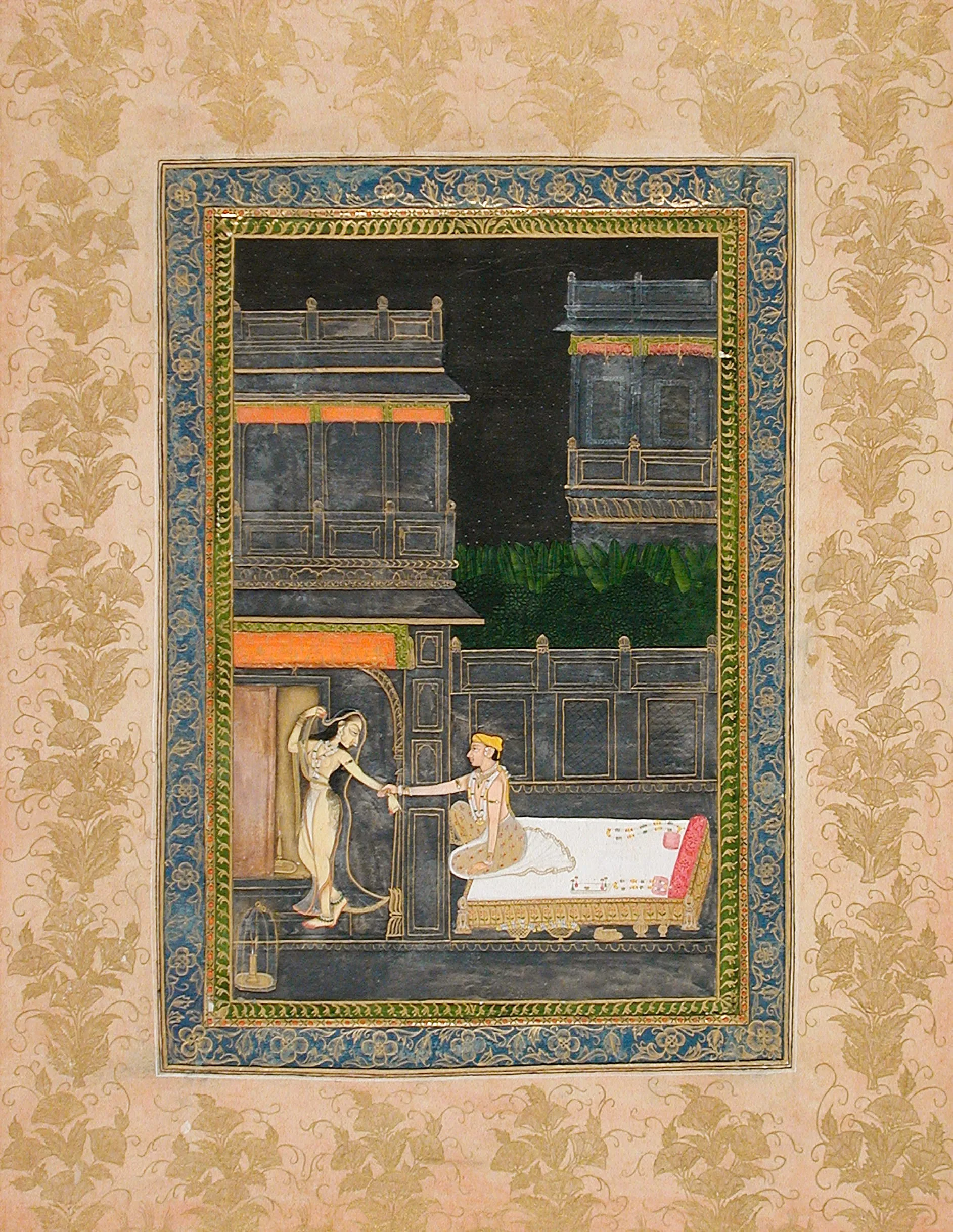
This sensual illustration of a nighttime tryst presents two lovers on a palace terrace and an elaborately prepared bed with a red bolster, floral garlands, and refreshments including betel nut (pan) and wine. Seated on the edge of the bed is a prince wearing a yellow turban, double-stranded pearl necklace, fine jewelry, and luxurious garments. A coquettish princess wearing only a transparent veil and double-stranded pearl necklace stands under the rolled up curtain in the doorway. Back over her shoulder at the prince, who grasps her wrist and attempts to entice her to join him on the bed. The moonless night is illuminated only by two floor lamps, one on the front of the terrace and another behind the half-open door of the interior room.
Attributed to circa 1800, the LACMA painting is a slightly later rendition of a painting with the same composition in the Reichart Collection in Germany that is attributed to circa 1750–1800. Significantly, the earlier version features Krishna in place of the latter’s unidentified prince. The clothing of the two male figures is identical, except for Krishna’s distinguishing turban. The posture of the females is the same in both representations, but their body proportions differ in that the Radha in the earlier painting is more harmoniously and correctly proportioned while the princess in the later work is more stylized with a proportionately larger head. The female features the distinctive Kishangarh almond-shaped eye in both depictions, but only Krishna also has it. The prince’s eye is less elongated. The other principal difference between the paintings is the extra margin between the inner border and outer borders. For the earlier painting, see Joachim Bautze, Lotosmond und Lowenritt: Indische Miniaturemalerei (Stuttgart: Linden Museum, 1991), pp. 177-178, 180, no. 73.