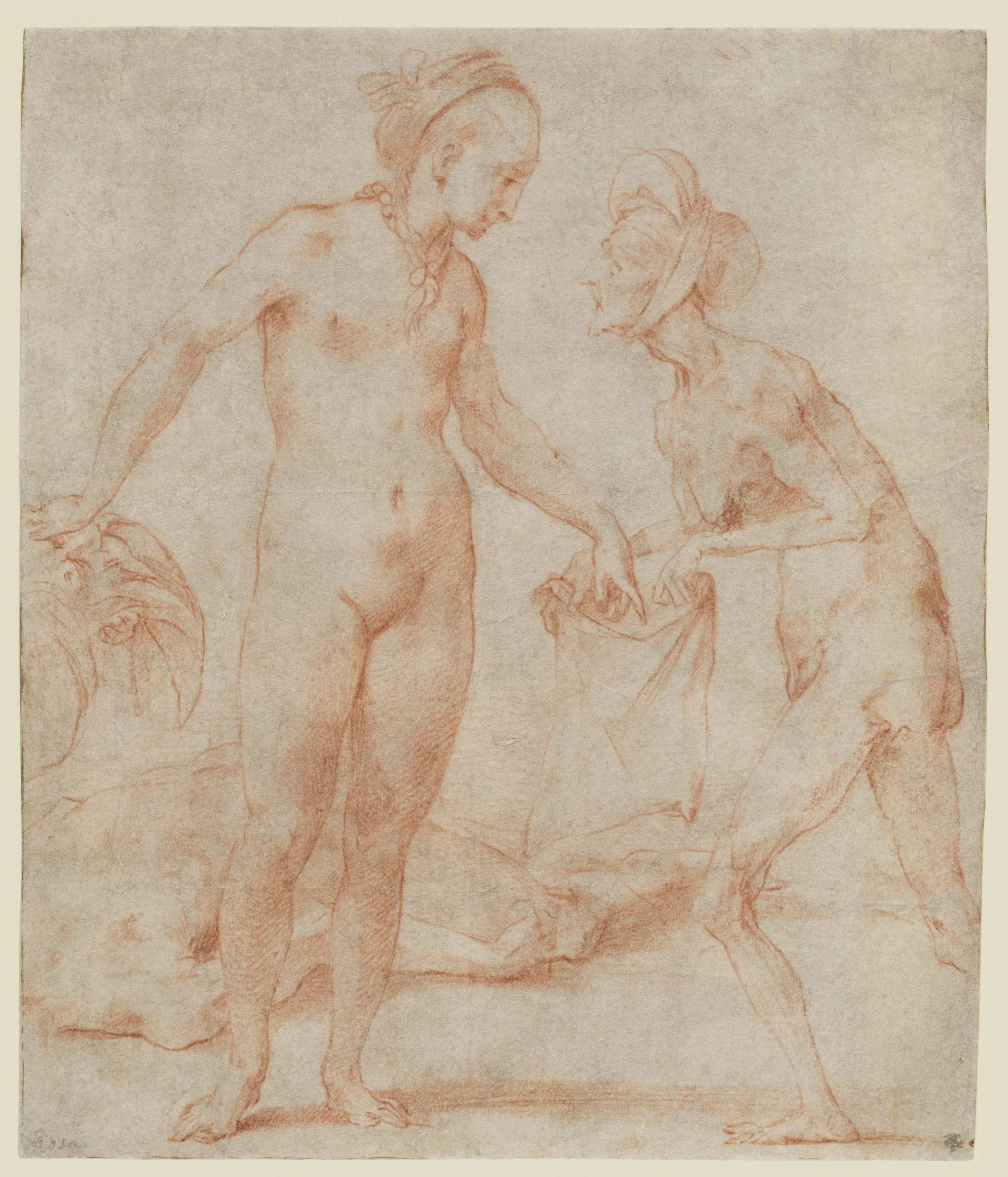
The subject of this drawing was well known in Italy and had a special meaning in Rosso Fiorentino's native Florence. Found in the Apocrypha, the story of the slaying of the Assyrian general Holofernes by the Israelite widow Judith is traditionally a parable of the triumph of humility and continence over pride and lust. In the late fifteenth century the Florentines placed Donatello's Judith and Holofernes in front of their town hall as a symbol of the qualities they hoped would keep them free from domination by enemies.
Rosso's interpretation of the event is unusual and enigmatic. The nudity of Judith, her servant, and the hapless general, for which there is scarcely precedent either in the story or its traditional depictions, is emphasized by Rosso's use of light and shadow. Judith's classical stance gives her an air of assured competence, allowing Rosso to convey her potent attractiveness in the modeling of her shapely thighs and fleshy lower abdomen. She holds Holofernes' head as effortlessly as she might a fan, her strong heroic arms and pubescent breasts modifying the statement of her sensual lower body.
According to the story Judith remained chaste not only here but for the rest of her life, but Rosso's Judith seems to partake of both virtue and sensuality. The sharp contrast of her youthfulness with the extremely aged woman also makes this work a parable of mortality. This multifaceted approach to religious subject matter is typical of early mannerist artists, who rebelled against the rational and universal ideals of the High Renaissance by interpreting iconic subjects in unconventional ways.