- Title
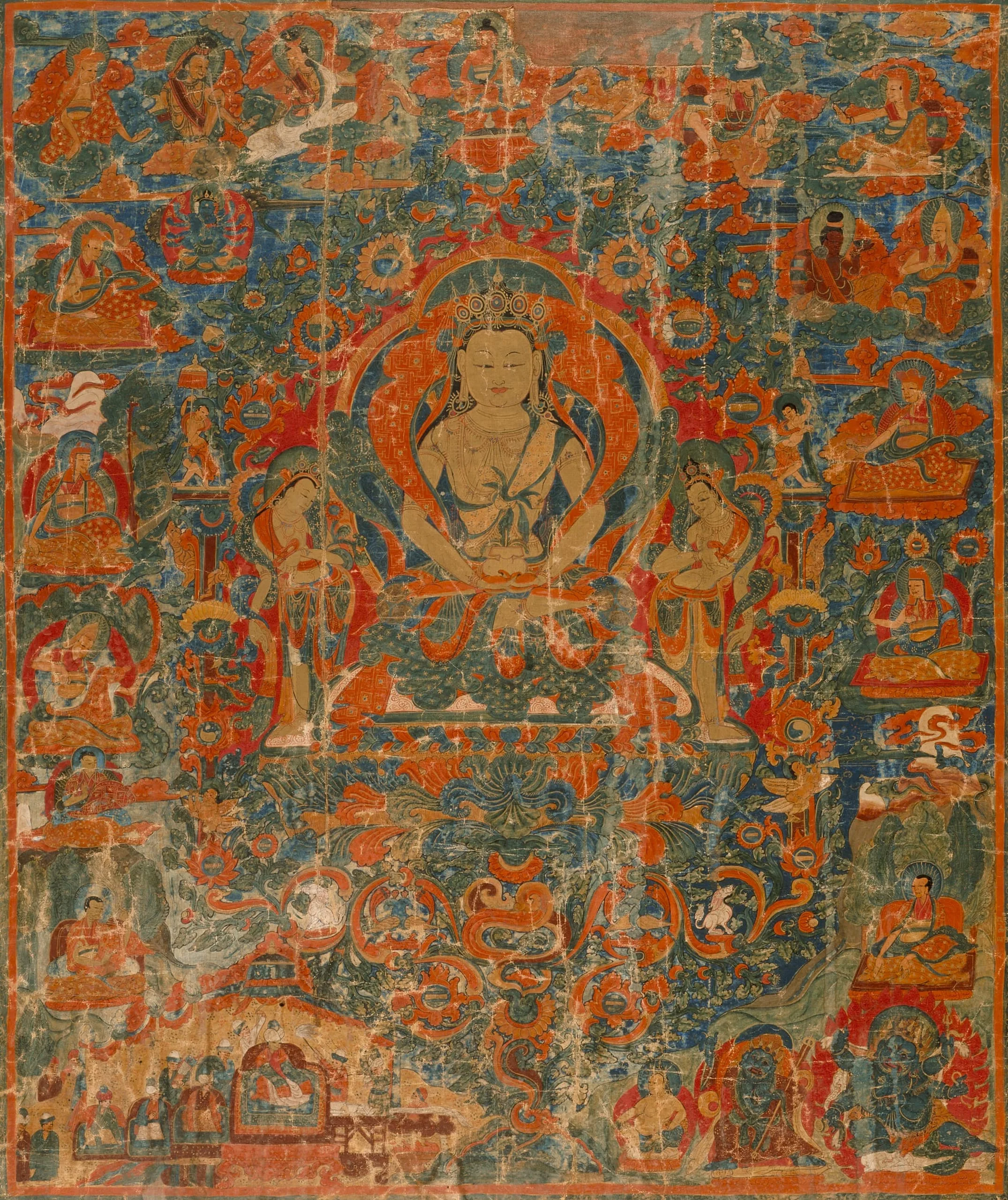
- Amitayus, the Buddha of Eternal Life
- Date Made
- circa 1625
- Medium
- Mineral pigments on cotton cloth
- Dimensions
- 30 3/4 x 25 3/4 in. (78.11 x 65.41 cm)
- Accession Number
- M.77.19.14
- Curatorial Notes
Amitayus, the Buddha of Eternal Life, has a golden complexion and is seated on a lotus throne in the center of this painting. His two hands in his lap are in the gesture of meditation (dhyana mudra) and hold a vase of immortality (tshe-bum) containing a plant or typically peacock feathers symbolizing the destruction of spiritual poison (see M.83.2.1).
This painting was most likely painted at Basgo Castle, the capital of Ladakh, during the reign of the warrior king Senge Namgyal (r. 1616–1642), who is depicted with his three sons in the lower left corner. It was probably painted before the king’s youngest son was ordained as a monk in 1630. The distinctive "Yarkand" Muslim style of turban the king wears was adopted at the Ladakhi court following the disastrous Muslim invasion of circa 1603 when Senge Namgyal’s father, King Jamyang Namgyal (r. 1595–1616?), was captured. After the king formally converted to Islam and married the daughter of his captor, he was permitted to return to Basgo Castle. He resumed patronage of Buddhist monasteries but continued to wear the Yarkand turban to indicate his allegiance. Because of the inclusion of the portrait of Senge Namgyal, this painting can conclusively be attributed to the Ladakh and was likely a royal commission.
- Selected Bibliography
- Pal, Pratapaditya. Art of Tibet. Los Angeles; Berkeley, CA: Los Angeles County Museum of Art; University of California Press, 1983.
- Beguin, Gilles. Dieux et Demons de l'Himalaya: Art du Bouddhisme Lamaique. Paris: Grand Palais, 1977.
- Fisher, Robert E. Art of Tibet. London: Thames and Hudson, 1997.
- Pal, Pratapaditya. Art of Tibet. Expanded edition. Los Angeles: Los Angeles County Museum of Art, 1990.
- Rosenfield, John. The Arts of India and Nepal: The Nasli and Alice Heeramaneck Collection. Boston: Museum of Fine Arts, Boston, 1966.