LACMA

ShopMembershipMyLACMATickets
LACMA
Los Angeles County Museum of Art
5905 Wilshire Blvd.
Los Angeles, CA 90036
info@lacma.org
(323) 857-6000
Sign up to receive emails
Subscribe
© Museum Associates 2025

Museum Hours

Monday

11 am–6 pm

Tuesday

11 am–6 pm

Wednesday

Closed

Thursday

11 am–6 pm

Friday

11 am–8 pm

Saturday

10 am–7 pm

Sunday

10 am–7 pm


  • About LACMA
  • Jobs
  • Building LACMA
  • Host An Event
  • Unframed
  • Press
  • FAQs
  • Log in to MyLACMA
  • Privacy Policy
© Museum Associates 2025
Collections

Unknown
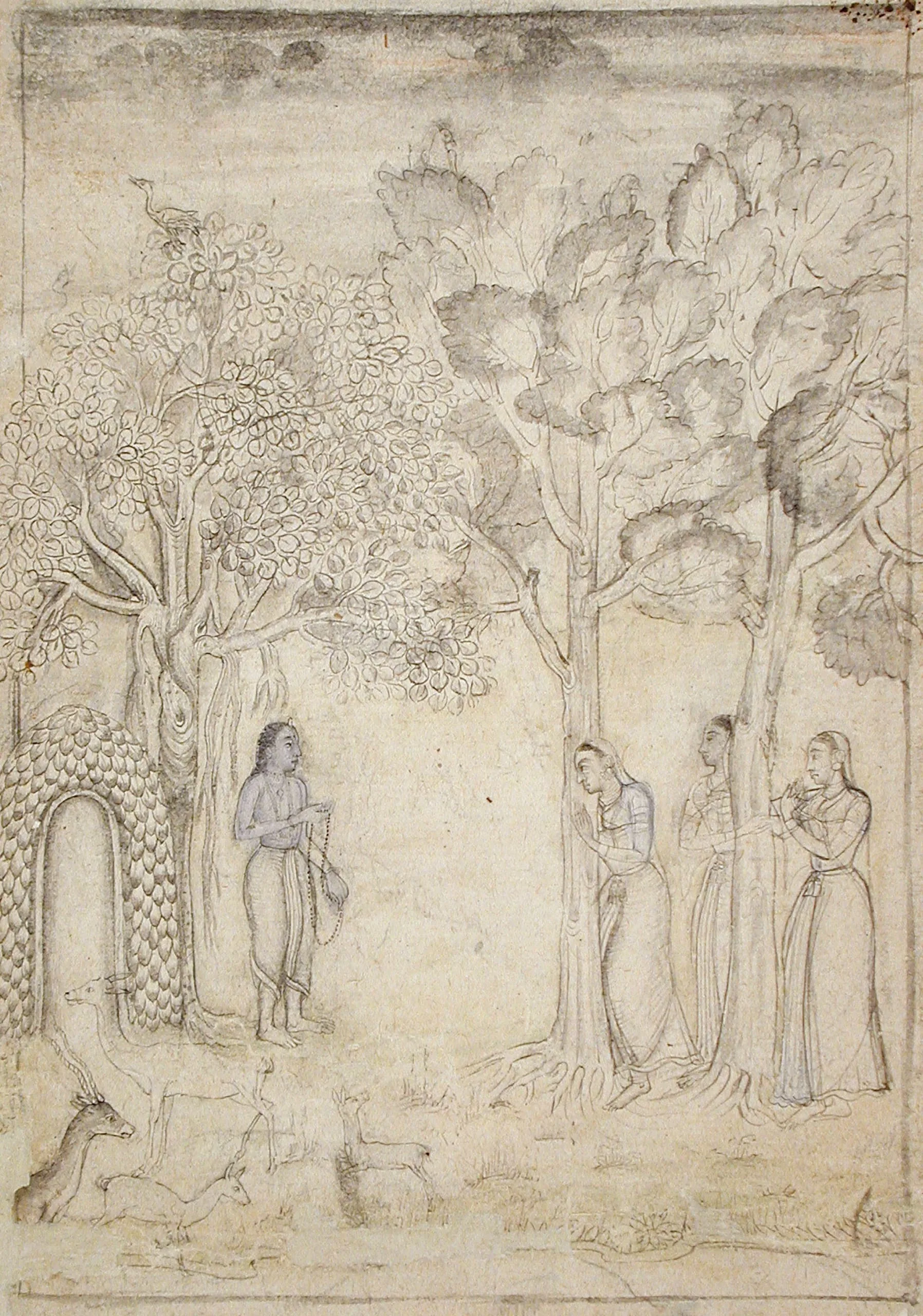
The Ascetic Rishyashringa at His Hermitage Approached by Beautiful Women1650-1675

Not on view
Gray ink and wash drawing on cream paper, four figures and deer among trees in a forest, with peacocks in the branches above
Artist or Maker
Unknown
Title
The Ascetic Rishyashringa at His Hermitage Approached by Beautiful Women
Place Made
India, Mughal Empire
Date Made
1650-1675
Medium
Ink and opaque watercolor on paper
Dimensions
Sheet: 8 7/8 x 6 1/4 in. (22.54 x 15.87 cm); Image: 8 1/2 x 6 1/4 in. (21.59 x 15.87 cm)
Credit Line
Gift of Paul F. Walter
Accession Number
M.76.149.1
Classification
Drawings
Collecting Area
South and Southeast Asian Art
Curatorial Notes

This nim qalam (half-pen) lightly tinted drawing depicts the youthful ascetic Rishyashringa at his hermitage. As narrated in the great Indian epics, the Ramayana (Adventures of Rama) and the Mahabharata ([War of the] Great Bharatas), Rishyashringa (having deer antlers) was supernaturally born of a doe and had a small protuberance on his forehead, whence his name. He led a sheltered life in a forest hermitage. One day he was approached by beautiful women sent by King Lomapada in the nearby kingdom of Anga who wished to request his aid in ending a severe drought. Enchanted by their beauty, Rishyashringa accompanied them to Anga, where his presence brought the lifegiving rains to end the drought. Here, Rishyashringa stands outside of his hut watching the women stealthily approach. He holds a long rosary, and his skin is ashen-colored in accordance with the ascetic’s practice of smearing one’s body with cremation ashes.

The drawing follows the spatial conventions and elongated figural style of this period of Mughal painting. Note the realistic representation of three-dimensional depth indicated by the women being depicted in front of and behind the trees. Noteworthy also is the naturalistic treatment of the antelope in the foreground, especially the blackbuck, or Indian antelope, with the spiraling horns in the lower left corner.

An illustration of this episode with the same composition, attributed to 1597-1605, is in the Freer Gallery of Art, Washington (F1907.271 Folio 19 obv).
Selected Bibliography
  • Pal, Pratapaditya. Indian Painting, vol.1. Los Angeles: Los Angeles County Museum of Art, 1993.
  • Pal, Pratapaditya and Catherine Glynn. The Sensuous Line: Indian Drawings from the Paul F. Walter Collection. Los Angeles: Los Angeles County Museum of Art, 1976.