LACMA

ShopMembershipMyLACMATickets
LACMA
Los Angeles County Museum of Art
5905 Wilshire Blvd.
Los Angeles, CA 90036
info@lacma.org
(323) 857-6000
Sign up to receive emails
Subscribe
© Museum Associates 2025

Museum Hours

Monday

11 am–6 pm

Tuesday

11 am–6 pm

Wednesday

Closed

Thursday

11 am–6 pm

Friday

11 am–8 pm

Saturday

10 am–7 pm

Sunday

10 am–7 pm


  • About LACMA
  • Jobs
  • Building LACMA
  • Host An Event
  • Unframed
  • Press
  • FAQs
  • Log in to MyLACMA
  • Privacy Policy
© Museum Associates 2025
Collections

Unknown
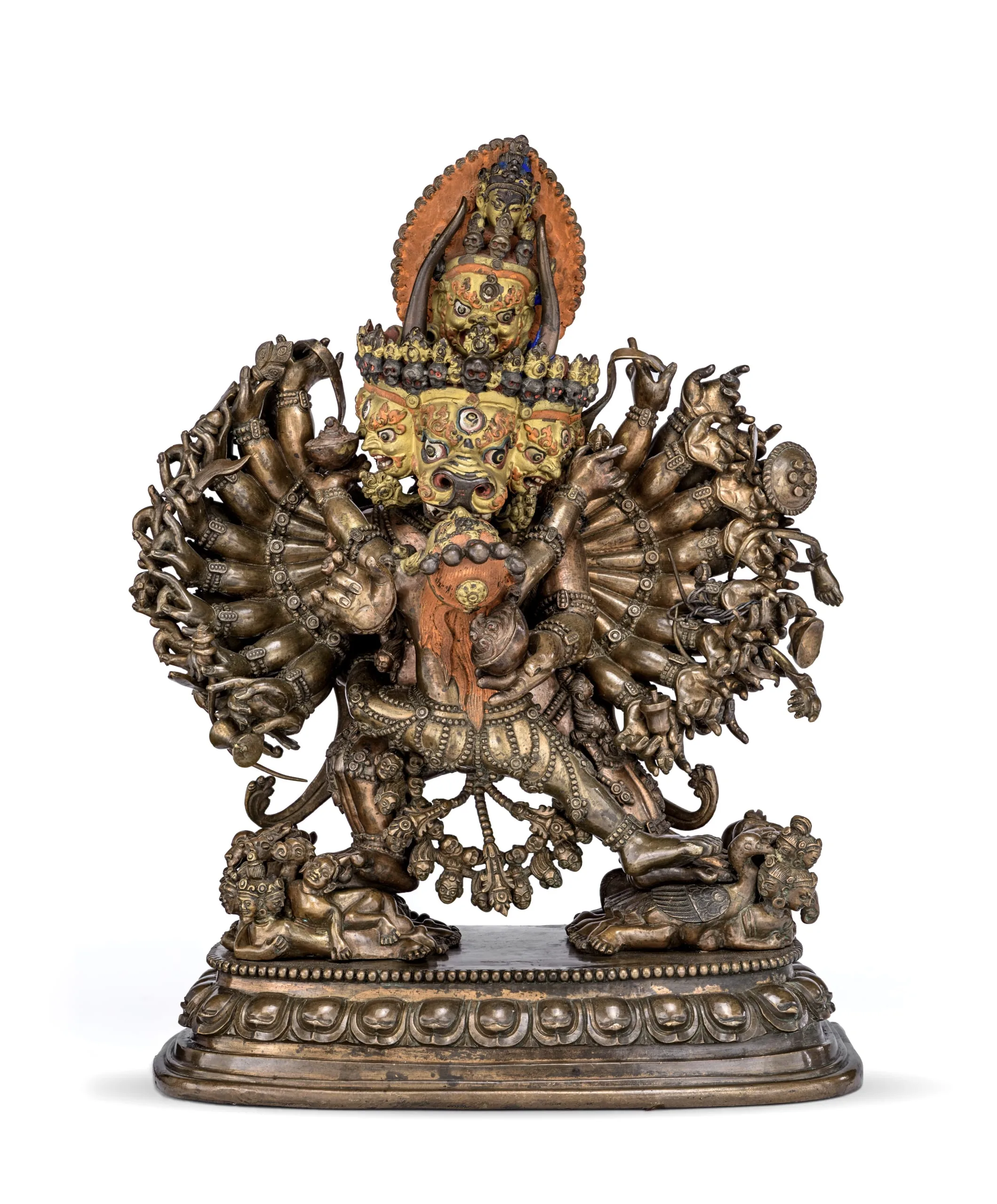
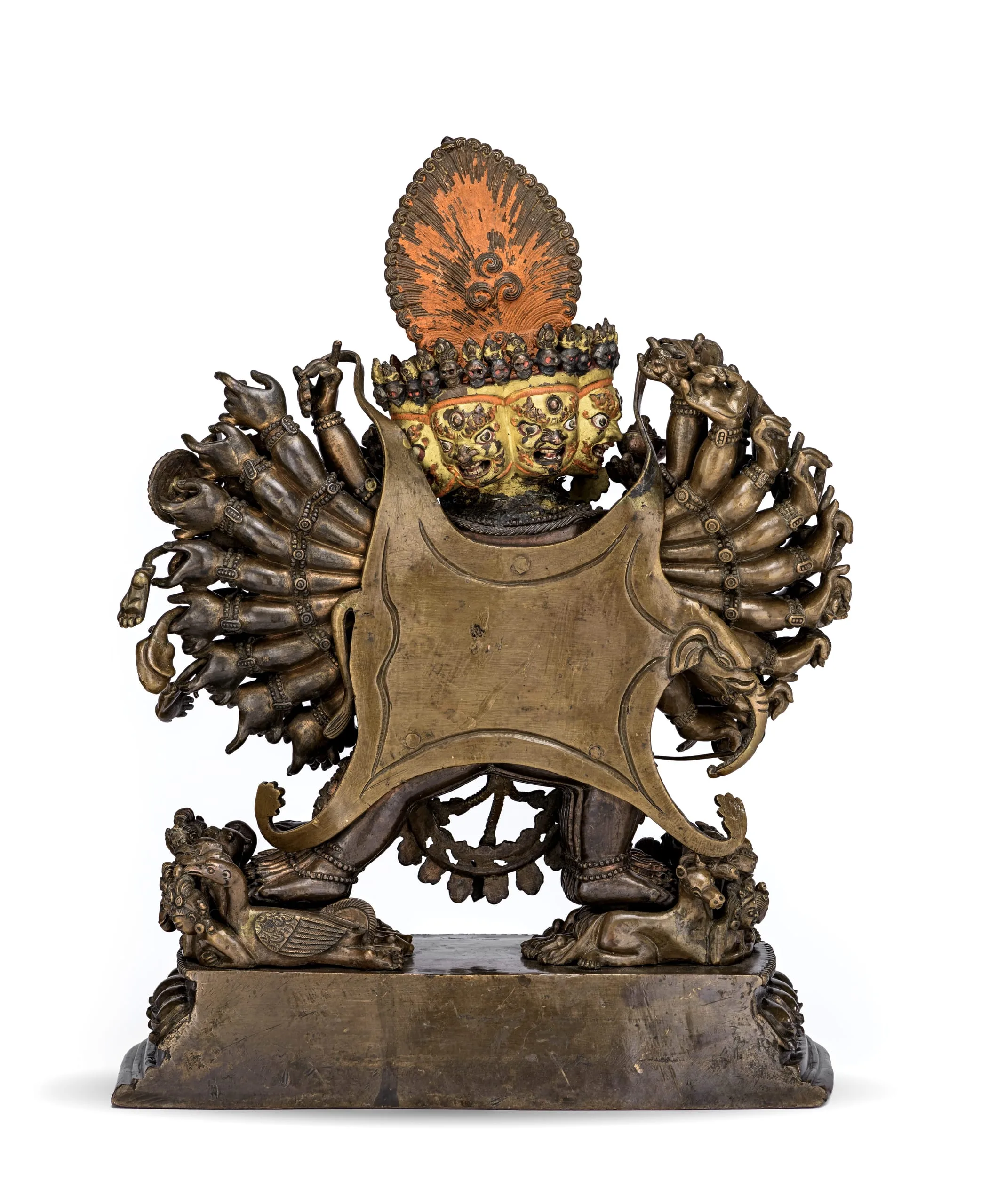
Vajrabhairava and His Consort Vajra Vetali17th century

On view:
Resnick Pavilion, floor 1
Gilt and polychrome bronze sculpture of a multi-headed, multi-armed Tibetan deity with stacked faces, radiating arms holding ritual objects, standing on a lotus base with prostrate figures beneath its feet
Gilt bronze sculpture of a multi-armed, multi-headed wrathful deity in wide-legged stance, with numerous arms fanning outward on both sides, polychrome faces with yellow and red pigment, orange flame mandorla rising above, standing atop crouching figures on a tiered rectangular base.
Artist or Maker
Unknown
Title
Vajrabhairava and His Consort Vajra Vetali
Place Made
Central Tibet, a Gelukpa Monastery
Date Made
17th century
Medium
Brass with cold gold paste and paint
Dimensions
9 1/2 x 7 x 3 3/4 in. (24.13 x 17.78 x 9.52 cm)
Credit Line
Gift of Christian Humann
Accession Number
M.76.143
Classification
Sculpture
Collecting Area
South and Southeast Asian Art
Curatorial Notes

Vajrabhairava (Adamantine Anger), also known as Yamantaka (Conqueror of Death), is the wrathful manifestation of Manjushri, the Bodhisattva of Wisdom. He is a meditational deity (yidam) in the Anuttara Yoga classification of Tantric Vajrayana Buddhism, which was practiced in the Gelug school of Tibetan Buddhism founded by Tsongkhapa (1357–1419). His consort is Vajra Vetali (Adamantine Zombie).

Vajrabhairava is represented in multiple iconographic forms. Here, he has a flaming nimbus and nine heads, eight of which are fierce. The primary head is a buffalo symbolic of Vajrabhairava's role as the destoyer of death. His uppermost placid head is Manjushri. He has thirty-four arms holding assorted weapons and attributes. His principal and hold a flaying knife (kartrika) and a skullcup (kapala). He holds an elephant skin draped behind him. The practitioner must visualize each ritual object and its specific Tantric symbolism. He has sixteen legs, stands in the militant posture (alidha asana), and is trampling various gods, humans, animals, and birds.

Vajrabhairava embraces Vajra Vetali in the "father-mother" (yab-yum) sexual posture. She has one head and two arms holding a thunderbolt (vajra) in her right hand and a skullcup in her left hand.

The complex image is cast in sixteen pieces and is a tour de force of Tibetan metalworking. See also M.77.19.8, M.79.243.1-.3, and a comparable 18th-century brass sculpture in the British Museum, London (1880.157).
Selected Bibliography
  • Little, Stephen, Tushara Bindu Gude, Karina Romero Blanco, Silvia Seligson, Marco Antonio Karam. Las Huellas de Buda. Ciudad de México : Instituto Nacional de Antropología e Historia, 2018.
  • Little, Stephen, and Tushara Bindu Gude. Realms of the Dharma: Buddhist Art across Asia. Los Angeles: Los Angeles County Museum of Art, 2025.