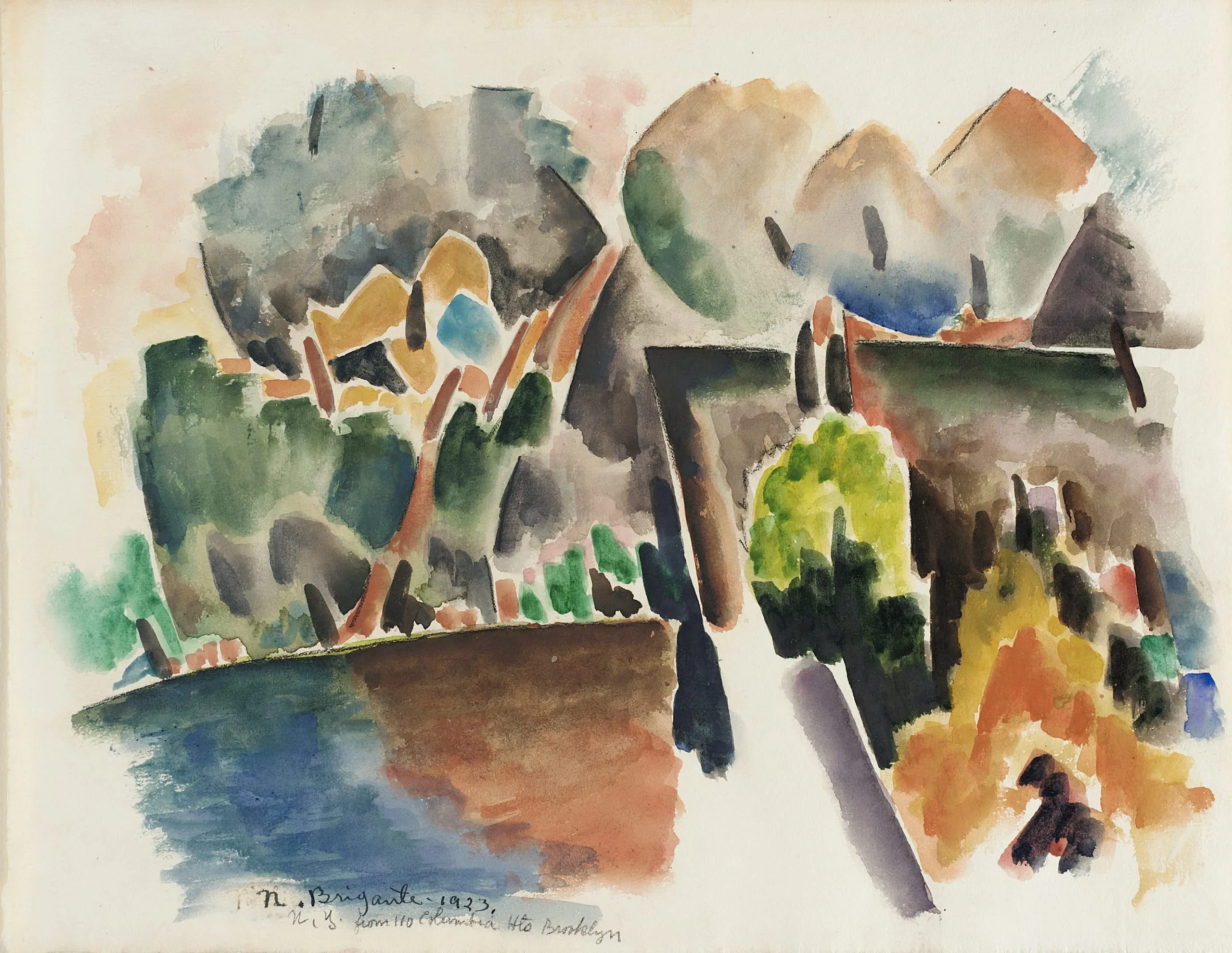
In April 1923 Brigante left Los Angeles for New York. The year he spent there was of seminal importance to his artistic development. He lived in a house on Columbia Heights in Brooklyn rented to him by the modernist sculptor Robert Laurent (1890-1970). Brigante, anxious to learn all he could, visited Alfred Stieglitz (1864-1946) in his gallery and became better acquainted with modern American trends, and he began exhibiting at the progressive Daniel Gallery. A devoted watercolorist, Brigante admired the art of JOHN MARIN and Charles Sheeler (1883-1965) but was most influenced by the work of CHARLES DEMUTH.
Although Brigante was living in a major metropolis and admired artists famous for depicting it, he still sought out nature. In this cityscape he moved toward abstraction, flattening, simplifying, and streamlining natural forms to narrow shapes, and presenting the scene as an arrangement of angular, overlapping planes.
The smooth paper further enhances the two-dimensionality of the composition. As did Demuth, Brigante preferred to leave parts of the watercolor unfinished to stimulate the viewer’s imagination. Brigante’s palette is expressionistic, with vivid purples, deep blues, and oranges as well as black outlines. This watercolor and the stylistically related oil painting Landscape Abstraction, 1923-24 (private collection), would be the closest Brigante came to cubism.