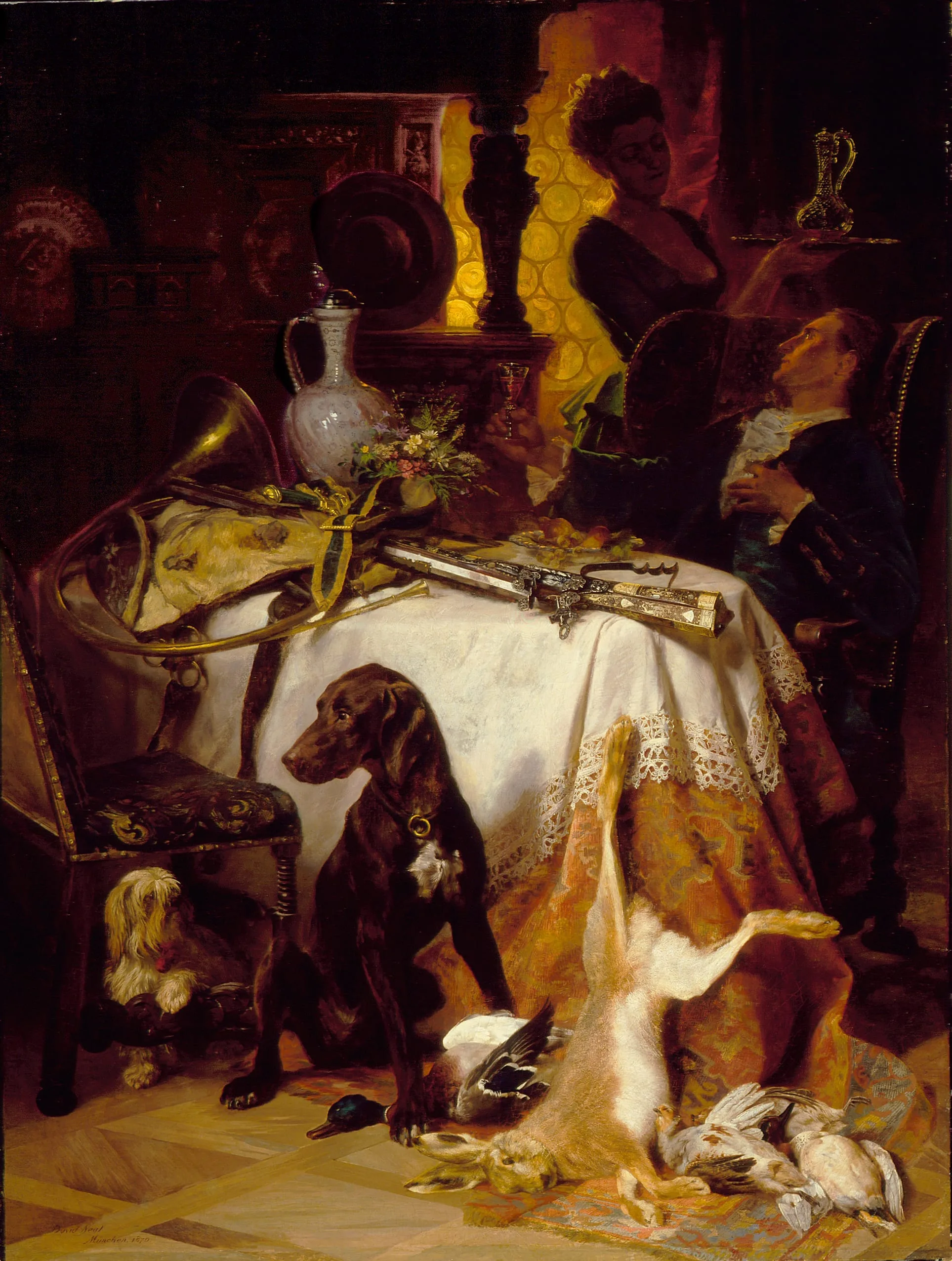
After the Hunt, Neal’s first great success, was a transitional work between his early architectural paintings and the history paintings that were to win him renown. Although not a history painting, it demonstrates his total mastery of the technique that would make those paintings so successful. Produced while Neal worked in Piloty’s atelier, After the Hunt exemplifies the style of romantic realism practiced and taught by his professor. During the late 1860s Piloty had transformed the teaching of the Munich academy by introducing an emphasis on skillful painting technique. Although based on the work of the old masters, the style he taught was capable of impressive realism of lighting and textures. It also reflected painstaking research of authentic settings, costumes, and accessories. After the Hunt, with its baroque lighting, dramatic contrasts, and rich, warm tonality, strikes the note of romanticism central to the style. The aristocratic hunter and the servant girl dressed in period costume, nominally the subject of the painting, are secondary to the foreground still-life arrangement, in which Neal’s virtuosity has persuasively reproduced a wide range of textures.
Still-life compositions are rare in the Munich tradition in contrast to that of Vienna, where this type--the corner of a room with a table piled with bric-a-brac -- was known. Two other Americans, WILLIAM M. CHASE and Theodore Wores (18601939), also included background figures in the most important still life they produced during their student years in Munich.
Neal’s painting originally bore the title Retour de Chasse and was reproduced in Aldine in 1872 as After the Chase.