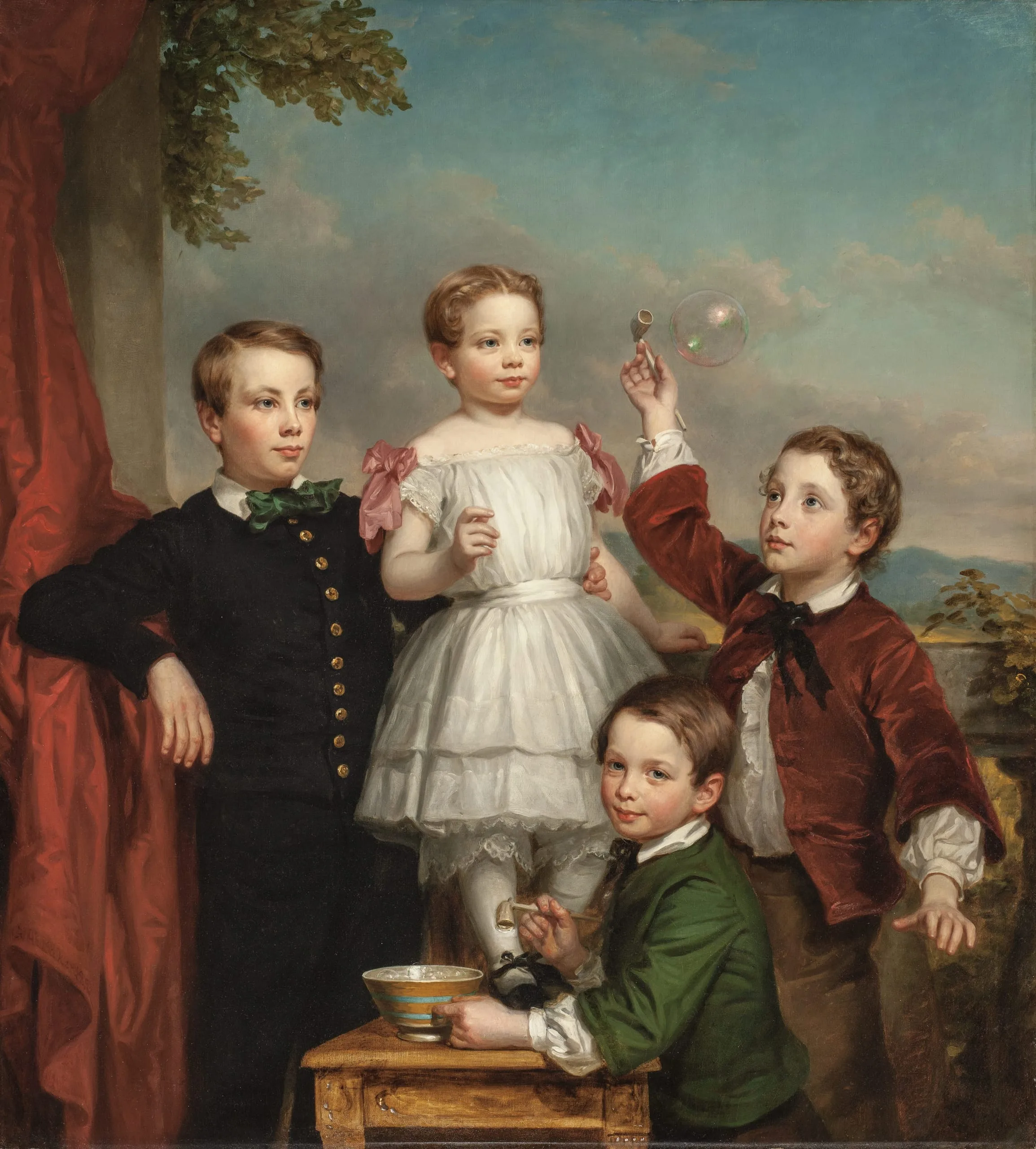
Although he painted many portraits of men, Baker was most highly regarded for portraits of women and children. This portrait, painted while he was strongly influenced by romanticism, displays the idealization, soft brushwork, and rich color for which Baker was known. Like other artists of the period, he has used the soap bubble to represent the innocent pleasures of childhood but also the transience of youth. Even though the subject required an outdoor setting, Baker introduced a column and curtain on the left as an element of formality.
The identification of the sitters can only be conjectured. The large size of the painting, the number of figures, and the attire all suggest that the portrait was commissioned by someone from the upper middle class, perhaps a prosperous businessman or financier. In 1854, the year after the portrait was painted, Baker exhibited in the National Academy of Design annual a group portrait of children owned by E. B. Sutton. Effingham B. Sutton (1817-1891) was the founder of the Sutton Line, the first clipper shipping service from New York to San Francisco. As Sutton fathered fourteen children, the museum’s portrait may be of his three oldest sons and daughter.