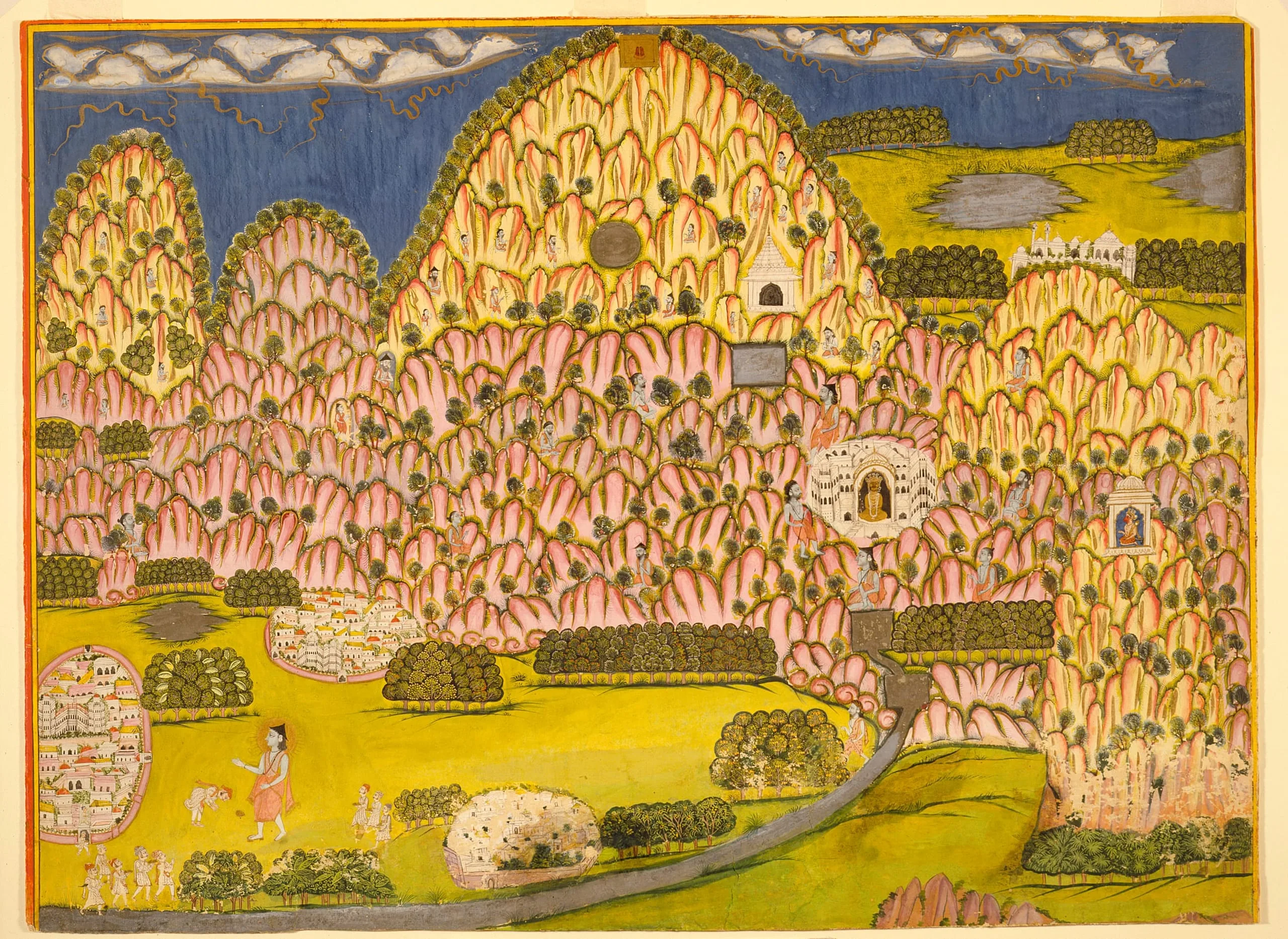
Maharaja Man Singh of Jodhpur (r. 1803–1843) was an ardent devotee of Jallandarnath, an immortal ascetic or mahasiddha (great perfected being), who is thought to have lived in the 13th century or earlier in Jalandhar, Panjab. Jallandarnath is venerated by the Nath Sampradaya, a Shaiva sect founded by the great Hindu saint and teacher Gorakhnath, who most likely lived in eastern Bengal in the early 11th century. The Naths were practitioners of hatha-yoga that emphasizes control over one’s vital force. Nath yogis were itinerant, often shown traveling between hermitages, and were believed to be endowed with supernatural powers. See M.85.283.10.
This painting depicts a spiritual landscape populated by numerous Nath yogis with ashen skin and large round earrings, most of whom wear black conical hats. The large, haloed figure in the lower left corner is likely Jallandarnath, who is receiving obeisance from a turbaned male figure while two additional groups of men bear offerings. At the summit of the central hill is a pair of red footprints on a golden pedestal symbolizing Gorakhnath (see also M.86.43). Halfway up the hill is the Mahamandir Temple near Jodhpur. This temple to Shiva was built in 1812 during Man Singh’s reign and has sculptures and murals portraying Nath yogis. In the foothills below is a large complex with a golden mahasiddha in a shrine. A small temple dedicated to the divine monkey general Hanuman is on a nearby peak. Three walled cities are in the plains below.