- Title
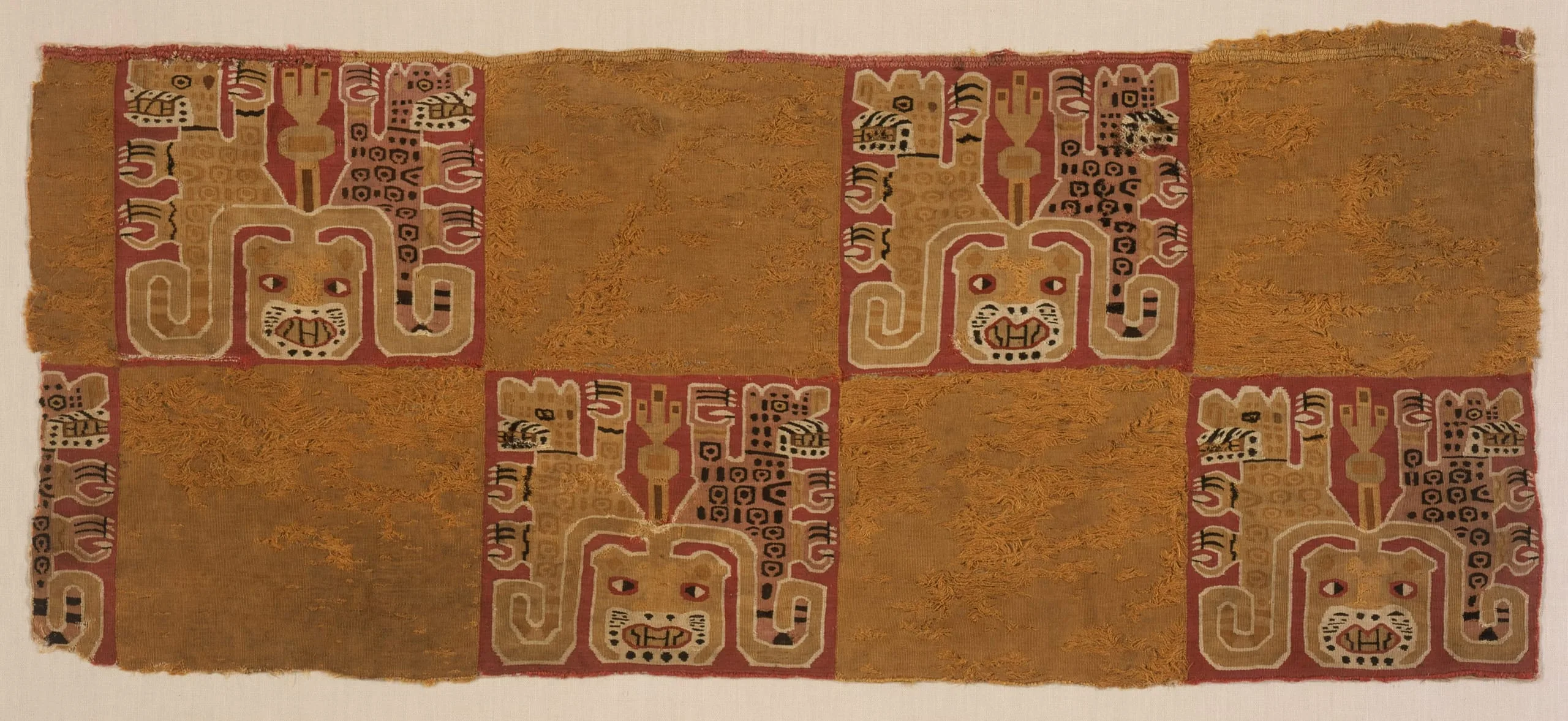
- Textile Panel Fragment
- Date Made
- 600-850
- Medium
- Camelid fiber and cotton, interlocked tapestry weave
- Dimensions
- 13 x 31 1/2 in. (33.02 x 80.01 cm)
- Accession Number
- M.72.68.8
- Curatorial Notes
The concept of transformation was fundamental to ancient Andean religion, implying interdependence and equivalence between human, animal, and supernatural beings. Felines with fangs, such as jaguars and pumas, were symbols of a primal predatory force, raw power, aggression, and the furor of nature that must be tamed to achieve social order and control. Rulers, shamans, and warriors identified both physically and spiritually with the powerful cat as an alter ego—a necessary intermediary between the natural and the supernatural in transforming nature’s chaos and violence for the benefit of the community.
The abundance of feline imagery in the art of Peru can be traced back as early as 900 BCE to the widespread and enduring influence of the highland ceremonial center of Chavín de Huántar, where cats were cult symbols frequently represented on portable textiles. The profile cats in this panel feature realistic claws and the distinctive jaguar coat (rendered in concentric circles). The black-and-white bisected eyes and headdresses of the front-facing felines illustrate the transformation of these naturalistic cats to supernatural status.
Nicole LaBouff via Kaye Spilker
2009
- Selected Bibliography
- Kahlenberg, Mary Hunt. Fabric and Fashion: Twenty Years of Costume Council Gifts. Los Angeles: Los Angeles County Museum of Art, 1974.