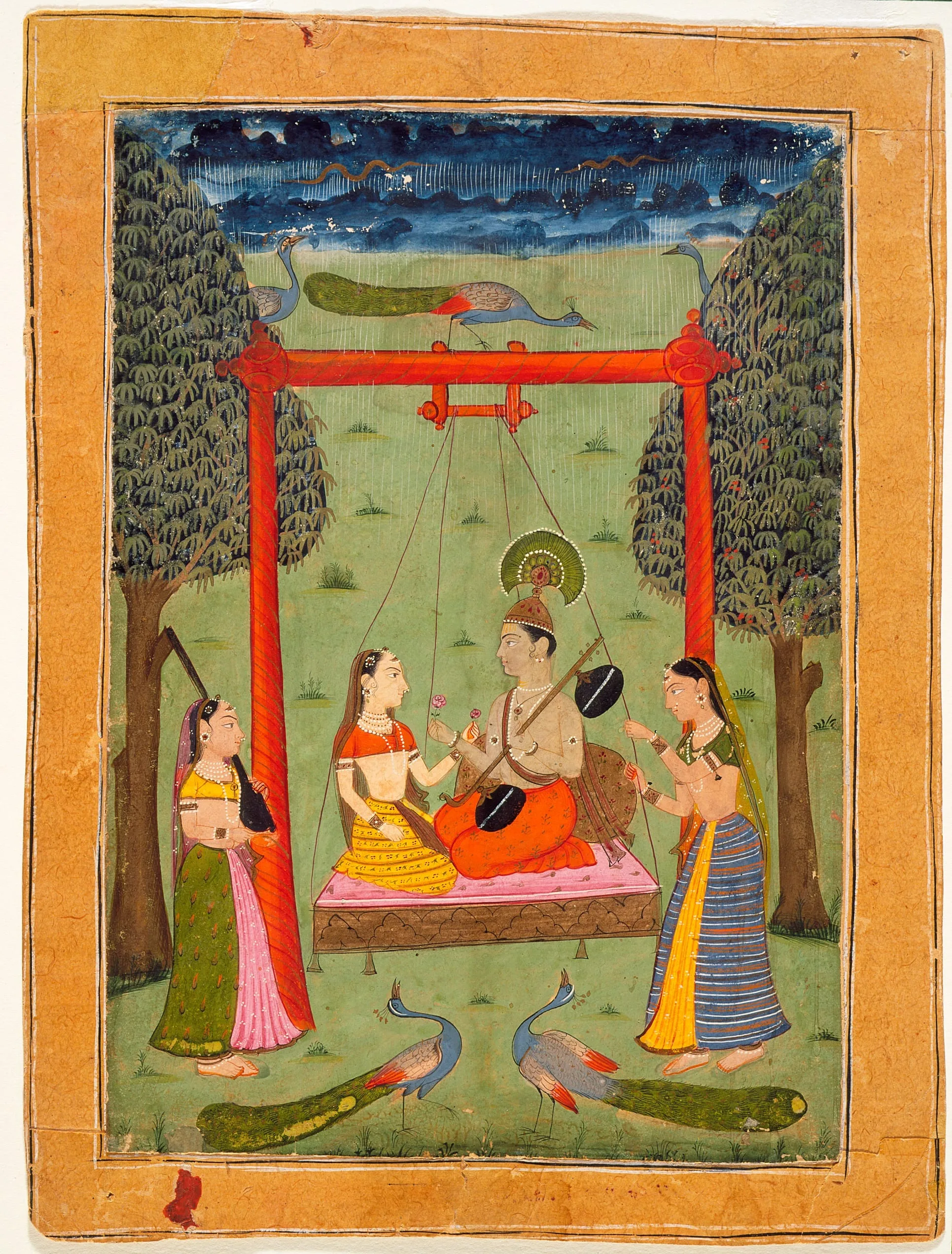
Inscriptions on the reverse in Arabic and devanagari scripts identify the melody. There is also a Gujarati inscription inaccurately characterizing Hindola as a female rather than a male. Hindola Raga is unique insofar as it is the only musical mode represented by the same basic imagery regardless of the iconographic or regional classification system followed. Its iconography is derived from its name, Hindola (swing), which is the predominant visual feature of the paintings. It is a morning melody associated with the rainy season, especially the month of Chaitra (March-April). Accordingly, burgeoning rain clouds are often present in Hindola Raga. Typically, a hero or Krishna is seated on the swing, usually with a heroine.
In this painting, Hindola Raga can be identified as Krishna by his distinctive peacock feather crown. His complexion is yellowish gray than his normal blue. This accords with the description by the Hindi poet Paida inscribed on an Amber Hindola Raga in the Kankroli collection. (Ebeling, Ragamala Painting, 1973) Krishna’s yellow skin coloration is also featured in the Vasant Ragini from this same series (M.79.191.28). Here, Krishna is sitting on a swing with a woman, perhaps his consort Radha. He is holding a vina, which is an uncommon iconographic feature (see also AC1999.127.6). A female attendant on the right moves the swing by pulling on its rope, while another on the left plays a tambura (a fretless lute). See also M.82.42.9 and M.2001.229.2.