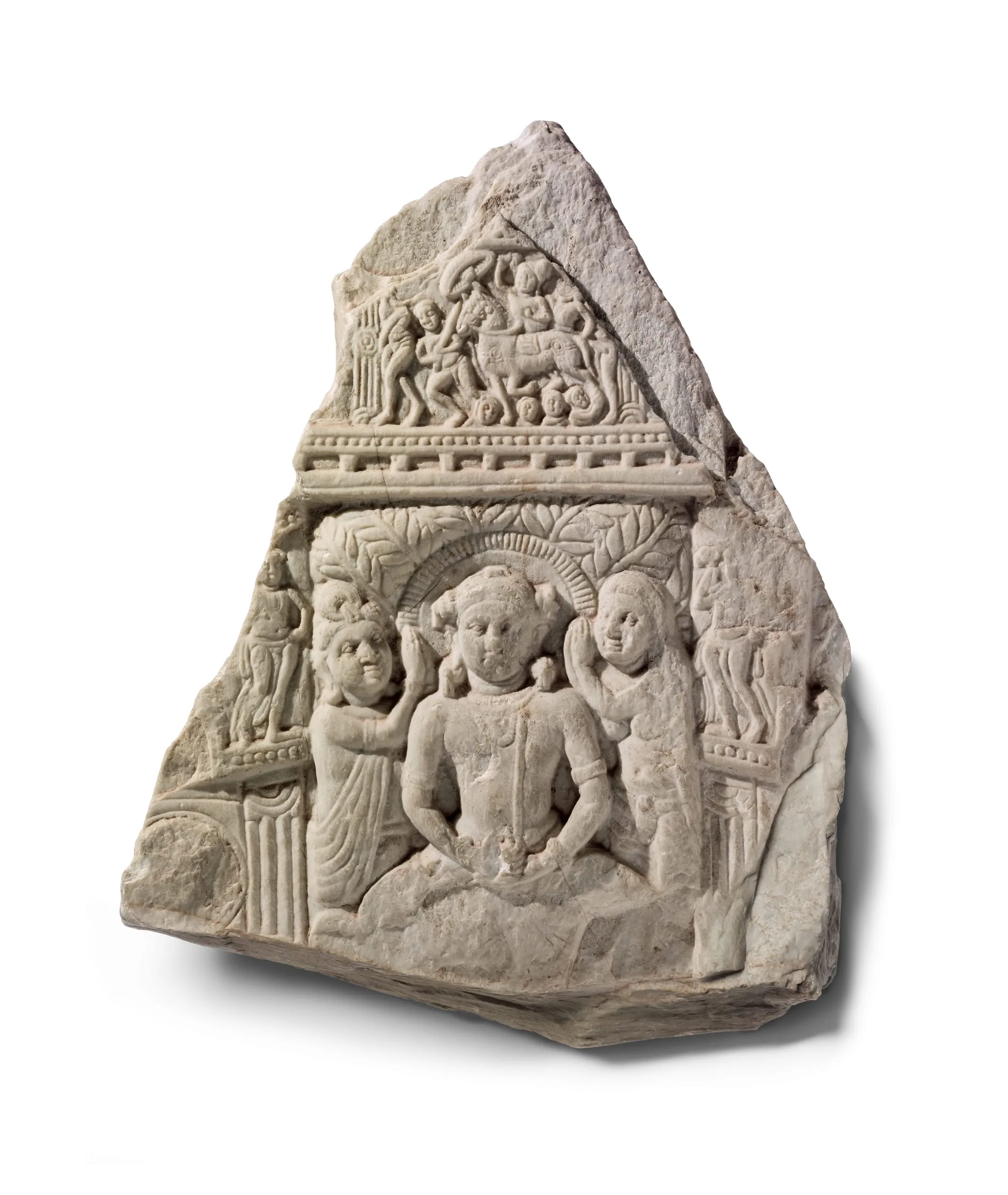
- Title
- The Great Departure (top), Miracle of the Jambu (wood-apple) Tree (bottom), Scenes from the Life of the Buddha
- Date Made
- 3rd century
- Medium
- Limestone
- Dimensions
- overall: 15 1/2 x 11 3/4 x 3 1/4 in. (39.37 x 29.845 x 8.255 cm)
- Accession Number
- M.72.50.1
- Curatorial Notes
This fragmentary relief was likely once part of the decorative program embellishing the exterior of a stupa (funerary mound) at Gummadidurru in Andhra Pradesh, which is dated by inscription to the 3rd century CE.
The bottom section depicts the "Miracle of the Jambu (wood-apple) Tree" in which Siddhartha Gautama, the future Buddha Shakyamuni, sits beneath the tree meditating on the nature of existence. He is flanked by his adoring father, King Shuddhodana, and foster mother, Mahapajapati Gotami. The upper section depicts "The Great Departure," in which Siddhartha secretly leaves his palace at night to renounce his princely life and begin his journey of enlightenment. The future Buddha is not shown riding the horse in accordance with the aniconic style of representation in the early Buddhist art of Andhra Pradesh, but the four nature deities (yakshas) that muffled the sound of horse’s hooves are portrayed, as well as attendants holding an honorific parasol and a fly whisk.
- Selected Bibliography
- Pal, Pratapaditya; R. Brown; R. Fisher; G. Kuwayama; Amy G. Poster. Light of Asia: Buddha Sakyamuni in Asian Art. ed. Dean, Lynne. Los Angeles: Los Angeles County Museum of Art, 1984.
- Pal, Pratapaditya. Indian Sculpture, vol.1. Los Angeles: Los Angeles County Museum of Art; University of California Press, 1986.
- Pal, Pratapaditya; Dehejia, Vidya; Slusser, Mary Shepherd; Fisher, Robert E.; Brown, Robert L. Arts of Asia 15 (6): 68-125 (November- December 1985).
- Soon, Teoh Eng. The Lotus in the Buddhist Art of India. Singapore: Teoh Eng Soon, 2003.
- Little, Stephen, Tushara Bindu Gude, Karina Romero Blanco, Silvia Seligson, Marco Antonio Karam. Las Huellas de Buda. Ciudad de México : Instituto Nacional de Antropología e Historia, 2018.
- Little, Stephen, and Tushara Bindu Gude. Realms of the Dharma: Buddhist Art across Asia. Los Angeles: Los Angeles County Museum of Art, 2025.