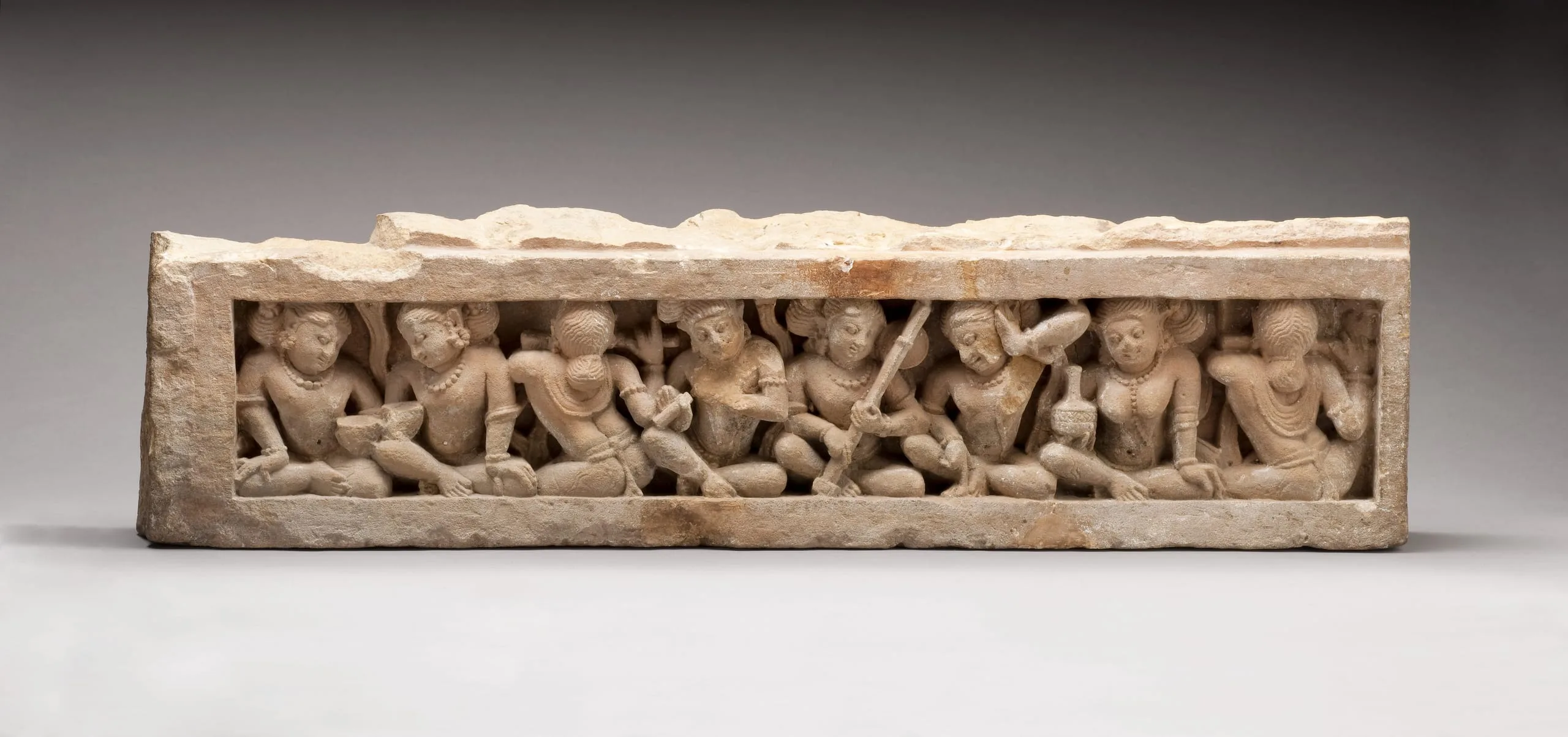
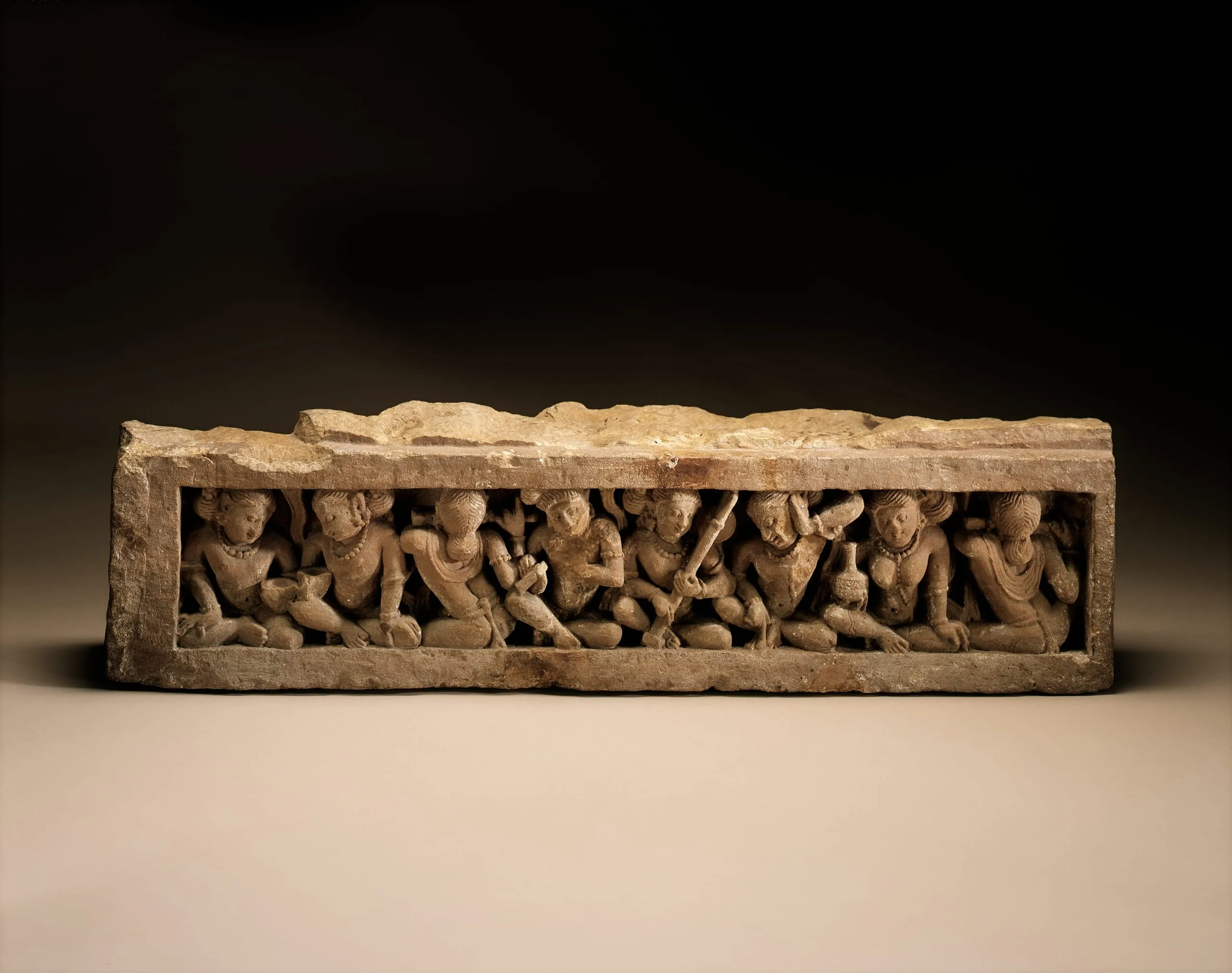
This lively frieze reputedly once adorned the Purana Mahadeva temple in Harshagiri, Sikar District, Rajasthan. As per the dedicatory site inscription, it was completed in 956 with structural embellishments and land endowments received up to 973. The temple was designed and constructed by the architect Chandrashiva for a Brahman patron named Allata during the reign of Maharajadhiraja Simharaja (r. circa 944–971) of the Chahamana Dynasty (948-1192). The magnificent temple is described in the inscription as,
“Glorious is the mansion of the divine Harshadeva [Shiva], which is charming with the expanse of (its) spacious hall (mandapa), exquisite with the splendour of a gold shell [(andaka)] covering the temple spire], (and) lovely in consequence of (the statues of) Vikata [ferocious form of Ganesha] and the sons of Pandu [the five Pandava brothers, heroes of the epic Mahabharata], set up in the row of structures along (its) sides. Resembling (in height) the peak of [Mount] Meru, it is pleasant on account of an excellent arched doorway (torana-dvara) and well-carved bull (Nandi), and is full of manifold objects of enjoyment.”
There are eight deeply cut figures represented in the frieze. Starting on the left, there are two men with wine cups who are enjoying the performance. They are followed by three musicians: a flutist facing the rear, a forward-facing flutist, and a vina player. Next is the vocalist with his hand cupped to his ear. The last two figures are a woman offering a flask of wine, and a repetition of the backward-facing flutist.
Additional musical friezes from the Purana Mahadeva temple are in the Nelson-Atkins Museum of Art, Kansas City, MO (35-304), Cleveland Museum of Art (1969.34), and Government Museum, Sikar.
See Martin Lerner, “Some Unpublished Sculpture from Harshagiri,” The Bulletin of the Cleveland Museum of Art 56:10 (December 1969): 354-64.