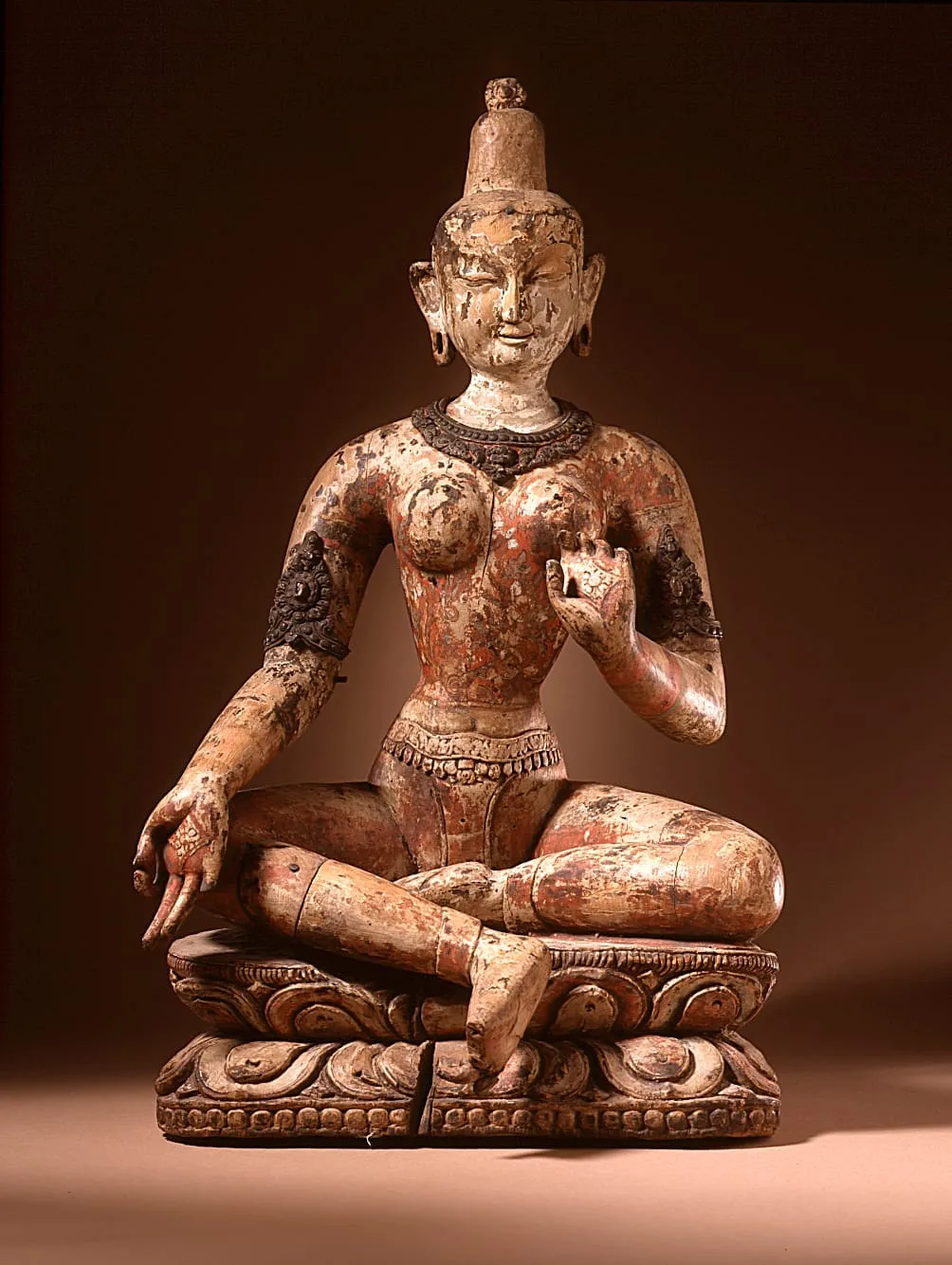
- Title
- The Buddhist Goddess Victorious Wisdom Tara (Jina-Prajna Tara)
- Date Made
- circa 15th century
- Medium
- Wood with traces of paint; copper ornaments inlaid with gemstones
- Dimensions
- 24 1/2 x 14 1/4 x 12 in. (62.2 x 35.9 x 30.5 cm)
- Accession Number
- M.72.1.10
- Curatorial Notes
This is an esoteric form of Tara, the Buddhist goddess of compassion. The Victorious Wisdom (Jina-Prajna) Tara represents a female aspect of the five transcendent Jina Buddhas, who express the ideal qualities of Buddhahood. Originally, this sculpture and three conceptually related goddess images would have been arrayed at the intermediary cardinal points around a Nepalese stupa (funerary mound) during the performance of rites.
The Victorious Wisdom Tara transcendence is indicated by the image’s lotus base, Mount Meru top knot (meru jata), and surmounting drop (bindu) of light emblematic of the attainment of enlightenment through meditational yoga. Her right hand is outstretched in the gesture of charity (varada mudra). Her left hand is raised in the gesture of reassurance (abhaya mudra) and likely once supported the stalk of a lotus flower. The sculpture was originally painted with elegant garments on the torso and legs, but ritual cleansings have abraded the painted textile designs. When under worship, the image would have been draped with sumptuous textiles and floral garlands. It would have been graced with a crown characteristic of the five Jina Buddhas and large earrings (all now missing). The current necklace and armlets, made of copper inlaid with gemstones, are likely replacements dating from the 18th-19th century.
- Selected Bibliography
- Pal, Pratapaditya. Art of Nepal. Los Angeles: Los Angeles County Museum of Art; University of California Press, 1985.
- Rosenfield, John. The Arts of India and Nepal: The Nasli and Alice Heeramaneck Collection. Boston: Museum of Fine Arts, Boston, 1966.
- Huntington, John C. and Dina Bangdel. The Circle of Bliss: Buddhist Meditational Art. Columbus: The Columbus Museum of Art; Chicago: Serindia Publications, 2003.
- Xingyun, editor. Encyclopedia of Buddhist Arts. Los Angeles: Buddha's Light Publications USA, 2018.
- Little, Stephen, and Tushara Bindu Gude. Realms of the Dharma: Buddhist Art across Asia. Los Angeles: Los Angeles County Museum of Art, 2025.