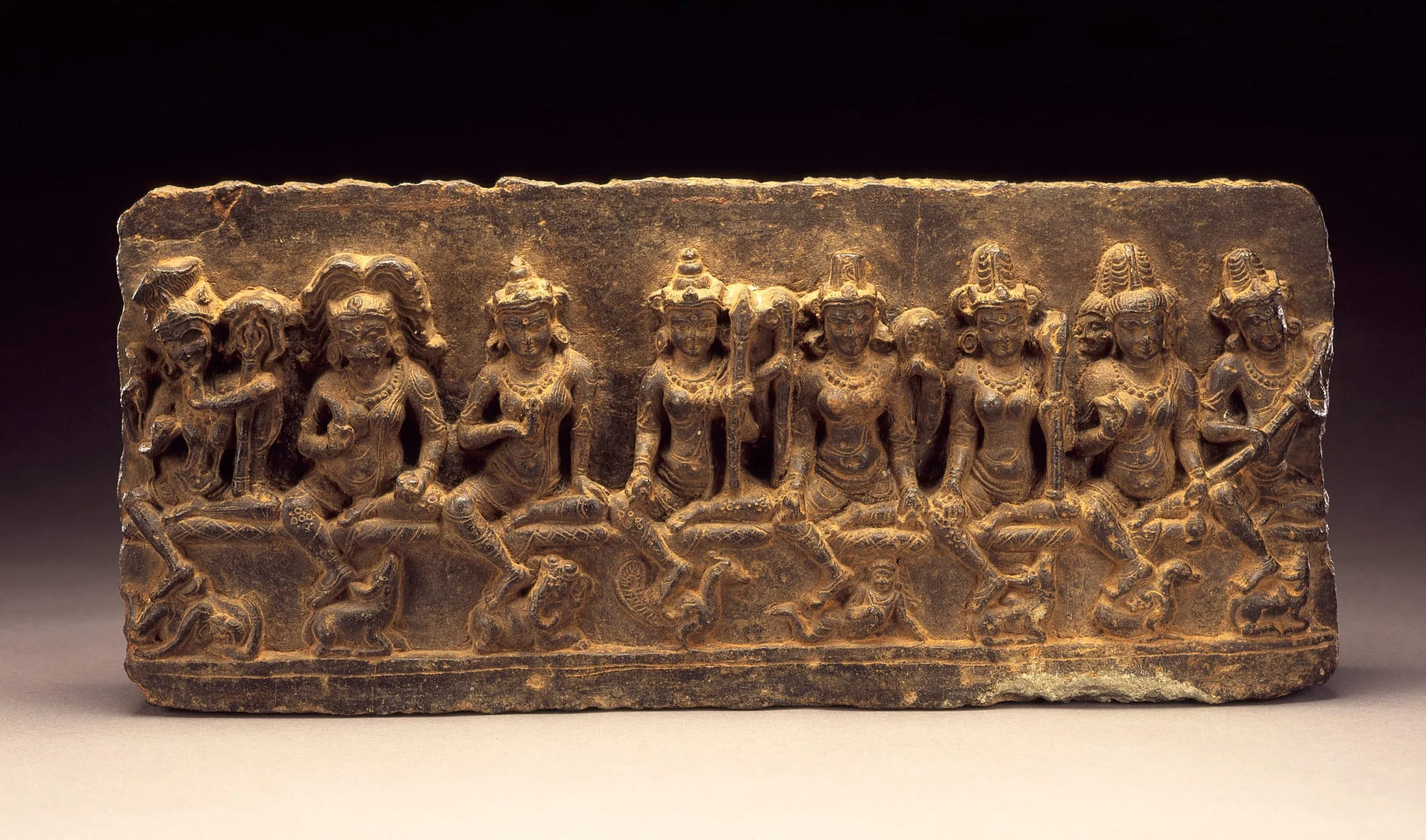
The Mother Goddesses (matrikas) are the female creative aspects (shaktis) of the Hindu gods. As such, they share attributes and mounts (vahana) with their namesakes. They can vary in number and identity, but the most common grouping is the seven Mother Goddesses (sapta matrikas). In northern and central Indian reliefs, they are often accompanied by a fierce form of Shiva, known as Virabhadra (Distinguished Hero) or by Shiva playing the vina (Vinadhara). The group is often flanked by the elephant-headed Ganesh, Lord of Obstacles. In this eastern Indian relief, Ganesha is omitted or perhaps is now lost through damage. This relief is also unusual because the sequence of the Mother Goddesses and Shiva begins on the right instead of the more commonplace left end. This is likely due to the relief’s originally intended location on the temple façade or doorway entablature or by the direction of the devotees’ ritual circumambulation.
From left to right, the deities represented here are Shiva as Vinadhara, holding a vina and with his bull mount, Nandi; the three-headed Brahmani (Brahma), holding a rosary (akshamala) and ascetic’s water pot (kamandalu), and with her gander (hamsa) mount; Maheshvari (Mahesvara or Shiva), holding a rosary and trident (trishula), and with her bull mount, Nandi; Vaishnavi (Vishnu), holding a discus (chakra), mace (gada), conch (shankha), and probably a lotus bud (padma), and with her half-human, half-avian mount, Garuda; Kaumari (Kumara), holding a lance (shakti) and a fruit (?), and with her peacock (mayura) mount; Indrani (Indra), holding a thunderbolt (vajra), and with her elephant (gaja) mount; the boar-headed (partially damaged) Varahi (Varaha) holding a flaying knife/chopper (kartrika) and skull cup (kapala), and with her buffalo (mahisha) mount; and the four-armed emaciated Chamunda (Durga), holding a skull cup, trident, an undetermined attribute, and displaying the gesture of admonition (tarjani mudra), and with her corpse (mritaka) mount. See also M.80.157.