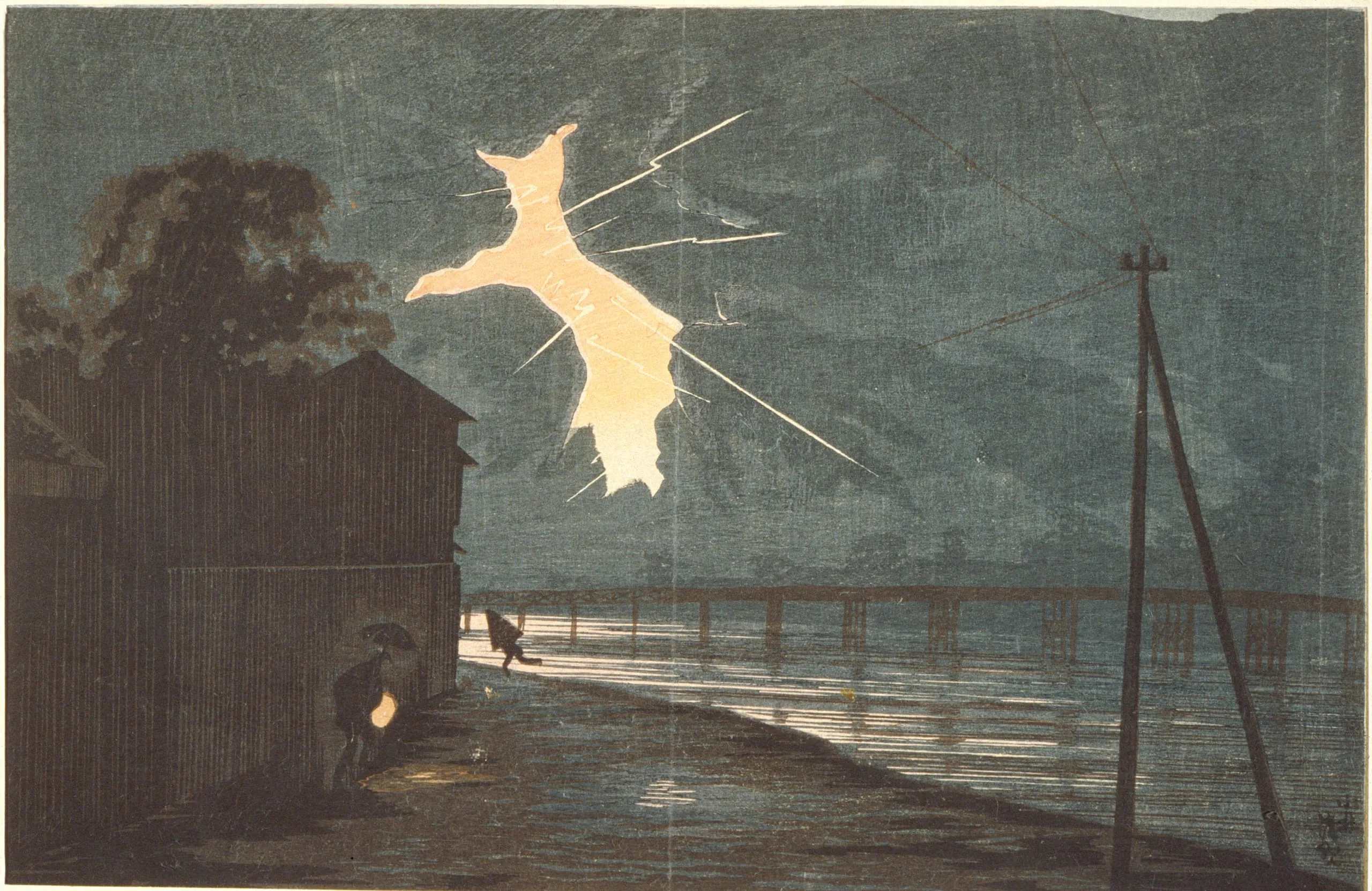
Kobayashi Kiyochika left his hometown of Edo in 1868 to spend several years in Shizuoka Prefecture. When he returned in 1874, it was to a startling different city—now called Tokyo—of gaslights, telegraph lines, brick buildings, steamships, and railroads. From 1876 to 1881, he explored the ukiyo-e genre in a series of views of Tokyo. Though typically depicting familiar locales and famous places, Kiyochika’s views are a stark departure from the customary renderings of the time as he sought to capture the environs of a rapidly modernizing city. Bridges, rivers, shrines, and parks are populated by silhouettes of figures set against a dark sky; picturesque scenes are fractured by telegraph poles and wires; and new Western-style buildings have replaced backgrounds of mountain ranges and forests.
Eschewing the bright colors traditionally used in woodblock prints, Kiyochika focused on light and shadow, an approach exemplified in LACMA’s dramatic Thunder and Lightning at Oumaya Bridge. His kōsenga (“light ray pictures”) are typically set at dawn, dusk, or night; sources of light are the rising or setting sun, the moon and stars, lightning, fire, and lanterns. He created reflections off rivers and lakes, rain-soaked streets, and glass windows; used rain, clouds, smoke, and fog to direct or obscure the light; and played with shadows and silhouettes.
Little is known about Kiyochika’s art education. Routinely described as self-taught, he was interested in both traditional Japanese and modern Western formats and processes. He studied and experimented with Japanese printmaking methods, merging them with Western techniques such as watercolor painting, etching, lithography, and photo-lithography. Among his innovative methods was his use of chiaroscuro, a technique where tonal gradations render three-dimensional objects and figures in a convincingly realistic manner. This technique was new to the design of Japanese landscape prints.
Kiyochika’s limited palette of muted tones may have been influenced by his interest in photography, which was introduced to Japan in the 1850s. Though he did produce more conventional landscapes (see M.71.100.48), comic and historical prints, and battle-scene triptychs during the Sino-Japanese War (1894−95; see M.83.41a-c), it was his treatment of light and dark that brought him fame.
2024