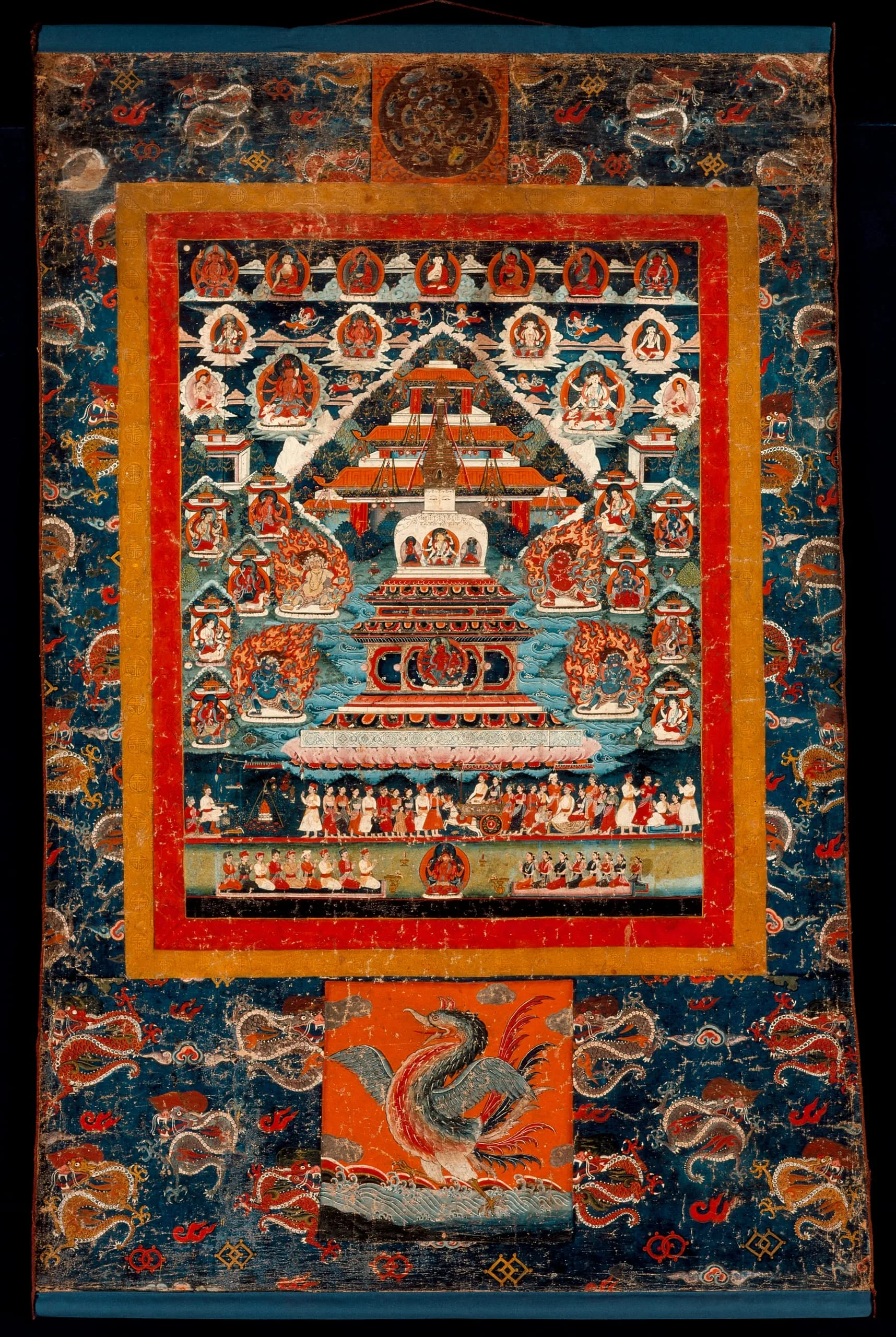
This thangka (painting on cloth) commemorates the Bhimaratha rite which is performed by an individual or by a married couple when either partner reaches the age of seventy-seven years, seven months and seven days. The performance of this rite absolves one from the responsibility of having to observe any religious functions until one’s death, it is in effect, the final religious rite.
The Bhimaratha ritual is particularly popular among Newars, the dominant ethnic group in Nepal, many of whom traveled to India and Tibet as merchants. As the Buddhist religion in Nepal had declined by the 17th century, the monasteries of Patan and Kathmandu were no longer esteemed seats of learning and Newari traders made it a point to visit Tibetan monasteries in the course of their travels, particularly Tashi Lhunpo, the seat of the Pachen (Great Scholar) lamas (Buddhist monks) who are believed to reincarnate in a child born soon after their death.
Invariably the Newari merchants would commission and consecrate thangkas such as this fine example in Tibetan monasteries and bring them back to Nepal as souvenirs. The style of these paintings is Tibetan, but the subject matter is usually Nepalese.
At the center of this painting is a stupa representing the Svayambhunath stupa in the Kathmandu valley rising from Lake Kalihrada. Ushnishavijaya (a goddess associated with longevity) flanked by two bodhisattvas (Buddhist saviors) resides in the bell of the stupa. Along the top center of the painting are the five transcendent Buddhas: Akshobya, Amitabha, Amoghasiddhi, Ratnasambhava and Vairochana. Various peaceful and protective deities are also represented, with the four angry protector gods Achala, Takkiraja, Niladanda and Mahakala striding shrouded in flames around the central stupa. Below the stupa, the Bhimaratha ritual is depicted, with the couple being honored seated in a chariot and dressed in the Indian Rajput clothing that was the fashion in 19th-century Nepal.
Of particular interest in this work is the surrounding border of the painting which is painted to look like the fine imperial Chinese silk brocades that were presented as gifts by the Chinese court to the Tibetan religious orders and which were used as borders for religious paintings. As sumptuary laws governed the use of imperial silk, the Newari patrons were required to settle for plain linen painted to resemble silk.