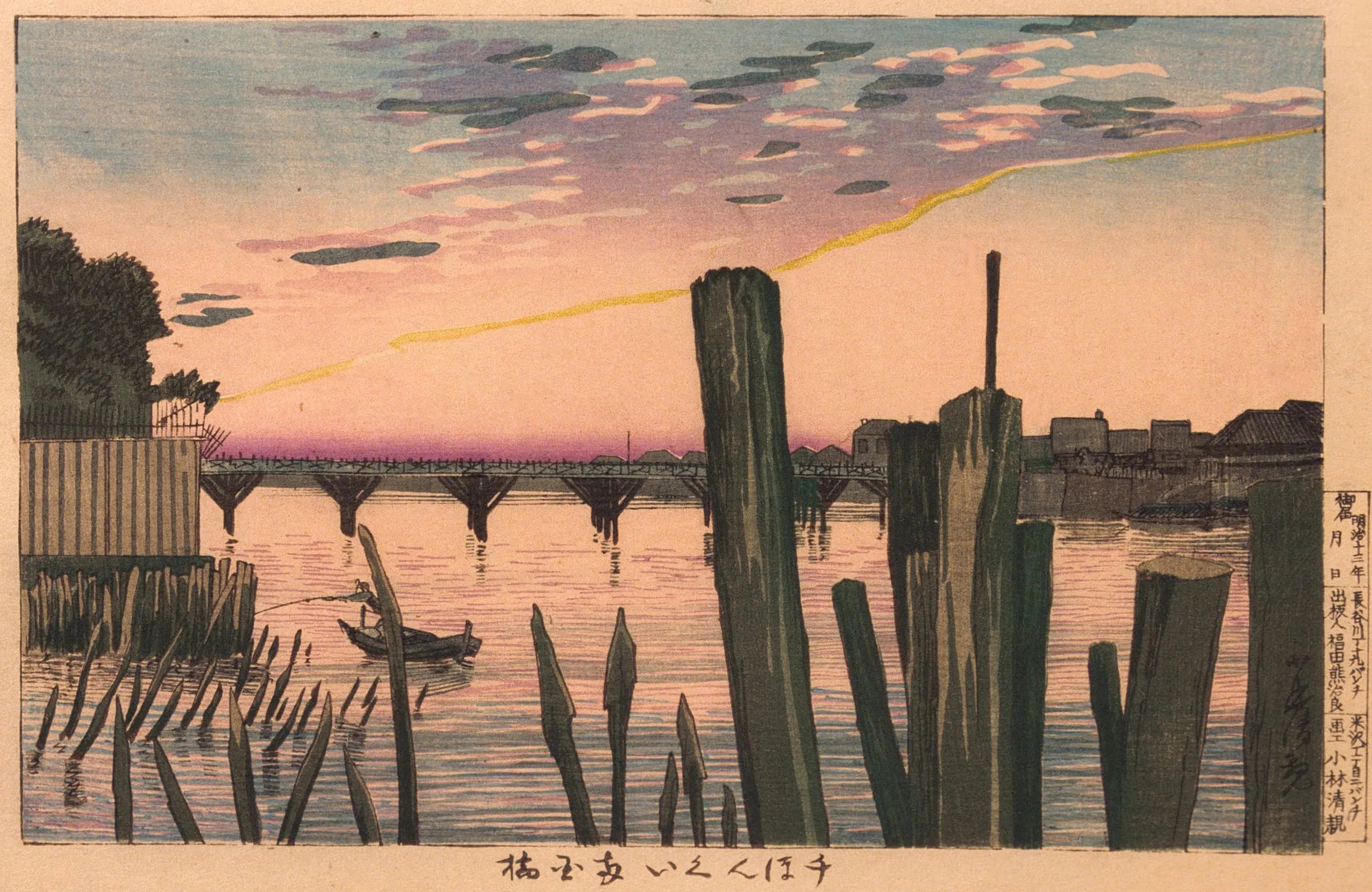
- Title
- Breakwater Stakes and Ryōgoku Bridge
- Date Made
- 1880
- Medium
- Color woodblock print
- Dimensions
- Image: 7 15/16 × 12 3/8 in. (20.16 × 31.43 cm)
Sheet: 9 3/4 × 14 1/2 in. (24.77 × 36.83 cm)
- Accession Number
- M.71.100.64
- Curatorial Notes
This woodblock print is from Kobayashi Kiyochika’s series of Tokyo views produced in 1876−81. The breakwater pilings become smaller from right to left as they recede into the middle ground, where a lone fisherman in a boat casts his line. A breakwater is a man-made barrier—in this case, large wood stakes—constructed in the water to protect the shore from the force of swift currents. This breakwater is variously known as Hyappongui (“one hundred stakes”) or Senbongui (“one thousand stakes”) and protects the shore from erosion at a curve in the Sumida River just north of Ryōguku Bridge, the long span of which is seen in the background. Kiyochika depicted this area several times in his print works (see M.71.100.99).
Like many Japanese artists during the Meiji period (1868−1912), Kiyochika was interested in Western art techniques. He had access to imported photographs, prints, and books, and was acquainted with Western artists living in Tokyo from whom he may have learned Western painting and print techniques, skills that he merged with traditional Japanese print processes. Kiyochika kept a sketchbook in which he captured landscape views, many of which he would reproduce in print format. The drawings were executed on Western paper in pencil with watercolor applied over the line drawing, a technique that he would have learned from Western sources. In comparing prints such as this one with their original sketches, it is evident that Kiyochika strove to retain the effects of Western-style watercolor painting in the woodblock medium.
2024
- Selected Bibliography
- Burrell, Jane; Kuwayama, George; Lee, Junghee; Garaventa, Gloria and Henry Smith. Tuchman, Mitch, ed. Tradition In Transition: Print Masters of the Meiji and Taisho Periods. Los Angeles, CA: Los Angeles County Museum of Art, 1983.