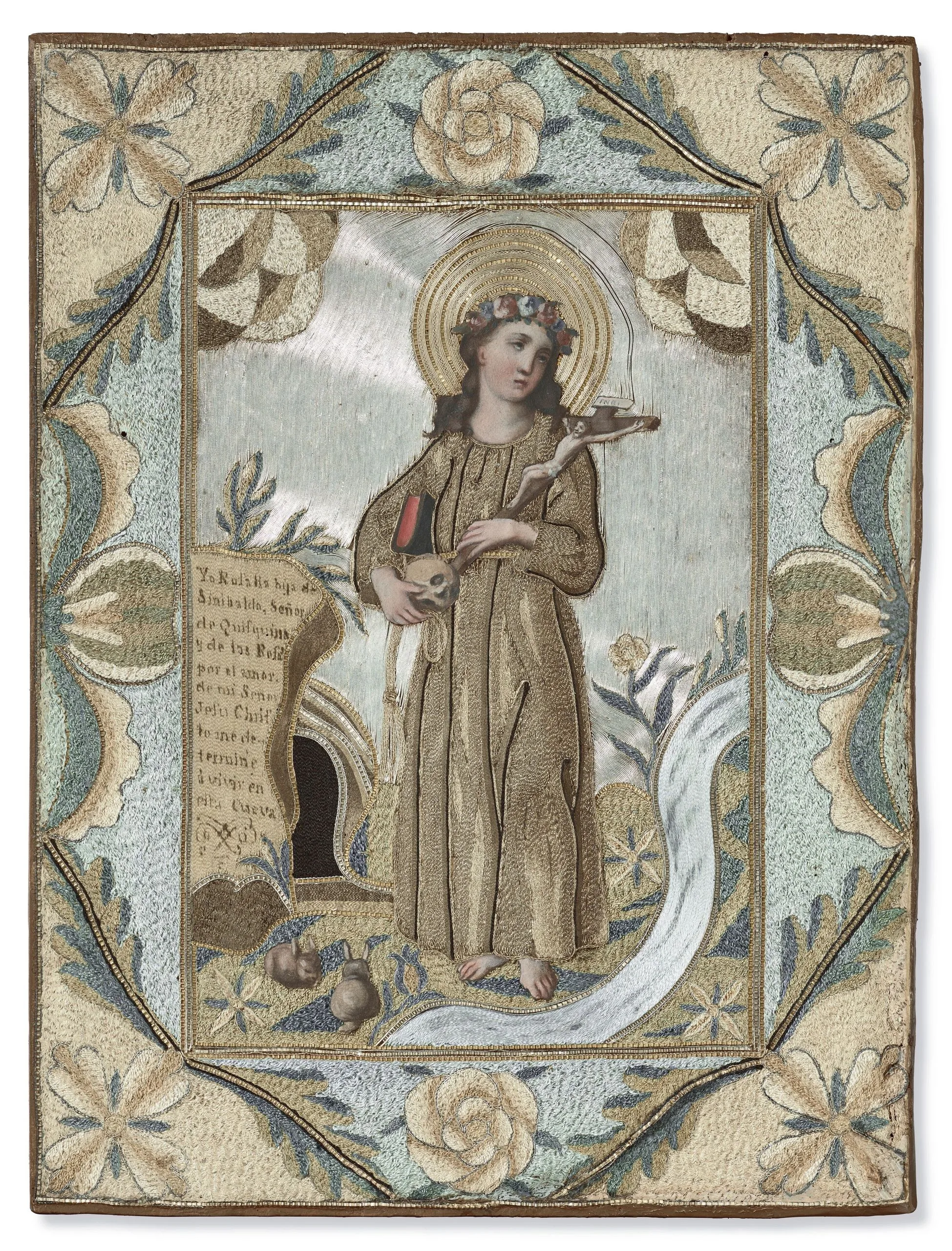
Saint Rosalia, the patron saint of Palermo, Sicily, is portrayed as a young woman wearing her crown of flowers and standing next to the cave on Mount Pellegrino, where she lived as a hermit. The stream and hares symbolize the wilderness at the summit of the Sicilian mount. A striking feature of the work is its combination of paint and embroidery, pointing to the possible collaboration of embroiderers and painters. The abundance of high-quality metal threads—gold and silver—and silk endows the composition with a sense of depth and heightens the interplay of light and shadows. Notice, too, the masterful application of the gold threads to create the halo, and of the silver ones for the sky. Given its small scale, this image of the wonder-working saint was most likely intended for private devotional use.
According to legend, the exceptionally beautiful Rosalia was born in the twelfth century to a noble family that traced its origins to Charlemagne. Devoutly religious, at a young age she retreated to Mount Pellegrino and became a hermit. In 1624, during a devastating plague that struck Palermo, she appeared to a hunter and instructed him to retrieve her remains from a cave and carry them in public procession to end the epidemic. After the plague subsided through her miraculous intercession, a sanctuary was built in her honor at the site where her bones were discovered. The saint developed a wide following for her thaumaturgic powers, and was often invoked during earthquakes and other natural calamities. Referred to as a "rose without thorns," Saint Rosalia is often depicted inside a cave, crowned with roses, and holding a lily or a skull to symbolize her purity and ascetic life devoted to Christ.
The Jesuit order, one of the most powerful and influential globally, was largely responsible for spreading her cult across Europe and Spanish America, including Mexico. In the seventeenth and eighteenth centuries, New Spain suffered a number of catastrophic floods, earthquakes, and epidemics. Sicilian missionaries introduced Saint Rosalia’s cult in the viceroyalty, orchestrating the translation of several Italian accounts of her life into Spanish. New hagiographies were also written in Mexico, attesting to the local appropriation of the cult. By the mid-eighteenth century, images of the saint—both public and private—flourished.
Ilona Katzew, 2026
Spanish transcription: Yo Rosalía hija de / Sinibaldo, Señor / de Quisquina / y de las Rosas / por el amor de mi Señor Jesu Chris-to / me de- / terminé a vivir en / esta Cueva (I, Rosalía, daughter of Sinibaldo, Lord of Quisquina and the Roses, for the love of my Lord Jesus Christ, have resolved to live in this cave)