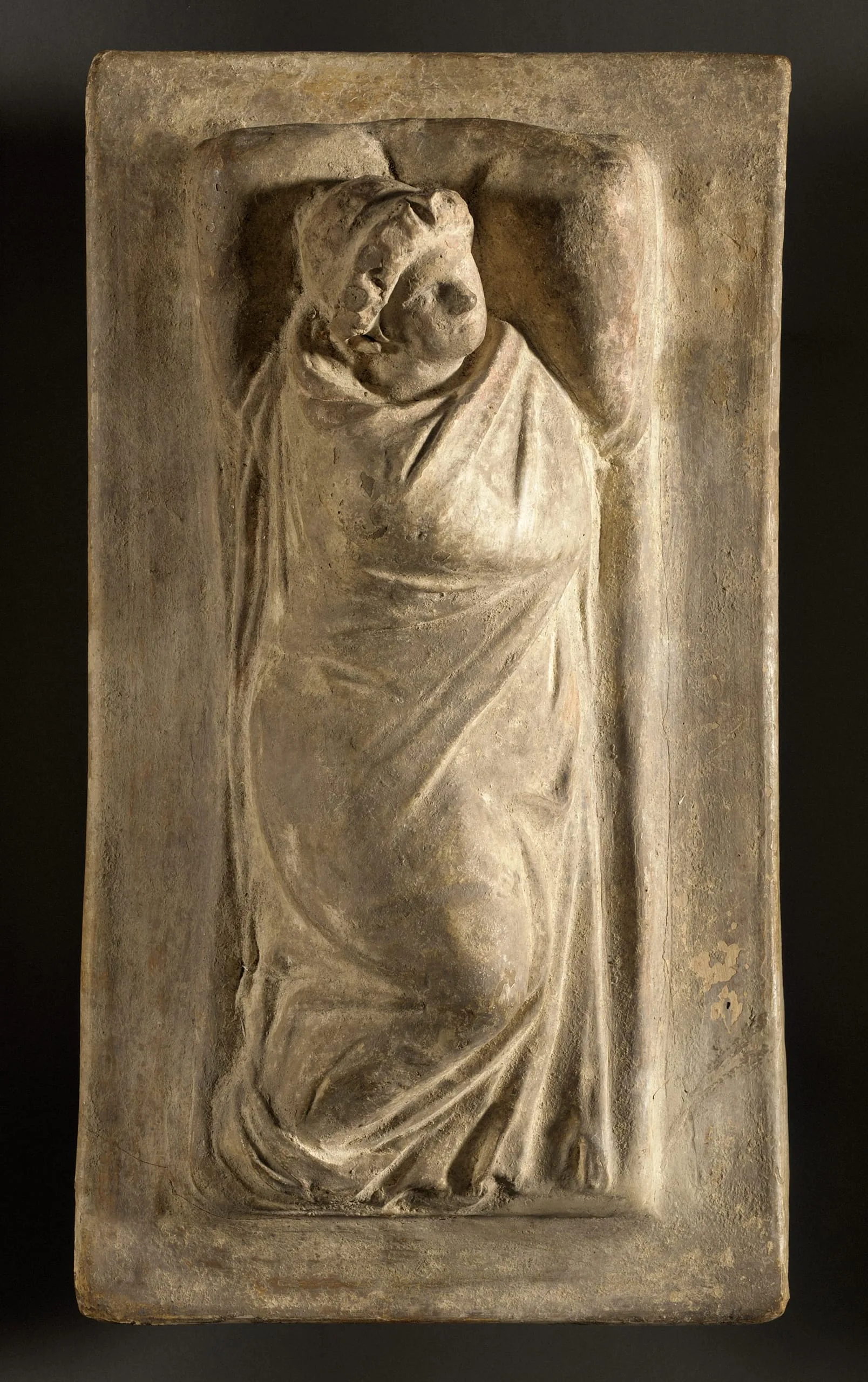
This painted ceramic cinerarium was used as a place in which the deceased’s cremated remains were laid to rest. The urn was found in Chiusi, a major settlement of the Etruscans, a civilization in central Italy that influenced Roman art and culture. Etruscan cinerary urns like this one are similar in appearance to larger Etruscan sarcophagi, in that they both depict the deceased reclining on the lid and feature relief sculpture on the sides. The relief sculpture on the body of our cinerarium was created using a mold, as confirmed by the existence of two other, identical urn reliefs now at the Cincinnati Art Museum and the Walters Art Museum.
The relief depicts a scene of two warriors and their shields, with one fighter lying wounded at the feet of the other. The scene has tentatively been identified as the battle between Eteocles and Polyneices, the sons of Oedipus, who fought over the throne of Thebes. The winged female figures on the edges of the scene are Vanths, chthonic Etruscan entities associated with death and the journey of the deceased to the Underworld. Vanths are commonly found in funerary art such as tomb paintings, urns, and sarcophagi and often appear in scenes depicting the moment of death or immediately after. The other sides of the urn are unadorned. The lid features a recumbent female figure, swathed in cloth, with her head on a pillow. Considerable polychrome survives, particularly red pigment on the pillow on the lid, and red, white, and yellow on the armor of the warriors in the relief.