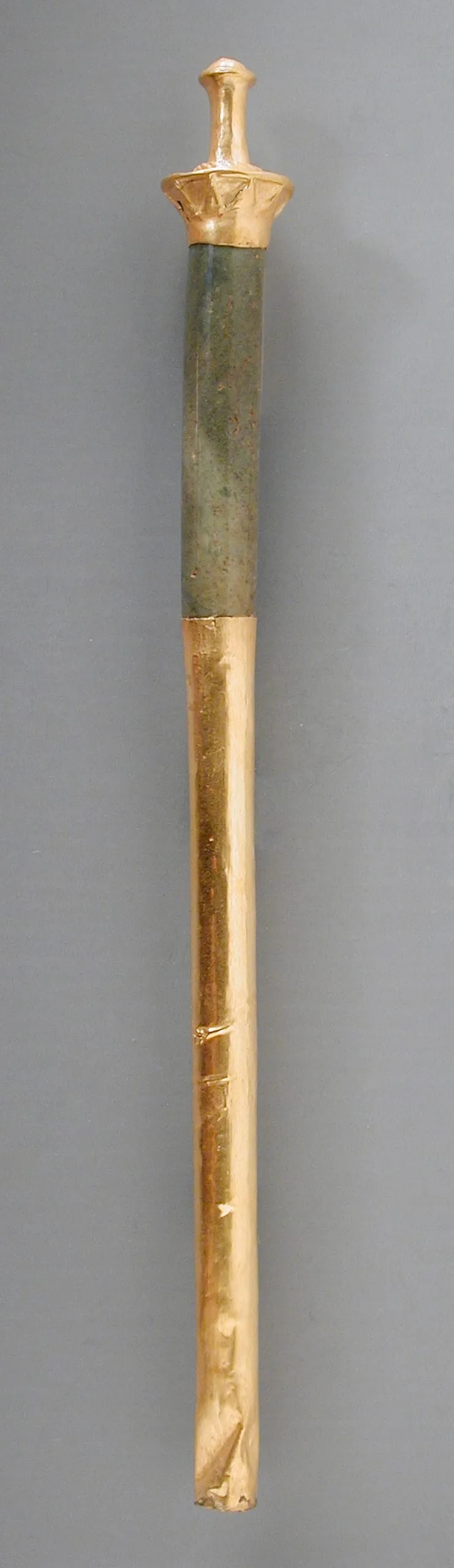
This ear rod would have hung forward in the wearer’s earlobe, with the cap at the back to prevent slipping. A piercing wide enough to accommodate the radius of the rod requires significant stretching of the lobe over time, resulting in a permanent and visible alteration of the body.
Ancient Panamanians practiced many kinds of body modification as expressions of cultural and personal identity. In addition to the wearing of gold adornments, there is evidence that members of the Greater Coclé region practiced cranial modification and body painting or tattooing. When colonization began, European invaders and Christian missionaries attempted to restrict these expressive practices, but present-day Indigenous Panamanians still adorn themselves with jewelry, body paintings, and colorful textiles such as molas, which are said to have protective properties.
To create this ear rod, the artist would have hammered a gold nugget into a sheet that was then wrapped around a core of painstakingly carved and polished jade, using a resin as adhesive. It is likely that a number of different people were involved in the process, creating items of high value and significance. This ear rod is said to have been found at Venado Beach, and similar examples have been excavated at El Caño and Sitio Conte.
Camille Neira and Julia Burtenshaw
2024