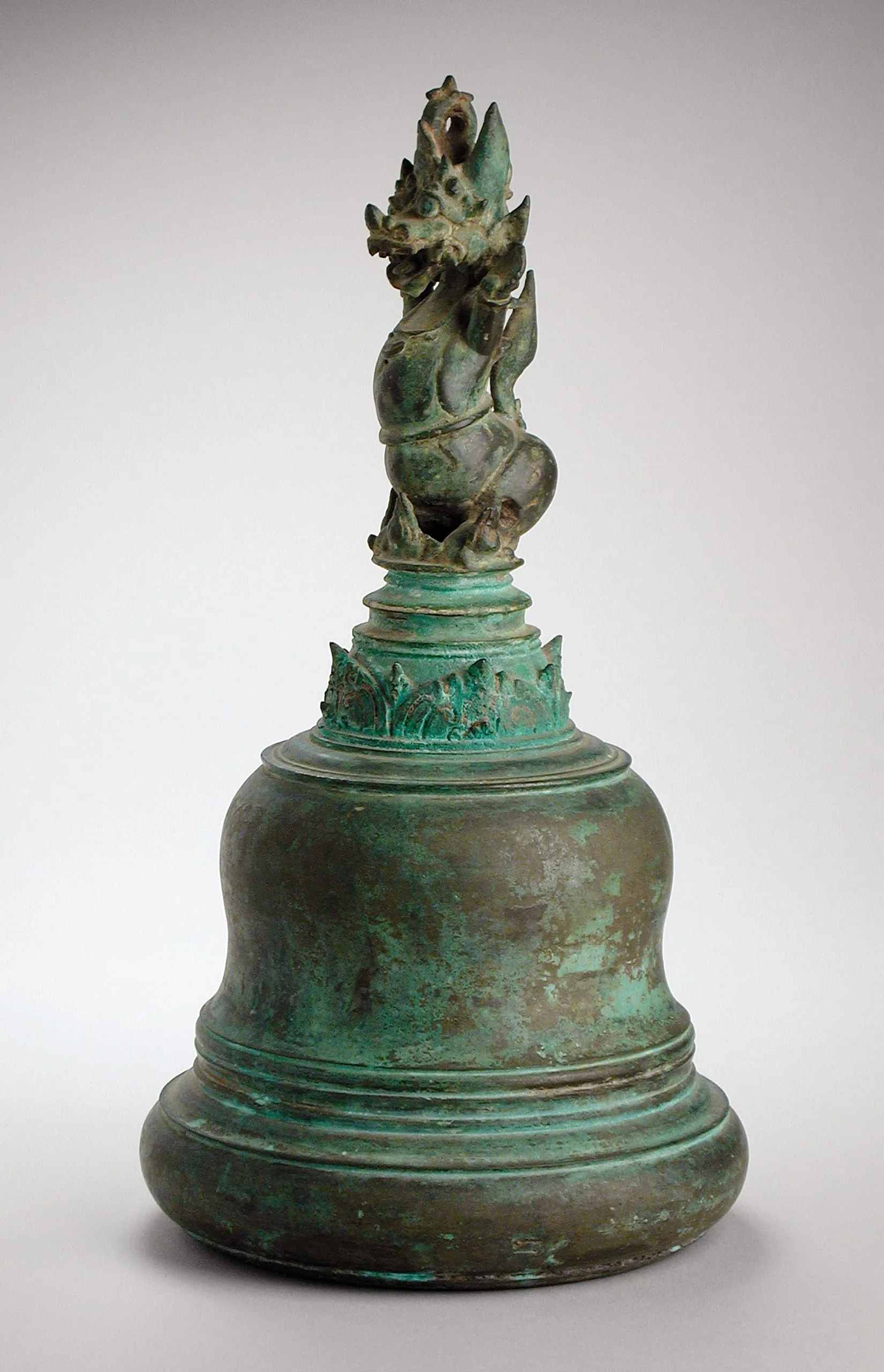
Hanging bells were often hung in Indonesian temple courtyards or monasteries. The top of the bell was frequently in the form of a rearing lion, with bulls, serpents, and various symbols less utilized. Hanging bells do not have clappers to produce their sound. Rather, the bell was rung by beating the lower rim of its circular base, called a sound bow, with a stick wrapped at one end with cloth. See J. E. van Lohuizen-de Leeuw, Indo-Javanese Metalwork (Stuttgart: Linden-Museum, 1984), pp. 84-87, nos. 50-53; Pauline Lunsingh Scheurleer and Marijke J. Klokke, Divine Bronze: Ancient Indonesian Bronzes from A.D. 600 to 1600 (Leiden: E. J. Brill, 1988), pp. 124-125, nos. 72-73; and Jan Fontein, The Sculpture of Indonesia (Washington: National Gallery of Art, 1990), p. 240, no. 73.
This hanging bell would have originally had a chain with a hook loop attached to the ring at the pinnacle of the lion terminal. The horned lion has bulging eyes and an upturned pointed snout. His jaws are wide open with fangs. He squats on his hindpaws and holds a small ball in each of its forepaws. He has a cord girdle around his waist. The ringed collar between the lion and bell is adorned at the upper juncture with demonic masks known as kala (time, death, or black) heads. The base of the collar has a row of upright lotus petals. The bell is stupa-shaped with concentric bands on the shoulders and base.
Comparable Eastern Javanese hanging bells with a rearing lion are in the Linden-Museum, Stuttgart (SA 35 269 L, SA 35 270 L, SA 35 271 L, and SA 35 272 L); Museum für Asiatische Kunst, Berlin (II 213) and Museum Nasional, Jakarta (9581). See also M.76.101.