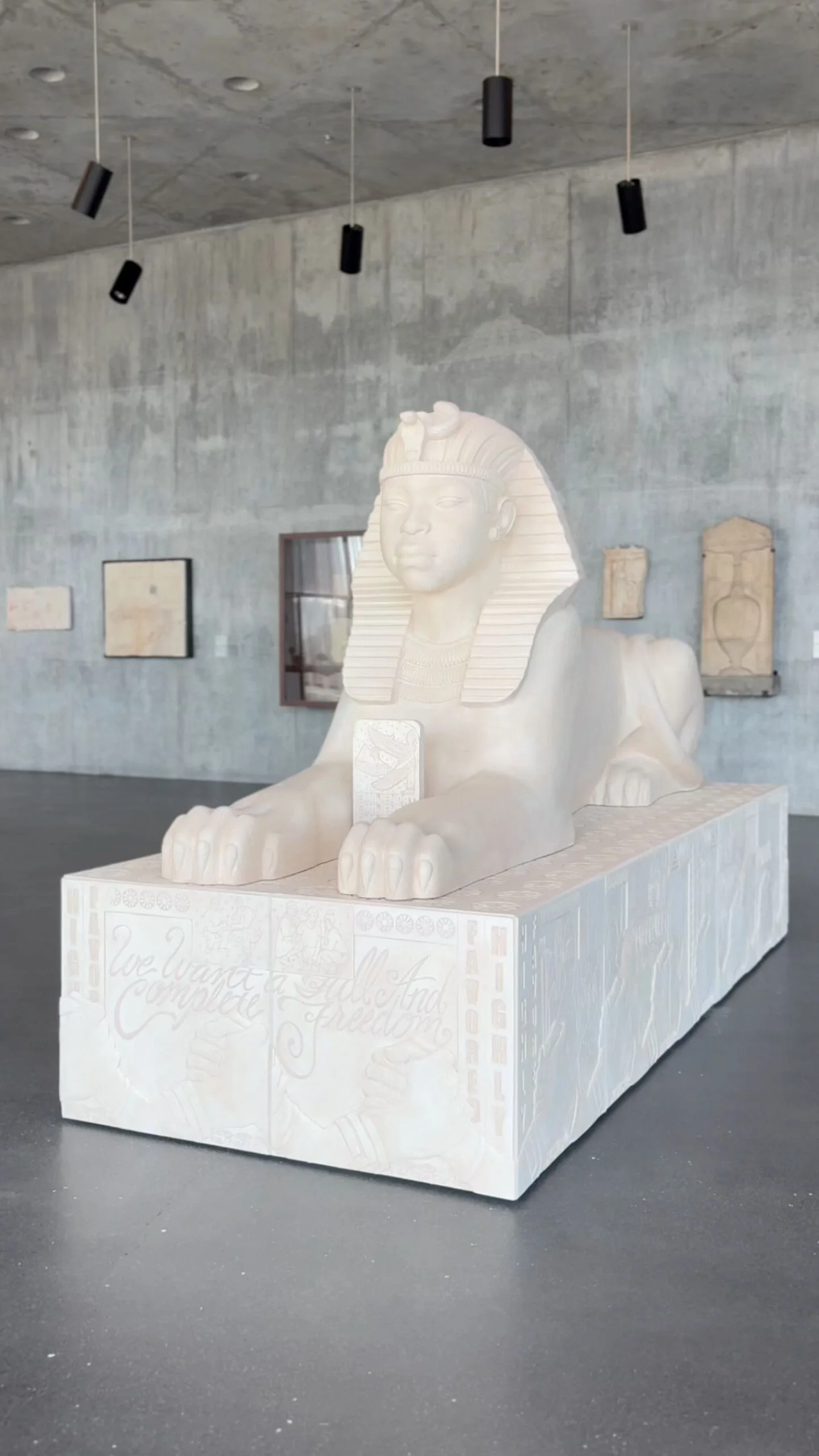
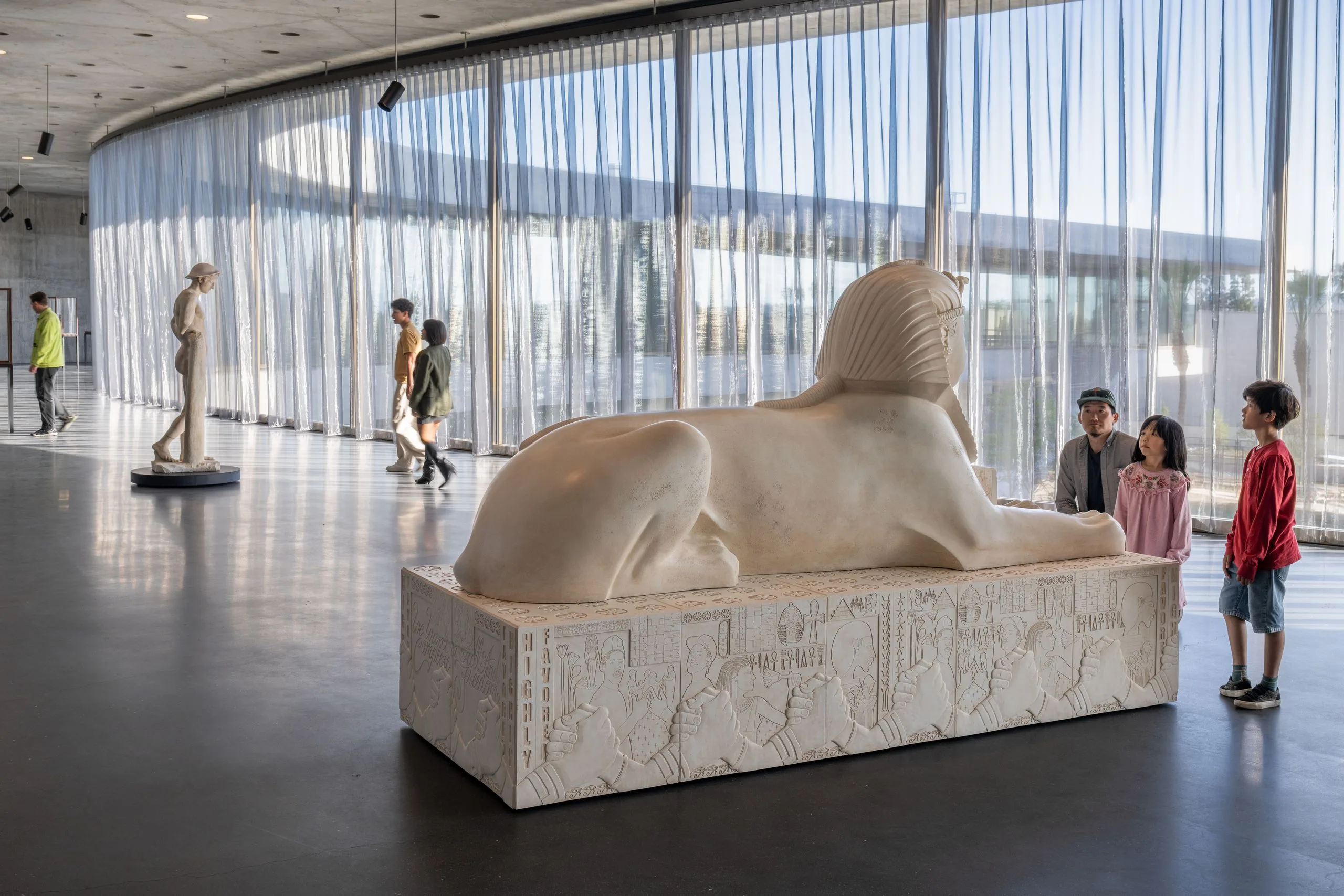
Los Angeles artist Lauren Halsey has created a monumental ten-foot reclining sphinx for the debut of the David Geffen Galleries in 2026. The work currently anchors a gallery devoted to the cross-currents of Egyptian, Greek, Roman, and African cultures.
Several themes emerge in this gallery, titled The Ancient Mediterranean: Merging Beliefs, especially the combination of Greek, Egyptian, and Roman deities, imagery, and artistic techniques. Examples include the transformation of the Egyptian goddess Isis into her Roman counterpart; the adoption of shared jewelry forms; and the development of ancient glass technology. A second theme is the connection between Egypt and greater Africa, a source of commerce, migration, and cultural exchange for millennia. Egypt is located in the northeastern corner of Africa, and the Nile River—the continent’s longest—ties it southward through Sudan and beyond. Nubian kings of the 25th dynasty ruled Egypt around 750–656 BCE, accelerating trade and the sharing of religious practices. Nubian rulers and their artisans emulated the basic forms of Egyptian pyramid tombs and temples and adopted some Egyptian deities, yet created a material culture that was highly original and sophisticated.
In much the same way, Halsey’s work often references Egyptian and Nubian forms and subject matter but creates something entirely new. As with her previous sphinx portraits, the primary image features an individual from her personal sphere, inviting viewers to think about the deeper heritage of our city. A plaque held between the paws identifies the work as a portrait of “Dael,” protected by the outstretched wings of an Isis-like figure and the repeated inscription EMAJENDAT.
The base is covered with Egyptian rosettes and other motifs such as wadjet eyes, pyramids, bands of stars, figures sniffing lotus flowers, Amarna profiles, and hieroglyphic inscriptions. Contemporary details appear alongside them: portraits of neighborhood residents and sayings such as “Highly favored,” “Echoes of the Obvious,” and “We want full and complete freedom” encircled by a motif of clasped hands and forearms.