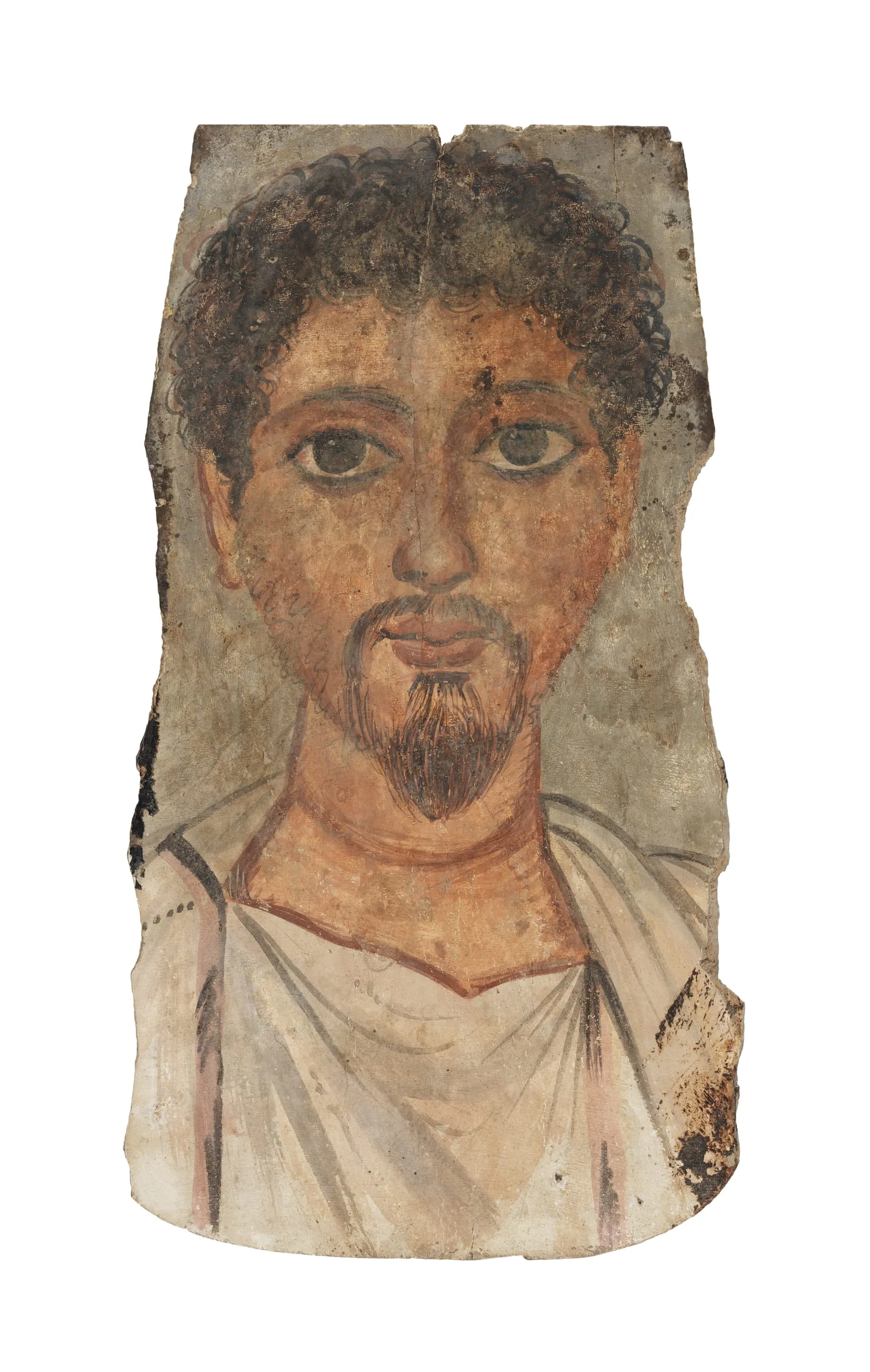
The tradition of painted naturalistic portraits of deceased elite individuals developed in the first to third centuries CE of the Roman Period in the Faiyum area of Egypt. Portraits on wood panels were placed over the heads of mummified bodies and anchored with linen wrappings or layers of plaster cartonnage. The Austrian archaeologist and dealer Theodor Graf uncovered several hundred portraits in the er-Rubayat cemetery in 1887. Graf’s inventory stamp on the back of the LACMA panel, as well as the stylistic similarities between this panel and others from the area, indicate that it was part of this group.
A young, curly-haired, bearded youth is shown frontally, his body turned slightly to the left. He wears a white tunic with decorative vertical pink stripes (clavi) and a white mantle over his left shoulder. As seen in other portraits, a dotted line indicates the tunic’s seam on his right shoulder. The gray background is also similar to many of the portraits believed to have originated in the Faiyum area. The portrait has been substantially cleaned, as an early photograph reveals a thin layer of a black substance, possibly a resinous burial material, covering the upper portion of the panel down to the sitter’s mouth.
Provenance: Excavated by Theodor Graf (1840-1903), b. Engerda (present-day Germany), 1887, exported by Bruno Kertzmar Gallery, Vienna, c 1930, acquired by Phil Berg (b.New York, 1902-1983), prior to 1959, gift to LACMA by Phil Berg to LACMA, 1971.
Publications
Catalogue of the Theodor Graf Collection of Unique Ancient Greek Portraits. Chicago: World’s Columbian Exposition, 1893.
Man Came This Way: Objects from the Phil Berg Collection. Los Angeles: LACMA, 1971, cat. 59.
Parlasca, Klaus. Ritratti di Mummie, Serie B, Volume IV. Repertorio d’arte dell’Egitto Greco-Romano 5. Rome: L’Erma di Bretschneider, 2003, no. 915.
The Phil Berg Collection. Los Angeles: Los Angeles County Art Institute Galleries, 1959, no. 32A.