- Title
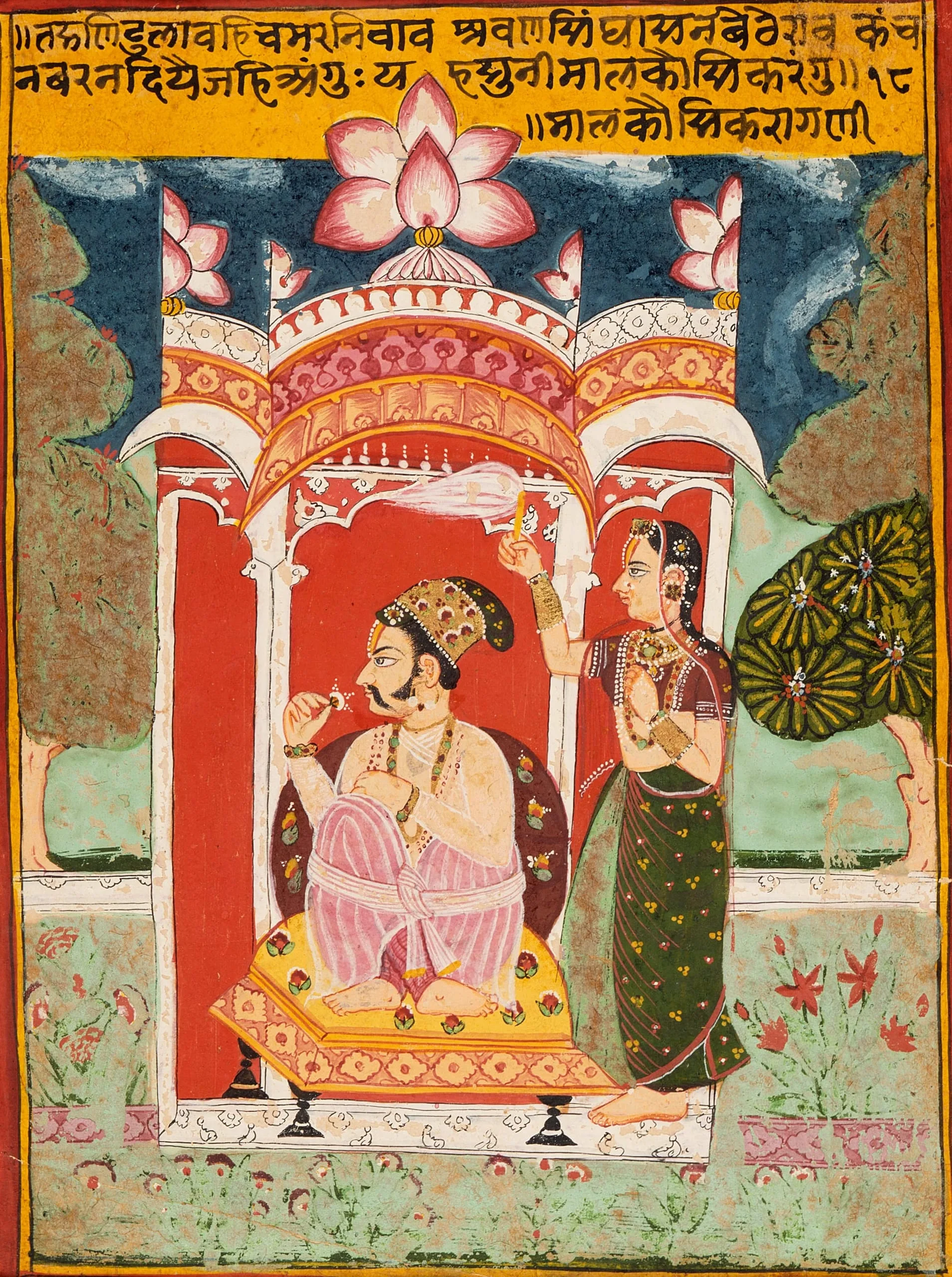
- Malkos Raga, Folio from a Ragamala (Garland of Melodies)
- Date Made
- circa 1675-1700
- Medium
- Opaque watercolor, gold, and ink on paper
- Dimensions
- Sheet: 8 1/16 x 6 in. (20.48 x 15.24 cm); Image: 7 3/16 x 5 1/2 in. (18.26 x 13.97 cm)
- Accession Number
- M.71.1.22
- Curatorial Notes
The devanagari inscription in the header identifies Malkos Raga by the variant spelling of “Malakausika Ragani.” He is described as a handsome monarch seated on a golden lion throne and being fanned with a fly whisk by a beautiful maiden. The couplet is inscribed as number eighteen. Malkos Raga is the second raga in the predominant ragamala (garland of melodies) classification system generally known as the Rajasthani system. It is a sublime melody associated with midnight or midday and late winter (December–January). It is personified as a prince seated in a pavilion attended by a woman or women bearing an honorific fly whisk.
Here, a prince sits on a small divan in an ornate pavilion with large lotus finials. The interior of the pavilion is painted red, a color with which he is culturally associated. He has a brocaded gold turban with floral motifs and pearls. He wears a necklace and matching bracelets made of gold, rubies, and emeralds. He is smelling a nosegay and has a support band around his knees. The female attendant behind him waves a fly whisk made of the white tail-hairs of a yak (cauri or chowri). The setting is a lush garden with poppy flowers and blossoming mango trees. See its series mate M.81.280.3.
- Selected Bibliography
- Rosenfield, John. The Arts of India and Nepal: The Nasli and Alice Heeramaneck Collection. Boston: Museum of Fine Arts, Boston, 1966.