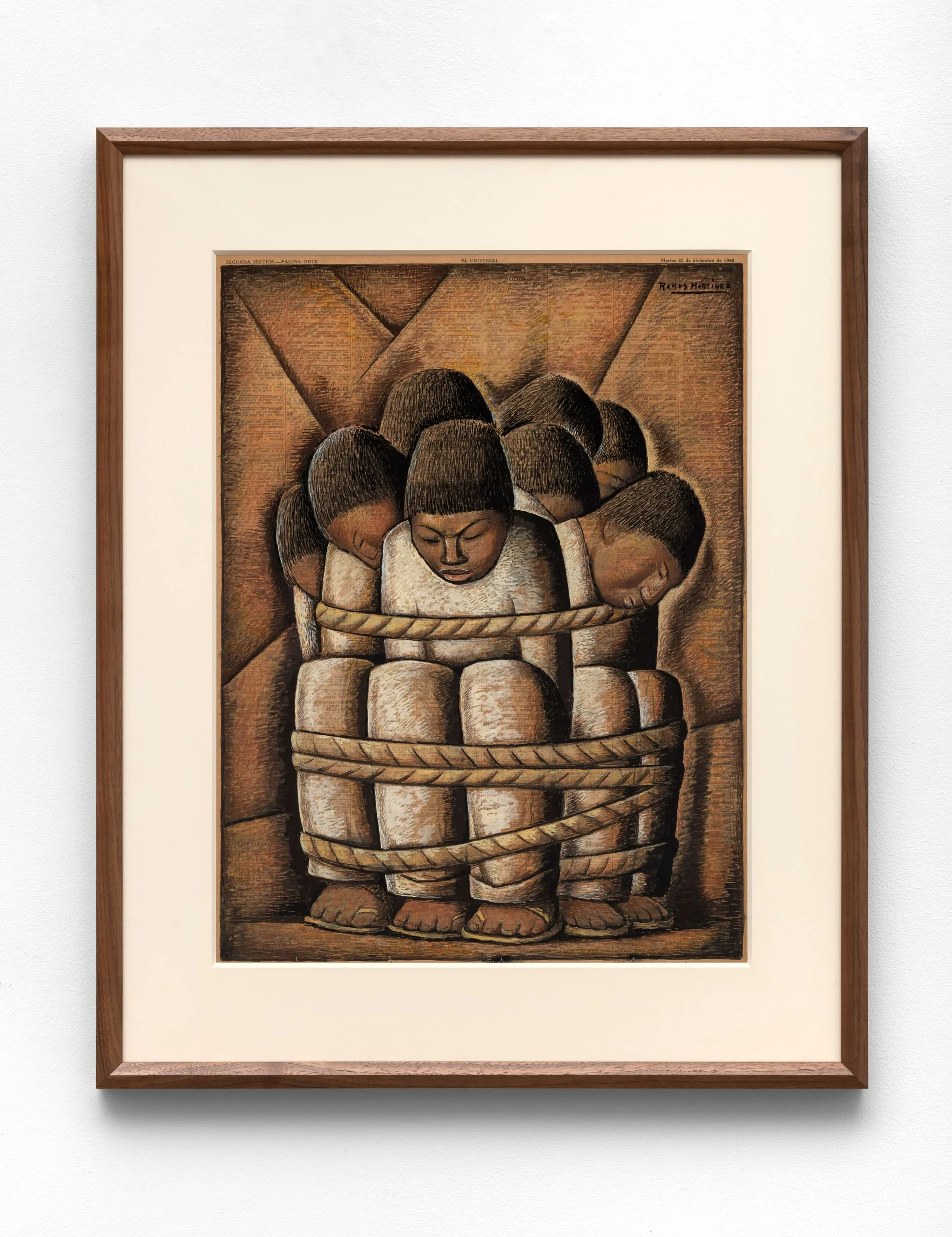
In La Guerra que todos ata (The War That Binds Us All), a group of eight rural Indigenous men are roped together, downtrodden and in despair. Rendered on a page from the December 22, 1942, issue of the Mexican newspaper El Universal, the victims are constrained physically and spiritually by the effects of war—a fate that binds everyone equally. This bold political image differs dramatically from Alfredo Ramos Martínez’s more picturesque representations of Indigenous types and festivals, for which he has become better known.
In the early twentieth century, many artists from Latin America traveled to Europe, where they were exposed to the most current art movements of the time. Upon returning to their homelands, they promoted the creation of a modern visual vocabulary rooted in the local. In the wake of the Mexican Revolution (1910–20), the lives, traditions, and rights of Indigenous peoples were celebrated as part of a national agenda, and art played an essential role in the dissemination of this new political discourse. Many of Ramos Martínez’s works of Indigenous subjects can be understood within this context. Although the artist did not participate in the revolution, some of his works from the 1940s respond to the atrocities of this armed conflict as well as the Cristero War of the 1920s, in which Catholic laity and clergy opposed the government’s attempt to suppress the church and popular religiosity. His interest in themes of war was likely spurred by the ongoing violence of World War II.
After his return from Europe to Mexico in 1910, Ramos Martínez directed the Escuela Nacional de Bellas Artes (National School of Fine Arts), and by the 1920s he was leading the famous open-air schools of painting, established by the Mexican government to teach children and young adults to paint. In 1929, he relocated to Los Angeles, where he developed a large Hollywood following—including Edith Head and Alfred Hitchcock—and was commissioned to paint several murals across Southern California.
Ilona Katzew
2025