LACMA

ShopMembershipMyLACMATickets
LACMA
Los Angeles County Museum of Art
5905 Wilshire Blvd.
Los Angeles, CA 90036
info@lacma.org
(323) 857-6000
Sign up to receive emails
Subscribe
© Museum Associates 2026
  • About LACMA
  • Jobs
  • Building LACMA
  • Host An Event
  • Unframed
  • Press
  • FAQs
  • Log in to MyLACMA
  • Privacy Policy
© Museum Associates 2026
Collections

Manuel de Arellano
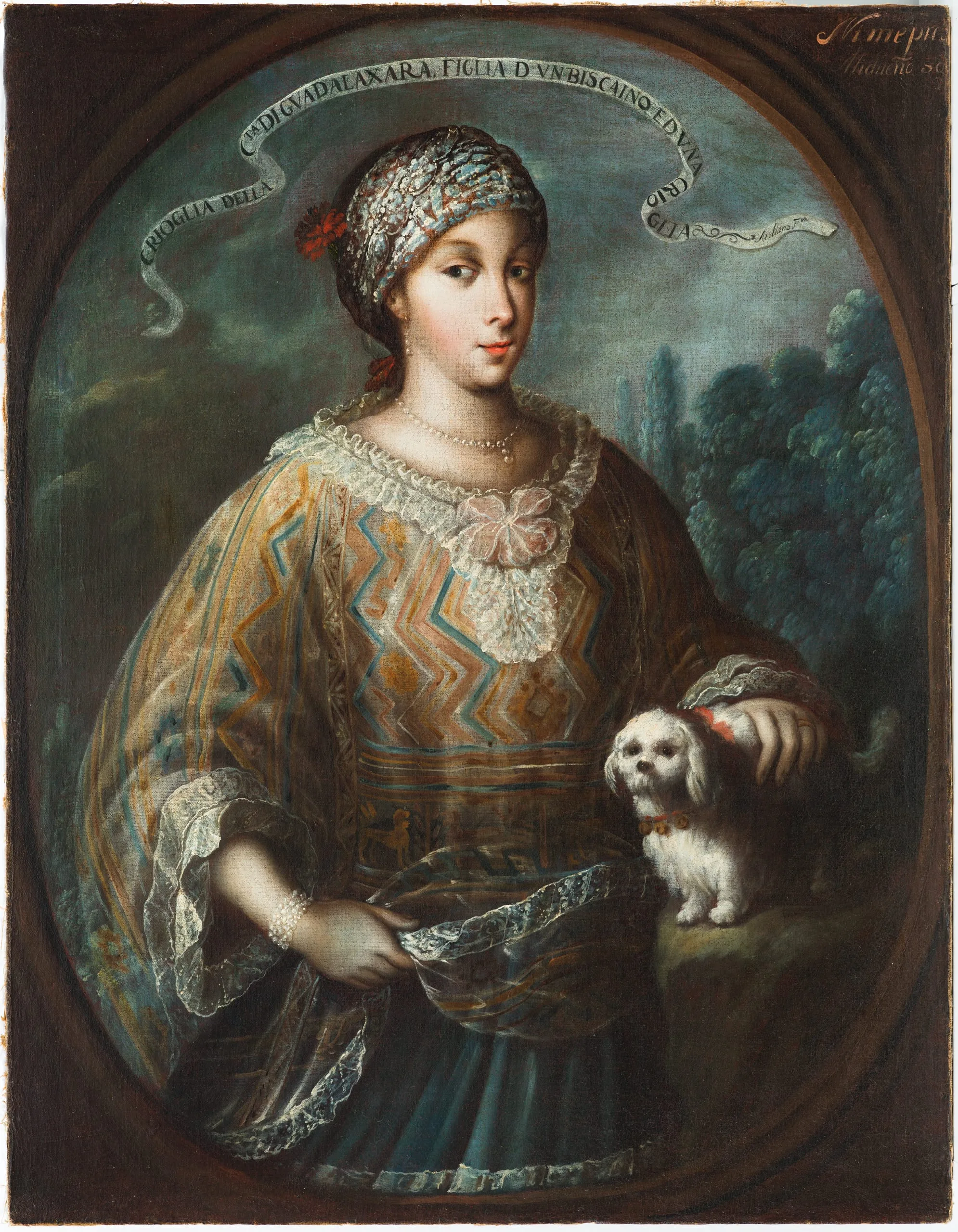
Creole Woman from the City of Guadalajaracirca 1710

On view:
Geffen Galleries, floor 2
Oil painting portrait, woman from the waist up within a painted oval, wearing a gold and teal zigzag-patterned robe and lace collar, holding a small white dog, with a banner inscription arching overhead
Artist or Maker
Manuel de Arellano
Mexico, 1662-1722
Title
Creole Woman from the City of Guadalajara
Date Made
circa 1710
Medium
Oil on canvas
Dimensions
Framed: 47 1/4 × 37 7/8 × 2 3/8 in. (120.02 × 96.2 × 6.03 cm); sight: 41 × 31 in. (104.14 × 78.74 cm)
Credit Line
Gift of the 2025 Collectors Committee with additional funds from an anonymous donor
Accession Number
M.2025.32.1
Classification
Paintings
Collecting Area
Latin American Art
Curatorial Notes

This painting and its pair (see M.2025.32.2) are not portraits of individuals but of different racial types. In fact, they are groundbreaking precursors of the famous casta (caste) paintings—a distinctive and highly complex genre invented in Mexico in the eighteenth century to depict multiracial families (see M.2014.223, M.2009.62, M.2011.20.1, M.2011.20.2, and M.2011.20.3). Intended to be exported to Europe to provide a glimpse of colonial life, the works are the first to codify Mexico’s diverse population and inventive sartorial practices.

The woman wears a combination of local and European clothing, including a diaphanous Indigenous blouse (huipil) with intricate geometric and animal motifs, trimmed with expensive Flemish lace. This loose blouse continued to be worn after the Conquest by Indigenous women, but also by Creole (Spaniards born in the Americas) ladies as a sign of their pride in the land. Her head covering, which recalls those worn by women of African descent in Mexico, is adorned with a carnation that symbolizes marriage. She is also festooned with an abundance of pearls, associated with the legendary riches of the Americas since the Conquest.

Manuel de Arellano came from a prominent dynasty of artists active in Mexico City. He trained with his father, Antonio de Arellano (1638–1714), and by 1690 he was working independently and creating paintings marked by a great deal of experimentation. His informal depictions of racial types developed during a period of mounting social and racial tensions in Mexico City, when Europeans believed the colony to be inhabited by unruly hybrids. Arellano’s works responded to these concerns by constructing a view of a mixed yet orderly and prosperous society.

Ilona Katzew

2025
Provenance
Private collection, Europe, c. 1970s; Dorotheum Old Master Paintings Auction, Vienna, April 2024, lot 83; Colnaghi, Madrid, 2024; LACMA, 2025.
Selected Bibliography
  • Ilona Katzew, "A Bold New Genre: Manuel de Arellano's Precursors of Casta Painting," Unframed, April 30, 2025, https://unframed.lacma.org/2025/04/30/inventing-genre-manuel-de-arellano-bold-precursors-casta-painting.

Copyright
photo courtesy Colnaghi

Related Unframed

A Bold New Genre: Manuel de Arellano's Precursors of Casta Painting
  • April 30, 2025
  • Ilona Katzew
LACMA Announces Six New Acquisitions During the 39th Annual Collectors Committee Weekend
  • April 28, 2025
  • Editors