- Title
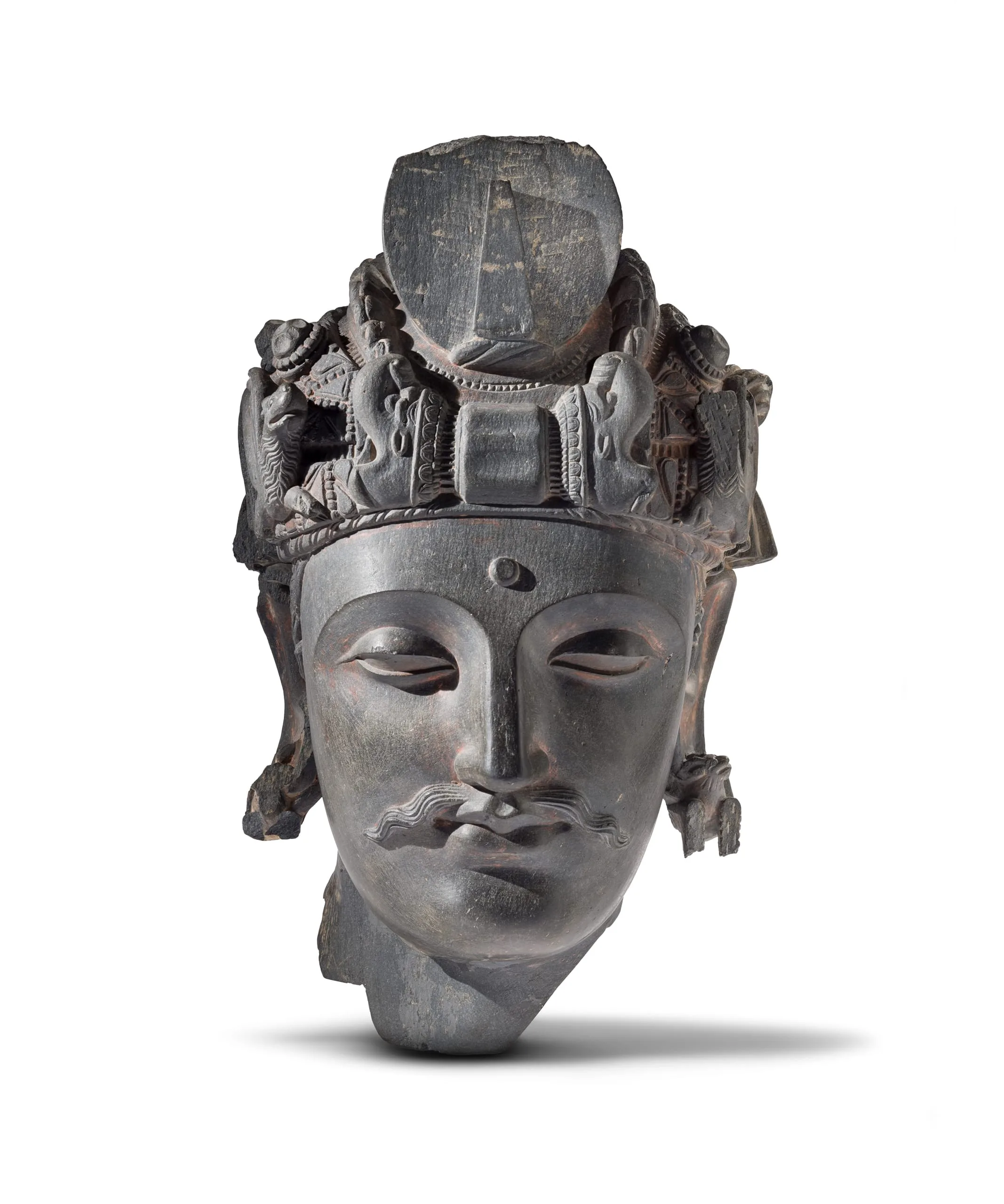
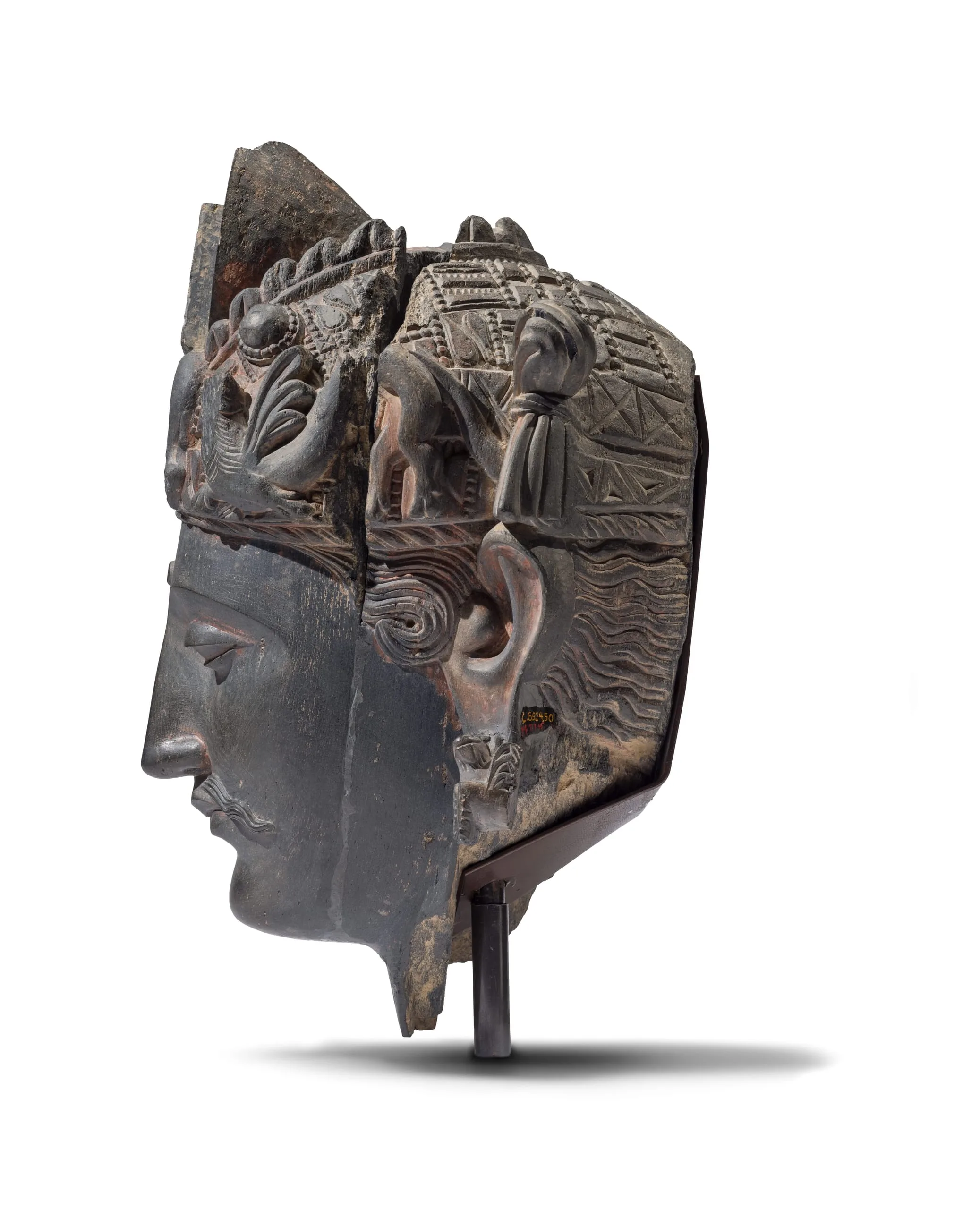
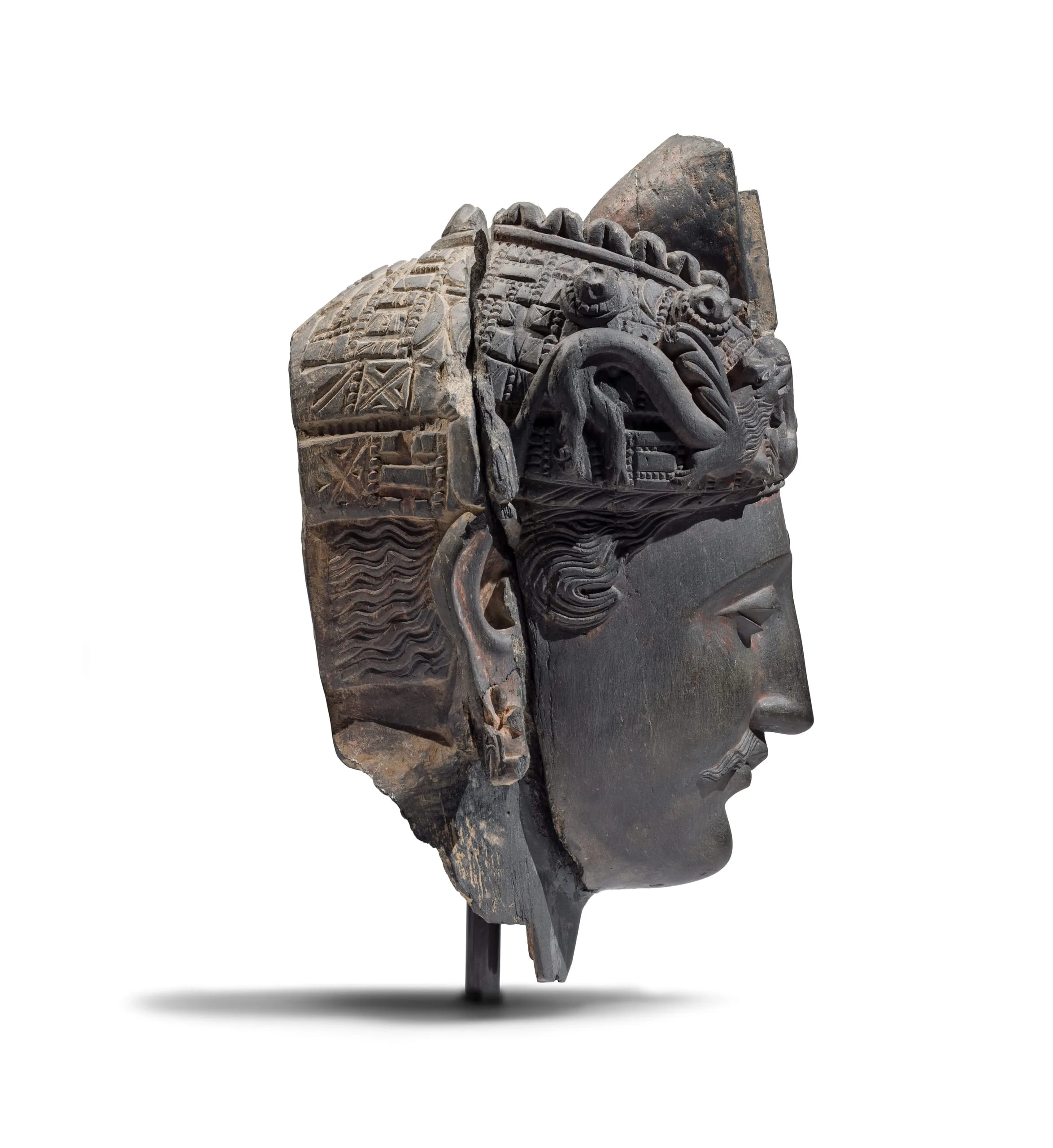
- Head of a Bodhisattva
- Date Made
- 2nd-3rd century
- Medium
- Gray schist with traces of red devotional paint
- Dimensions
- 18 1/2 x 11 1/4 x 11 3/4 in. (46.99 x 28.58 x 29.85 cm)
- Accession Number
- M.71.1.45
- Curatorial Notes
A Bodhisattva is an awakened person who voluntarily delays their attainment of final enlightenment (mahaparinirvana) out of compassion to help all sentient beings avoid suffering. Contrary to representations of the Buddha, who is depicted in simple monastic garb without jewelry, bodhisattvas are portrayed as noblemen or noble women wearing copious amounts of heavy gold jewelry and a lower garment and upper scarf worn around his shoulders with drapery folds derived from Greco-Roman clothing conventions.
This over life-size Bodhisattva head wears an elaborate turban replicating contemporary printed textiles and festooned with gemstones and gold jewelry. Across his forehead is a bifurcated pendant in the form of a mythical aquatic creature (makara). Around the sides of his head the pendant morphs into winged lions or griffins with elongated arched bodies. The turban is crested with an unadorned flat oval with a tapering tenon in the center that was used to affix a separate medallion with a small identifying attribute, such as a seated Buddha for the bodhisattva of compassion, Avalokiteshvara, or a stupa (funerary monument) for the future Buddha, Maitreya. The head features a mustache, characteristic of most Gandharan bodhisattvas. Between his eyes is a raised circle called an urna that is a sacred marking signifying the bodhisattva’s eminence and enlightenment.
- Selected Bibliography
- Pal, Pratapaditya. Indian Sculpture, vol.1. Los Angeles: Los Angeles County Museum of Art; University of California Press, 1986.
- Rosenfield, John. The Arts of India and Nepal: The Nasli and Alice Heeramaneck Collection. Boston: Museum of Fine Arts, Boston, 1966.
- Little, Stephen, Tushara Bindu Gude, Karina Romero Blanco, Silvia Seligson, Marco Antonio Karam. Las Huellas de Buda. Ciudad de México : Instituto Nacional de Antropología e Historia, 2018.
- Little, Stephen, and Tushara Bindu Gude. Realms of the Dharma: Buddhist Art across Asia. Los Angeles: Los Angeles County Museum of Art, 2025.