Maurice Brazil Prendergast was a formative figure in American modernism whose art was shaped in important ways by his sustained engagement with Europe. Over the course of his career, he traveled there multiple times, encountering artists and traditions that left clear marks on his practice, from Vittore Carpaccio to Édouard Vuillard and Aubrey Beardsley. Initially trained and employed as a commercial artist, Prendergast first went to England in the 1880s and later studied in Paris between 1891 and 1894. A return to France in 1907 proved especially consequential, exposing him to the work of Paul Cézanne, Henri Matisse, and the Fauves. After this trip, a marked shift appeared in both his watercolors and oils, as his compositions became more structurally daring and his color more animated and experimental.
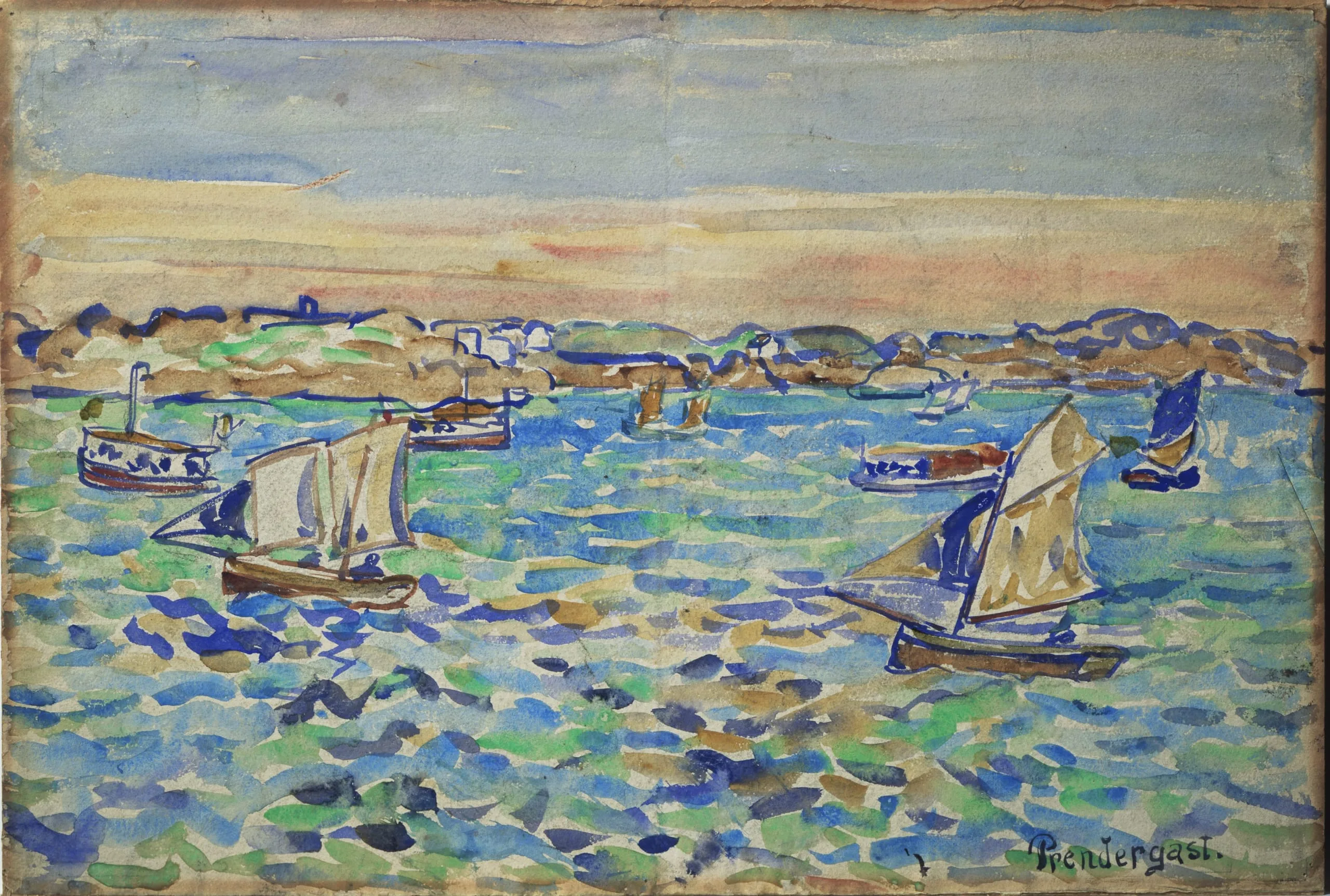
Sea and Boats likely depicts Saint-Malo, the resort town in Brittany that Prendergast visited in 1907. The watercolor takes up a familiar Impressionist subject—boats just offshore along a lively shoreline—but treats it in a distinctly Postimpressionist manner. Rather than dissolve the scene into atmosphere, Prendergast built it through energetic, individualized strokes of bright color. The result is both decorative and dynamic, with forms held in a delicate balance between observation and pattern. The sea, boats, and shore become less a topographical record than a rhythmic field of color and movement.
The work belongs to a pivotal moment in Prendergast’s development. It exemplifies the increasingly vibrant, patterned handling that would come to define his mature style. Throughout his career, Prendergast returned to scenes of public leisure—parks, beaches, promenades, and city streets—often filling them with crowds whose movement animates the entire surface of the picture. In Sea and Boats, even without the dense figurative activity of some of his later compositions, that same sense of visual vitality is already present. The watercolor pulses with the flicker of light, shifting color, and the shared energy of people and place.
Prendergast’s importance within American modernism was confirmed during his lifetime through his participation in two key exhibitions: The Eight in 1908 and the Armory Show in 1913. Yet his work remains distinctive within that history. He drew from European modernism while maintaining a highly personal idiom, one that joined watercolor’s immediacy with an increasingly decorative, architectonic sense of composition.
The watercolor entered LACMA through the generosity of the Henry and Rose Pearlman Foundation. One of six gifts from the descendants of Henry and Rose Pearlman, it continues their long commitment to sharing major works of art with the public.