LACMA

ShopMembershipMyLACMATickets
LACMA
Los Angeles County Museum of Art
5905 Wilshire Blvd.
Los Angeles, CA 90036
info@lacma.org
(323) 857-6000
Sign up to receive emails
Subscribe
© Museum Associates 2025

Museum Hours

Monday

11 am–6 pm

Tuesday

11 am–6 pm

Wednesday

Closed

Thursday

11 am–6 pm

Friday

11 am–8 pm

Saturday

10 am–7 pm

Sunday

10 am–7 pm


  • About LACMA
  • Jobs
  • Building LACMA
  • Host An Event
  • Unframed
  • Press
  • FAQs
  • Log in to MyLACMA
  • Privacy Policy
© Museum Associates 2025
Collections

Unknown
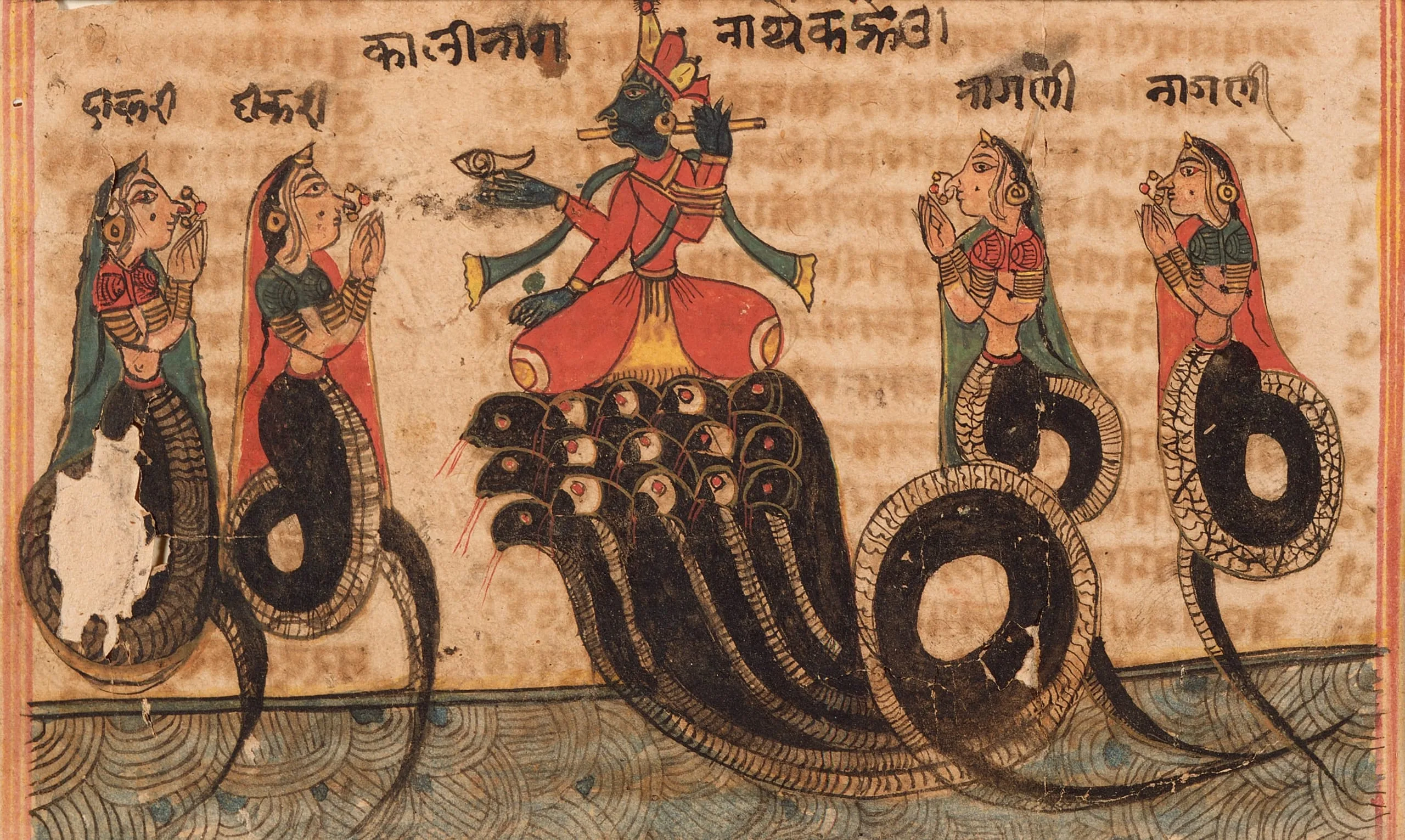
Krishna Quelling the Serpent King Kaliya (recto), Text (verso), Folio from a Bhagavata Purana (Ancient Stories of the Lord)1718

Not on view
Illustrated manuscript page with Devanagari script, depicting a blue-skinned figure dancing on a multi-headed black serpent, flanked by four female serpent figures with hands pressed together
Artist or Maker
Unknown
Title
Krishna Quelling the Serpent King Kaliya (recto), Text (verso), Folio from a Bhagavata Purana (Ancient Stories of the Lord)
Place Made
India, Rajasthan, Marwar
Date Made
1718
Medium
Opaque watercolor and ink on paper
Dimensions
Sheet: 5 1/4 x 9 in. (13.34 x 22.86 cm); Image: 4 5/8 x 7 in. (11.75 x 17.78 cm)
Credit Line
From the Nasli and Alice Heeramaneck Collection, Museum Associates Purchase
Accession Number
M.71.1.23
Classification
Drawings
Collecting Area
South and Southeast Asian Art
Curatorial Notes

The Bhagavata Purana (Ancient Stories of the Lord) is traditionally ascribed to the legendary poet-sage Vyasa in the 8th-10th century CE. It stresses the path of devotion (bhakti) to Krishna, the eighth incarnation of Vishnu, the Hindu God of Preservation. To fulfill his role as the guardian of the world, Vishnu manifests as a succession of heroic animals and semi-mortal saviors, called avatars.

This folio is from a dispersed Bhagavata Purana dated 1718 (samvat 1775). The recto illustration depicts Krishna quelling the Serpent King Kaliya (here labeled as Kali Nag), who was terrorizing villagers living by the Yamuna River in Vrindavan, Uttar Pradesh. In his previous life, Kaliya had been the sage Vedshira, but because of his hostility and envy he had been cursed by the sage Ashvashira to be reborn as a thousand-headed poisonous snake. According to the legend, Kaliya’s poison had contaminated the water of the Yamuna. When Krishna dove into the river, Kaliya entrapped him in his coils to kill him. But Krishna expanded his body to force Kaliya to release him. Then Krishna danced on his serpent hoods until Kaliya vomited blood. When Kaliya’s wives (nagapatnis) beseeched Krishna to spare their husband, Krishna forgave Kaliya after he promised to leave the Yamuna and never harm anyone again (Bhagavata Purana 10:16).

Folios from a comparable folkish Marwari series attributed to 1725 are in the Metropolitan Museum of Art, New York (1979.12.3 and 1979.12.4).
Selected Bibliography
  • Rosenfield, John. The Arts of India and Nepal: The Nasli and Alice Heeramaneck Collection. Boston: Museum of Fine Arts, Boston, 1966.