LACMA

ShopMembershipMyLACMATickets
LACMA
Los Angeles County Museum of Art
5905 Wilshire Blvd.
Los Angeles, CA 90036
info@lacma.org
(323) 857-6000
Sign up to receive emails
Subscribe
© Museum Associates 2025

Museum Hours

Monday

11 am–6 pm

Tuesday

11 am–6 pm

Wednesday

Closed

Thursday

11 am–6 pm

Friday

11 am–8 pm

Saturday

10 am–7 pm

Sunday

10 am–7 pm


  • About LACMA
  • Jobs
  • Building LACMA
  • Host An Event
  • Unframed
  • Press
  • FAQs
  • Log in to MyLACMA
  • Privacy Policy
© Museum Associates 2025
Collections

Unknown
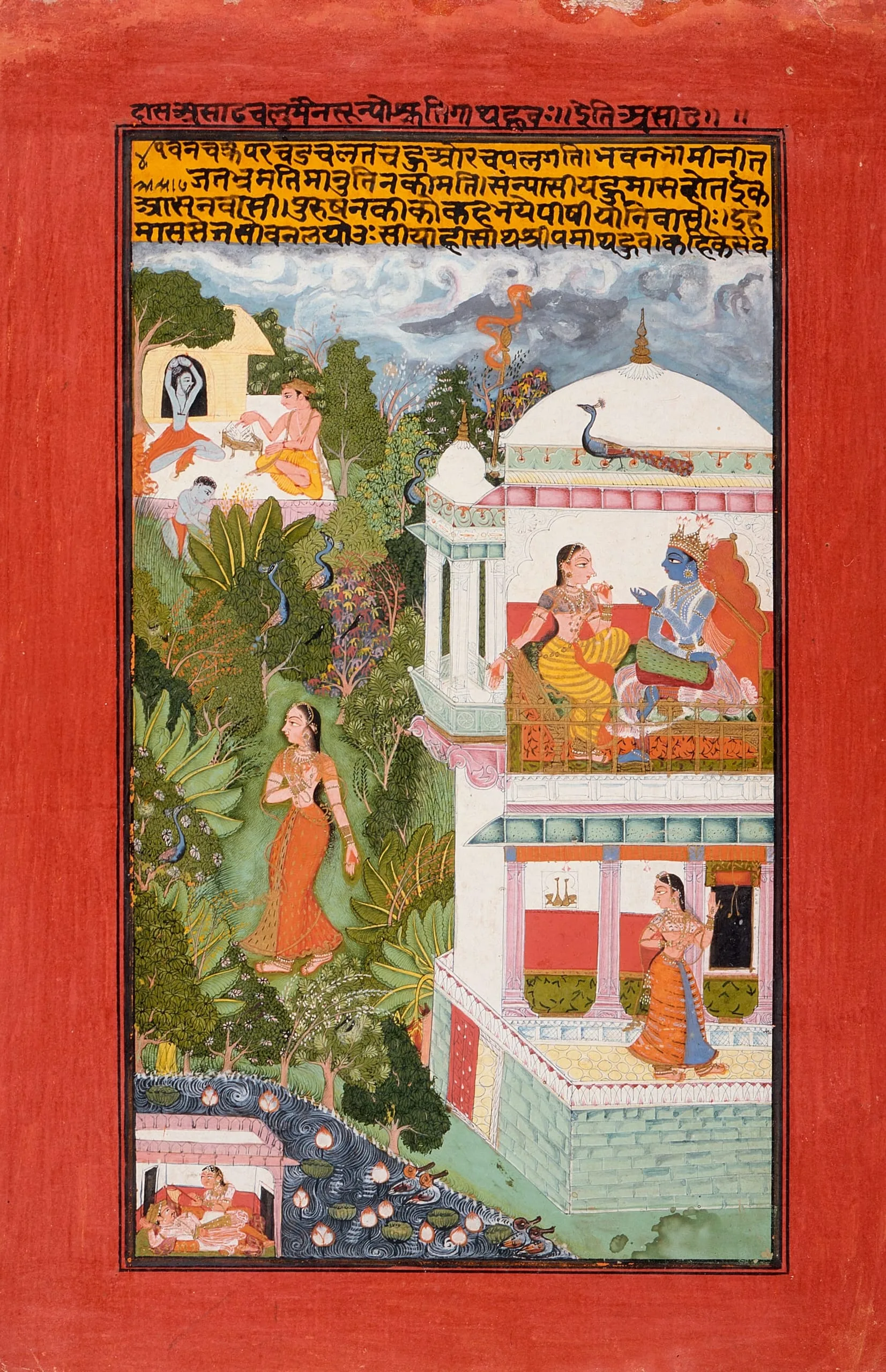
The Month of Ashadha (June-July), Folio from a Barahmasa (The Twelve Months)circa 1700-1725

Not on view
Indian miniature painting with multiple figures in a lush garden and domed architectural setting, with Devanagari script above and below the scene, in a coral-red border
Artist or Maker
Unknown
Title
The Month of Ashadha (June-July), Folio from a Barahmasa (The Twelve Months)
Place Made
India, Rajasthan, Kota
Date Made
circa 1700-1725
Medium
Opaque watercolor, gold, and ink on paper
Dimensions
Sheet: 8 1/2 x 12 1/2 in. (21.59 x 31.75 cm); Image: 5 3/4 x 9 1/4 in. (14.61 x 23.5 cm)
Credit Line
From the Nasli and Alice Heeramaneck Collection, Museum Associates Purchase
Accession Number
M.71.1.26
Classification
Drawings
Collecting Area
South and Southeast Asian Art
Curatorial Notes

The Barahmasa (The Twelve Months) is a collection of poems adapted from India’s vast oral traditions that describe the months of the year and their correlating climates and emotional states. The most popular text for painters to illustrate was the Kavipriya (Poet’s Delight) composed in 1601 in Braj-Bhasa by the poet Keshavdas (1555–1617) of the Orchha court. Chapter 10 of the Kavipriya describes the activities of people and animals in each of the twelve lunar months.

This painting illustrates the month of Ashadha (June-July), as described in the inscribed verses of the Kavipriya:
Strong winds are blowing all around. In such weather only a man of feeble mind will go out leaving his wife and house. Even the mendicants use only one asana [yogic position], i.e. they avoid going out for begging. What to talk of human beings, even the birds do not leave their nests. Lord Vishnu has taken Shri (Lakshmi) along with him to spend this time in bed. Poet Keshavdas says that during the month of Ashada, he has not heard anybody leaving his home, even in the Vedas and Gathas (ballads).
(Translation by V. P. Dwivedi.)

In a pavilion, Radha implores Krishna not to go out in the fierce storm. A woman strolls in the lush forest. Another is on the verandah. An ascetic sits in a yogic position beside a princely visitor. In the small pavilion, a prince reclines while being fanned.

See its series mate M.71.1.25. A comparable illustration attributed to Kota, circa 1720, is in the Municipal Museum, Allahabad.
Selected Bibliography
  • Rosenfield, John. The Arts of India and Nepal: The Nasli and Alice Heeramaneck Collection. Boston: Museum of Fine Arts, Boston, 1966.
  • Trabold, J. The Art of India, An Historical Profile. Northridge, CA: California State University Press, 1975.