- Title
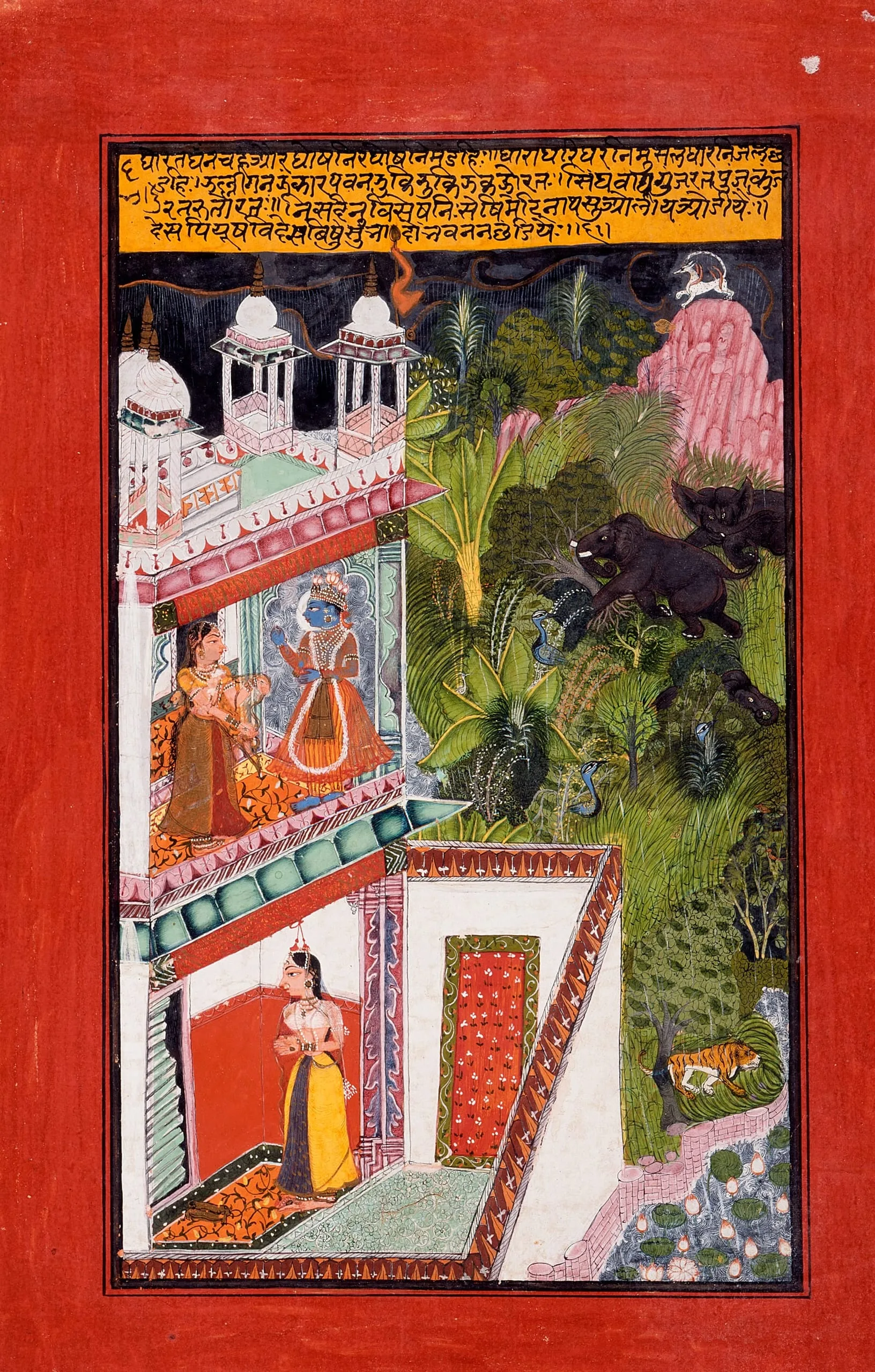
- The Month of Bhadon (August-September), Folio from a Barahmasa (The Twelve Months)
- Date Made
- circa 1700-1725
- Medium
- Opaque watercolor, gold, and ink on paper
- Dimensions
- Sheet: 12 3/4 x 8 1/2 in. (32.39 x 21.59 cm); Image: 9 1/8 x 5 3/4 in. (23.18 x 14.61 cm)
- Accession Number
- M.71.1.25
- Curatorial Notes
The Barahmasa (The Twelve Months) is a collection of poems adapted from India’s vast oral traditions that describe the months of the year and their correlating climates and emotional states. The most popular text for painters to illustrate was the Kavipriya (Poet’s Delight) composed in 1601 in Braj-Bhasa by the poet Keshavdas (1555–1617) of the Orchha court. Chapter 10 of the Kavipriya describes the activities of people and animals in each of the twelve lunar months.
This painting illustrates the month of Bhadon (August-September), as described in the inscribed verses of the Kavipriya:
The dark clouds have gathered all around and are thundering loudly. The rain is pouring in torrents. The cicadas are chirping continuously and strong wind is blowing fiercely. Tigers and lions are roaring and herds of elephants are breaking trees. There is no longer any difference between day and night (because of the constantly clouded in the sky). One’s own home is like nectar and outside is like poison. The poet is of the opinion that one should not leave his home during this month.
(Translation by V. P. Dwivedi.)
In the second story of an elaborate pavilion, Radha is entreating Krishna to stay home during the fierce storm. Below, a woman enters the verandah. In the lush landscape abounding with peacocks, a rampaging elephant tears down a tree with an agitated elephant nearby. A tiger prowls near the fortress walls. A griffin stands on a mountaintop.
See its series mate M.71.1.26.
- Selected Bibliography
- Pal, Pratapaditya. Elephants and Ivories in South Asia. Los Angeles: Los Angeles County Museum of Art, 1981.
- Rosenfield, John. The Arts of India and Nepal: The Nasli and Alice Heeramaneck Collection. Boston: Museum of Fine Arts, Boston, 1966.