LACMA

ShopMembershipMyLACMATickets
LACMA
Los Angeles County Museum of Art
5905 Wilshire Blvd.
Los Angeles, CA 90036
info@lacma.org
(323) 857-6000
Sign up to receive emails
Subscribe
© Museum Associates 2025

Museum Hours

Monday

11 am–6 pm

Tuesday

11 am–6 pm

Wednesday

Closed

Thursday

11 am–6 pm

Friday

11 am–8 pm

Saturday

10 am–7 pm

Sunday

10 am–7 pm


  • About LACMA
  • Jobs
  • Building LACMA
  • Host An Event
  • Unframed
  • Press
  • FAQs
  • Log in to MyLACMA
  • Privacy Policy
© Museum Associates 2025
Collections

Sita Ram
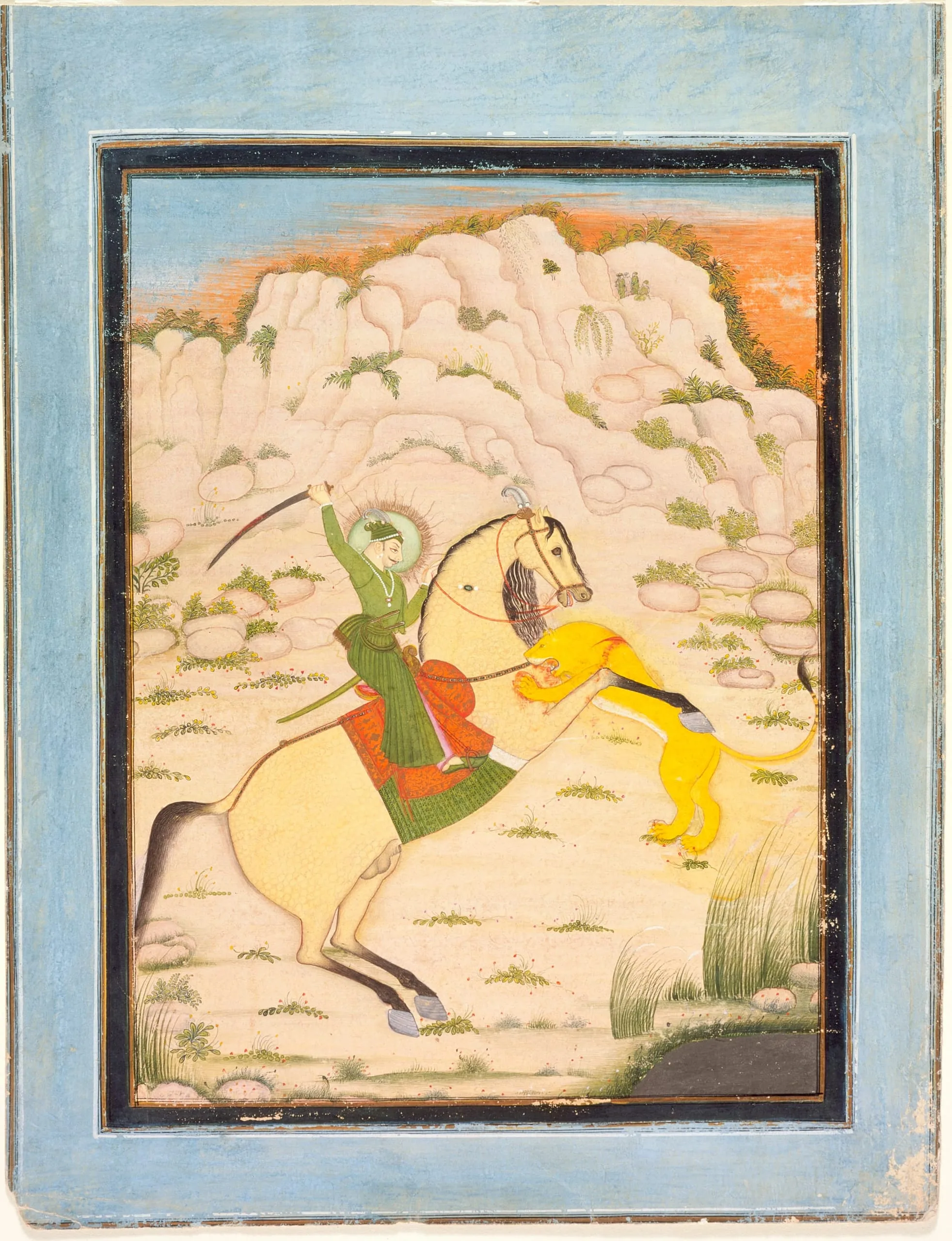
Maharaja Pratap Singh of Rupnagar Killing a Lioncirca 1790-1800

Not on view
South Asian miniature painting of a turbaned rider on a rearing cream horse raising a curved sword over a crouching yellow lion, set against white rocky cliffs and an orange sky
Artist or Maker
Sita Ram
India, active circa 1730-1814
Title
Maharaja Pratap Singh of Rupnagar Killing a Lion
Place Made
India, Rajasthan, Kishangarh
Date Made
circa 1790-1800
Medium
Opaque watercolor, gold, and silver on paper
Dimensions
Image: 9 7/8 x 7 3/8 in. (25.08 x 18.73 cm); Sheet: 13 x 10 in. (33.02 x 25.4 cm)
Credit Line
From the Nasli and Alice Heeramaneck Collection, Museum Associates Purchase
Accession Number
M.71.1.28
Classification
Drawings
Collecting Area
South and Southeast Asian Art
Curatorial Notes
Maharaja Pratap Singh (regnal dates unknown) was the ruler of the fiefdom of Rupnagar near Mewar, Rajasthan. During a visit to the kingdom of Kishangarh, Rajasthan, he killed a lion single-handedly on horseback with a sword. Later his heroic feat was celebrated in this painting by the Kishangarh court artist Sita Ram (active circa 1730-1814). A long inscription on the reverse not only identifies the subject and the artist but also provides a poetic description of the hunt and valor of the prince. The prose part tells us how Pratap Singh of Rupnagar engaged a lion while visiting Kishangarh and this picture was painted by Sita Ram. The poem sings the heroic qualities of the royal hunter and compares him with the Hindu god of destruction, Shiva, and his sword to Shiva's wife, Bhavani (Parvati). Little is known about the life of Pratap Singh. A comparable Kishangarh inscribed portrait of “Maharaja Pratap Singh Bahadur, Raja of Rupnagar” hawking, attributed to 1790-1795, was sold at Sotheby’s London, October 2010 (Arts of the Islamic World, sale # L10223, lot 83).
The Rupnagar rulers were descended from the powerful Solanki dynasty of Gujarat and Rajasthan (circa 940-1244) and shared a common ancestor with another Mewar fiefdom, Badnor (see AC1998.52.1 and AC1998.52.2). Rupnagar Fort guarded an important mountain pass between Mewar and Marwar. Due to its strategic location, its rulers were among the most trustworthy and valiant of the Maharana of Mewar's subjects.
Selected Bibliography
  • Rosenfield, John. The Arts of India and Nepal: The Nasli and Alice Heeramaneck Collection. Boston: Museum of Fine Arts, Boston, 1966.
  • Trabold, J. The Art of India, An Historical Profile. Northridge, CA: California State University Press, 1975.