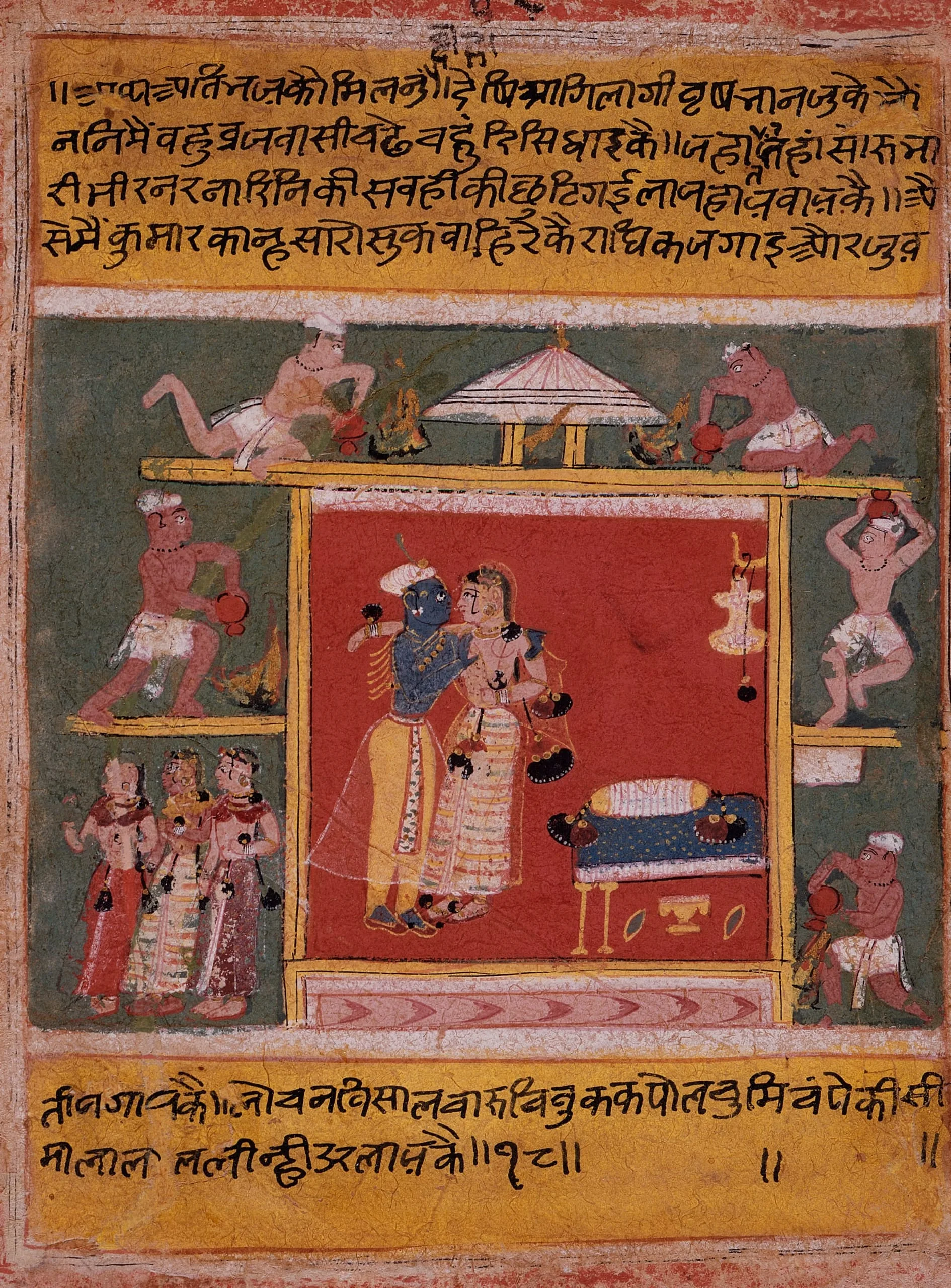
The Rasikapriya (Connoisseur’s Delights) was composed in 1591 in Braj-Bhasa by the poet Keshavdas (1555–1617). The text portrays Radha and Krishna as archetypal male and female lovers (nayakas/nayikas) and their corresponding emotions and encounters.
This folio illustrates the inscribed verses, “Meeting at the Time of the Fearful Event” (Bhayako Milana) (Rasikapriya 5:147):
Hearing that fire had broken out
In Vrishabhanu’s house, all Braja poured in;
From all sides men did throng and shout,
And fear threw all shame to the winds.
When parrot and starling he had moved,
And woken the other maids - then Krishna
At last near slumbering Radha stood,
And kissed her lovely eyes and chin,
And quivering breasts; and clasped her close
As champa flowers in garland stringed -
Thus that fair maiden he awoke!
(Translation by K. P. Bahadur.)
Additional folios from this dispersed series are in the Brooklyn Museum (42.407 and 86.227.51), Cleveland Museum of Art (1938.303 and 2018.124), Metropolitan Museum of Art, New York (51.58), National Gallery of Canada, Ottawa (23605v), National Museum, New Delhi (49.19/24), National Museum of Asian Art, Washington (F1935.2), Philadelphia Museum of Art (1947-49-2b), Salar Jung Museum, Hyderabad (77-21), and Victoria and Albert Museum, London (IS.26.1958 and IS.86.1958).
For an alternate translation by V. P. Mishra, see Harsha V. Dehejia, Rasikapriya: Ritikavya of Keshavdas in Ateleirs of Love (New Delhi: D.K. Printworld, 2013), pp. 71, 196, verse and fig. 5.31.