LACMA

ShopMembershipMyLACMATickets
LACMA
Los Angeles County Museum of Art
5905 Wilshire Blvd.
Los Angeles, CA 90036
info@lacma.org
(323) 857-6000
Sign up to receive emails
Subscribe
© Museum Associates 2025

Museum Hours

Monday

11 am–6 pm

Tuesday

11 am–6 pm

Wednesday

Closed

Thursday

11 am–6 pm

Friday

11 am–8 pm

Saturday

10 am–7 pm

Sunday

10 am–7 pm


  • About LACMA
  • Jobs
  • Building LACMA
  • Host An Event
  • Unframed
  • Press
  • FAQs
  • Log in to MyLACMA
  • Privacy Policy
© Museum Associates 2025
Collections

Unknown
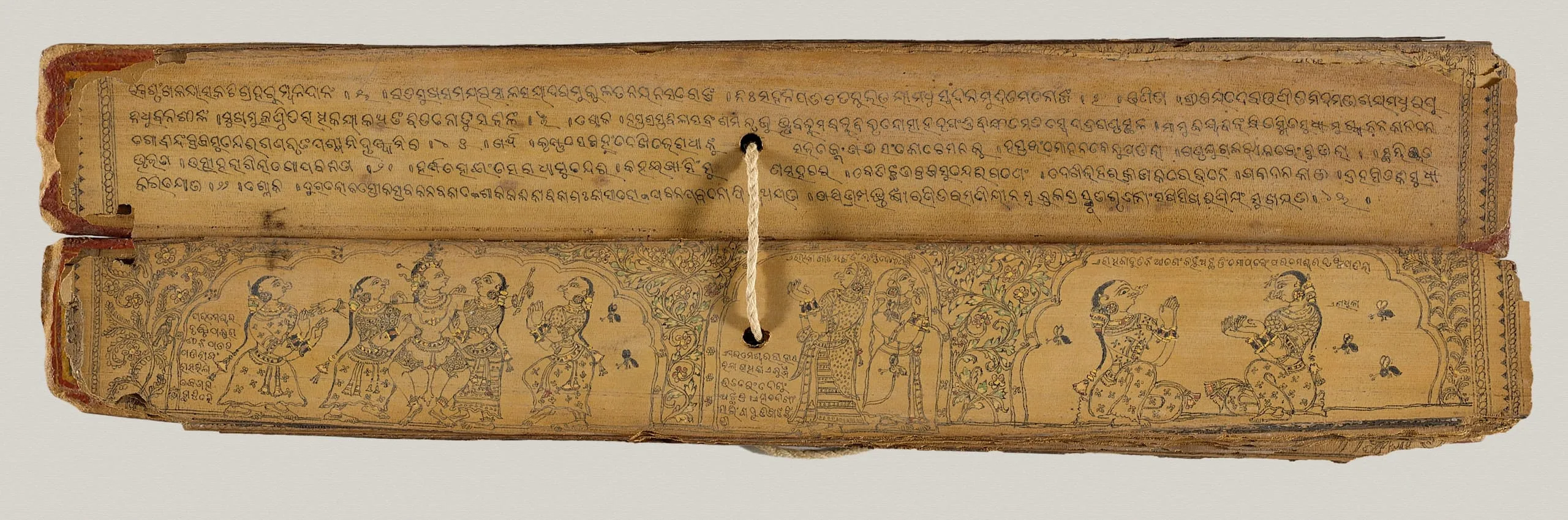
Gita Govinda (Song of the Cowherd) Manuscriptearly 18th century

Not on view
Horizontal palm-leaf manuscript with two boards visible, the lower one illustrated with figures, trees, and architectural elements in fine ink lines, with text in an Indic script
Artist or Maker
Unknown
Title
Gita Govinda (Song of the Cowherd) Manuscript
Place Made
India, Odisha (Orissa)
Date Made
early 18th century
Medium
Ink and pigment on palm leaf; wood covers with paint
Dimensions
Pages: 1 3/4 x 12 3/4 in. (4.44 x 32.38 cm) each; Cover: 1 3/4 x 13 in. (4.44 x 33.02 cm)
Credit Line
From the Nasli and Alice Heeramaneck Collection, Museum Associates Purchase
Accession Number
M.71.1.33.1-.34
Classification
Manuscripts
Collecting Area
South and Southeast Asian Art
Curatorial Notes

The Gita Govinda (Song of the Cowherd) was composed by the Sanskrit poet Jayadeva (eastern India, circa 1170-1245). The celebrated poem marks the debut of Krishna’s paramour Radha. Previously, she was known only from sporadic literary and epigraphical references beginning in the 7th century. She is absent from the major early texts in which the life of Krishna is related: the Harivamsha (Lineage of Hari [Vishnu]), 1st century; Vishnu Purana (Ancient Stories of Vishnu), circa 450; and Bhagavata Purana (Ancient Stories of the Lord), 8th-10th century. It describes the initial passion of Radha and Krishna, their temporary estrangement over Radha's jealousy of Krishna sharing his love with other gopis (cow-herdswomen), and their ecstatic reconciliation in Krishna's nocturnal bower of delight.

The traditional technique for Odishan palm-leaf manuscripts is to incise and blacken the text and illustrations on sections of dried palm leaves, then fill in the designs with light color washes of black, red, yellow, and green. In the folio illustrated here, in the cartouche on the left Krishna is dancing with two gopis while two more women keep time with their hands. In the center cartouche, two woman stand back-to-back. In the cartouche on the right, two seated women are discoursing. Bees float in the outer cartouche scenes.
Selected Bibliography
  • Rosenfield, John. The Arts of India and Nepal: The Nasli and Alice Heeramaneck Collection. Boston: Museum of Fine Arts, Boston, 1966.
  • Anderson, D. The Aesthetics of Calligraphy. Los Angeles: University of Southern California, 1977.