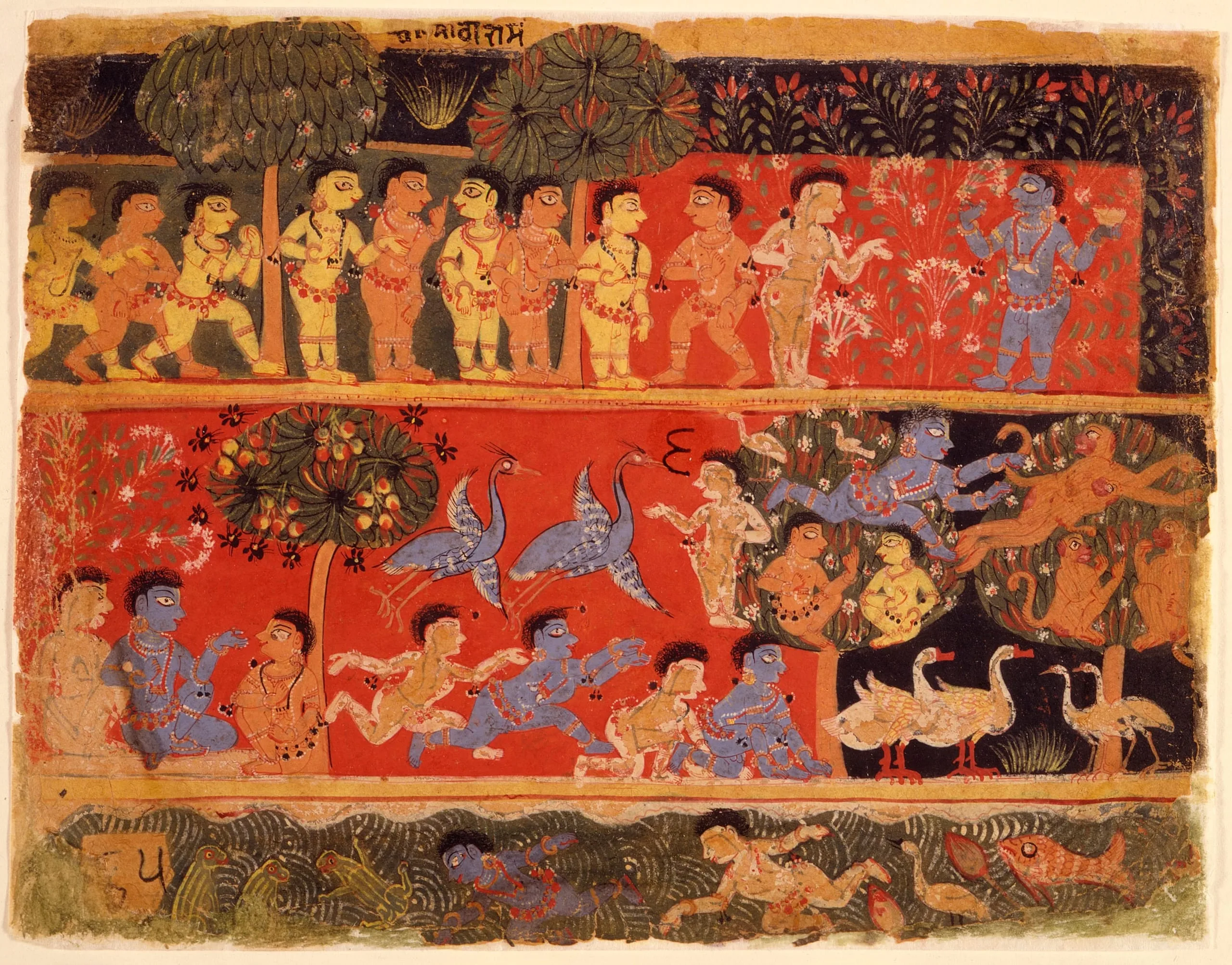
The Bhagavata Purana (Ancient Stories of the Lord) is traditionally ascribed to the legendary poet-sage Vyasa in the 8th-10th century CE. It stresses the path of devotion (bhakti) to Krishna, the eighth incarnation of Vishnu, the Hindu God of Preservation. Vishnu appears in times of crisis as a succession of heroic animals and semi-mortal saviors, called avatars.
This folio is from the “Palam” Bhagavata Purana, so named after the suburb of Delhi reportedly listed in an owner’s colophon. Now widely dispersed, it originally consisted of about 300 folios, of which some 200 survive. Sanskrit text is on the reverse. Inscribed with the owner’s name, Sa Mitharam. Here, Krishna and Balarama frolic with cowherds (gopas) in Vrindavan. Krishna and Balarama pluck flowers (upper register), Krishna and Balarama chase birds and monkeys (middle register), and Krishna and Balarama swim in a river (lower register).
See its series mates M.71.1.8, M.72.1.26, and M.91.69. Additional folios are in the Bharat Kala Bhavan, Varanasi (10663), British Museum, London (1958,1011,0.4), Brooklyn Museum (80.41), Cleveland Museum of Art (1960.53 and 1971.171), Fralin Museum of Art, Charlottesville (1999.20), Museum Rietberg, Zurich (RVI 907, 915, 1870, and 1912), National Museum, New Delhi (63.1598), National Museum of Asian Art, Washington (F1966.32), Philadelphia Museum of Art (2004-149-8), San Diego Museum of Art (1990.581), Santa Barbara Museum of Art (2019.36.8), Victoria and Albert Museum, London (IS.1-1977), and Virginia Museum of Fine Arts, Richmond (64.36.1).