LACMA

ShopMembershipMyLACMATickets
LACMA
Los Angeles County Museum of Art
5905 Wilshire Blvd.
Los Angeles, CA 90036
info@lacma.org
(323) 857-6000
Sign up to receive emails
Subscribe
© Museum Associates 2025

Museum Hours

Monday

11 am–6 pm

Tuesday

11 am–6 pm

Wednesday

Closed

Thursday

11 am–6 pm

Friday

11 am–8 pm

Saturday

10 am–7 pm

Sunday

10 am–7 pm


  • About LACMA
  • Jobs
  • Building LACMA
  • Host An Event
  • Unframed
  • Press
  • FAQs
  • Log in to MyLACMA
  • Privacy Policy
© Museum Associates 2025
Collections

Unknown
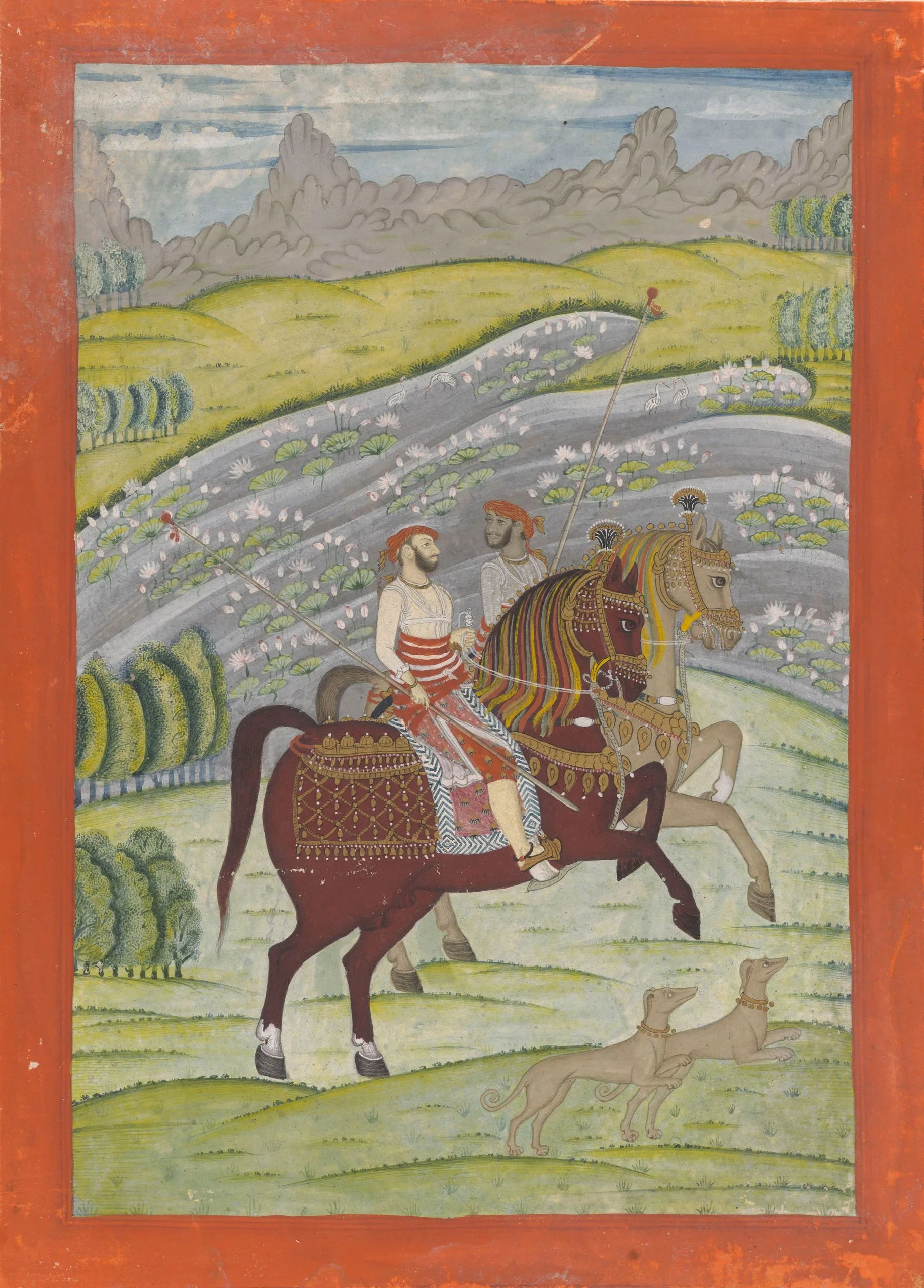
Rao Shatrujit Singh of Datia (r. 1762-1801) Hunting with a Companioncirca 1775

Not on view
Indian miniature painting of two elaborately dressed riders on decorated horses crossing a hilly landscape, with two greyhounds running below
Artist or Maker
Unknown
Title
Rao Shatrujit Singh of Datia (r. 1762-1801) Hunting with a Companion
Place Made
India, Madhya Pradesh, Datia
Date Made
circa 1775
Medium
Opaque watercolor and gold on paper
Dimensions
Sheet (Sheet): 8 1/2 x 6 1/8 in. (21.59 x 15.5575 cm) Image (Image): 7 1/2 x 5 1/8 in. (19.05 x 13.0175 cm) Frame: 19 × 14 in. (48.26 × 35.56 cm)
Credit Line
From the Nasli and Alice Heeramaneck Collection, Museum Associates Purchase
Accession Number
M.71.1.17
Classification
Drawings
Collecting Area
South and Southeast Asian Art
Curatorial Notes
Rao Shatrujit Singh (r. 1762-1801), shown in profile, was the sixth ruler of Datia, a small kingdom in the Bundelkhand region of present-day Madhya Pradesh founded in 1626 by Rao Bhagwan Singh (r. 1626-1656). Datia was originally part of Orchha (founded in 1531) and came under British control with other central Indian princely states under the Treaty of Bassein in 1802. Shatrujit Singh was known as one of Datia’s most gallant rulers. He increased its territory and effectively repulsed external threats. In 1801 he fell in battle against the army of the Maratha leader, Daulat Rao Sindhia (1794-1827). In this painting, Shatrujit Singh sits astride his favorite horse, a chestnut stallion named Hayaraja ("king of horses"). He and his unknown companion each wear a distinctive central Indian flat turban. They each carry what appears to be a pole mace (gada) with a long annular pattern haft and red tassels. Shatrujit Singh is portrayed in the facial profile view traditionally used for Indian rulers, but his companion is shown with a three-quarter view face, which likely reflects perspectival assimilation from European artistic traditions introduced via the Mughals. The riders are accompanied by two saluki hunting dogs whose leaping postures mimic the galloping horses. Behind the figures is a lotus pond and mountainous landscape. A comparable portrait of Shatrujit Singh is in the Chazen Museum of Art, University of Wisconsin–Madison (2005.1.10).
Selected Bibliography
  • Rosenfield, John. The Arts of India and Nepal: The Nasli and Alice Heeramaneck Collection. Boston: Museum of Fine Arts, Boston, 1966.