- Title
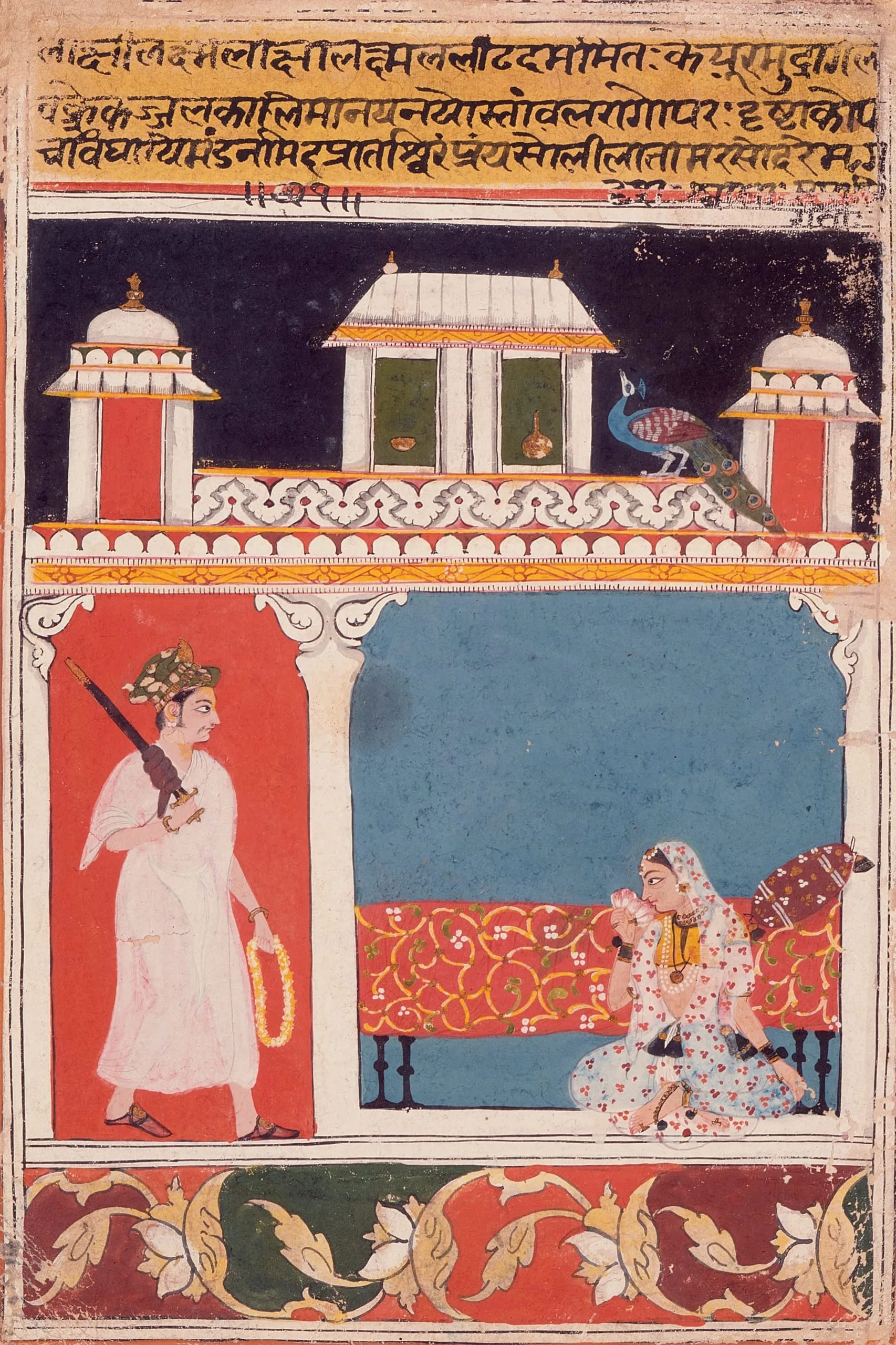
- Return of the Errant Lover, Folio from an Amaru Shataka (Hundred Stanzas of Amaru)
- Date Made
- circa 1650-1660
- Medium
- Opaque watercolor, gold, and ink on paper
- Dimensions
- 8 5/8 x 5 3/4 in. (21.91 x 14.61 cm)
- Accession Number
- M.71.1.16
- Curatorial Notes
Amaru was an 7th- or 8th-century Sanskrit poet who composed a hundred (shataka) verses about love and its various moods. The text verses corresponding to the folio’s imagery are inscribed in the header: “A mark of lac-dye on both sides of the forehead, the impress of the arm-band on the neck, the dark spots of collyrium on the face, the color of the betel standing pre-eminent on the eyes - after the gazelle-eyed one, in the early morning, had long looked at such anger-exciting ornaments of the lover, her sighs got smothered in the chalice of the lotus which she gaily sported in her hand.” (Amaru Shataka 71)
Here, the heroine sits in a bedchamber as the errant lover returns. See also its series mate AC1999.127.19. Additional folios from this dispersed series, which is distinguished by a meandering flowering vine along the bottom, are in the Asia Society Museum, New York (1979.58) and National Museum of Asian Art, Washington (F1934.16).
- Selected Bibliography
- Pal, Pratapaditya. Elephants and Ivories in South Asia. Los Angeles: Los Angeles County Museum of Art, 1981.
- Rosenfield, John. The Arts of India and Nepal: The Nasli and Alice Heeramaneck Collection. Boston: Museum of Fine Arts, Boston, 1966.