- Title
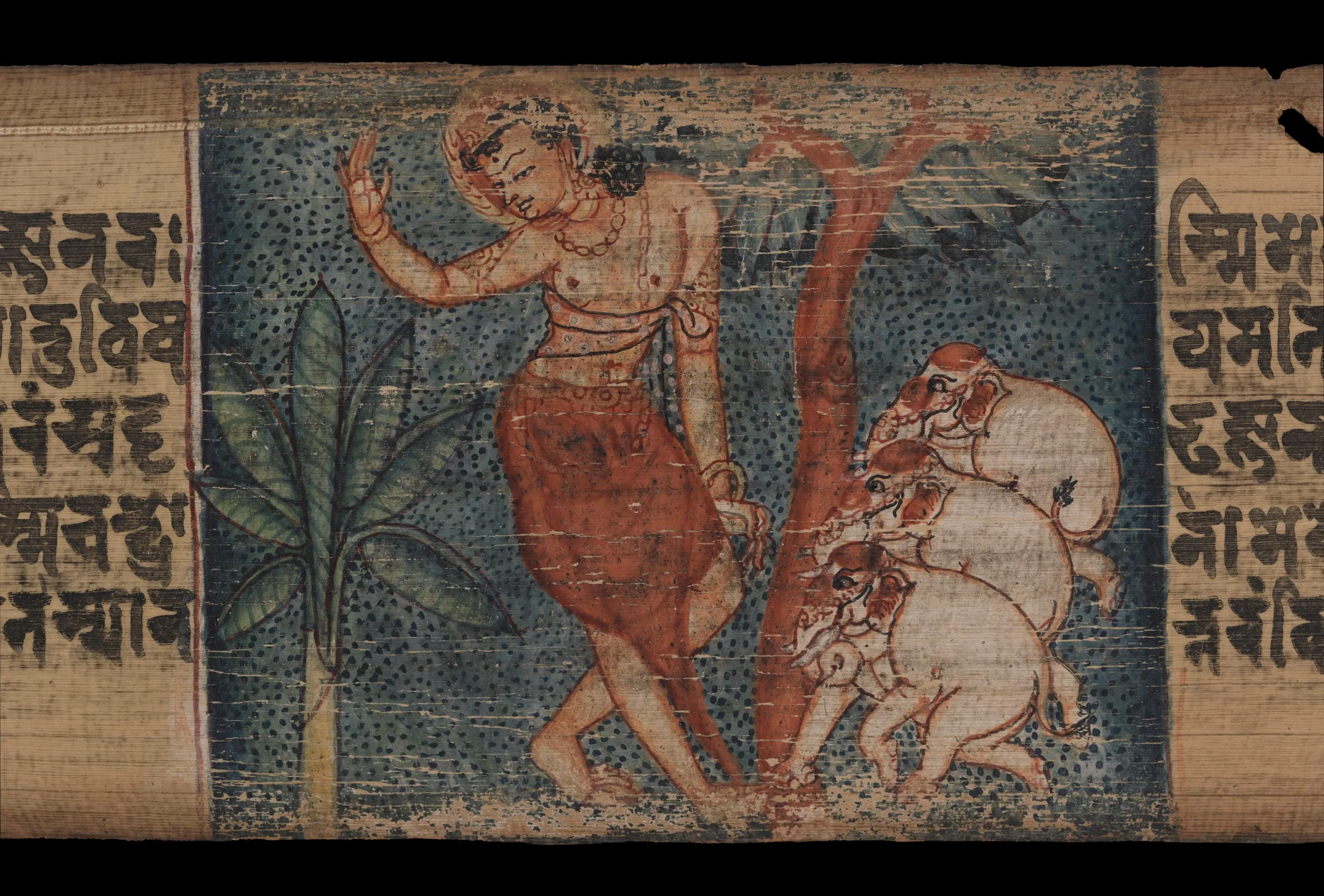
- Sudhana with Three Elephants (top), Folio from a Gandavyuha (The Structure of the World)
- Date Made
- circa 1150-1175
- Medium
- Opaque watercolor and ink on palm leaf
- Dimensions
- 2 1/2 x 21 3/4 in. (6.35 x 55.24 cm)
- Accession Number
- M.71.1.1a
- Curatorial Notes
The Gandavyuha (The Structure of the World), written in India in circa 200-300 CE, is a spiritual travelogue of the young prince Sudhana's pilgrimage in search of Enlightenment. It was one of the most important and popular texts of Mahayana Buddhism, though few illustrated examples have survived from South Asia. Illustrations from the text were also depicted on the reliefs of the renowned 8th-9th-century monument of Borobudur in central Java; in the main assembly hall of the mid-11th-century monastery of Tabo in western Tibet, a site associated with the important Tibetan teacher Rincen Zangpo (958-1055); and frequently in China and Japan. See also its series mates M.71.1b-f.
Folios a-c feature pointilistic dots in the background. Typical of paintings from the Kathmandu Valley, the tall, lithe figures are gracefully posed and the drawing is fine and elegant. Even though there is only minimal shading of some receding areas, the quality of line and juxtaposition of colors create an impression of three-dimensional space. A landscape setting for some of the scenes is indicated by the stylized rock form conventions also found in Nepalese sculpture (for example, see M.75.4.15, M.81.23, and M.2002.215).
- Selected Bibliography
- Pal, Pratapaditya. Art of Nepal. Los Angeles: Los Angeles County Museum of Art; University of California Press, 1985.
- Vajracharya, Gautama V. Watson Collection of Indian Miniatures at the Elvehjem Museum of Art: Detailed Study of Selected Works. Madison, WI: Elvehjem Museum of Art, University of Wisconsin , 2002.
- Anderson, D. The Aesthetics of Calligraphy. Los Angeles: University of Southern California, 1977.
- Kramrisch, Stella. The Art of Nepal. New York: The Asia House Inc., 1964.
- Rosenfield, John. The Arts of India and Nepal: The Nasli and Alice Heeramaneck Collection. Boston: Museum of Fine Arts, Boston, 1966.