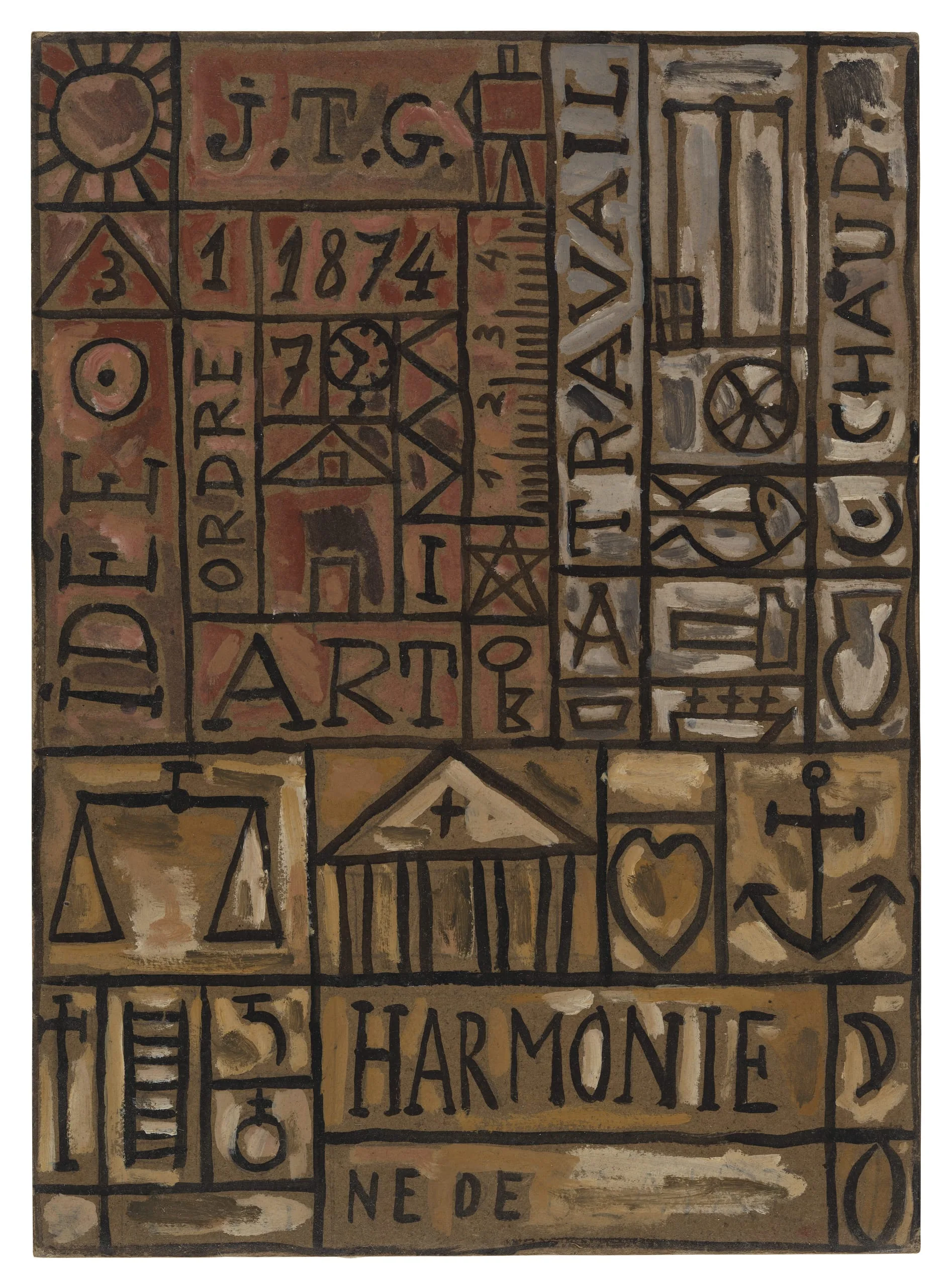
For artist, teacher, and theoretician Joaquín Torres-García, “Construction should be above all the creation of an order.” To that end, he invented a unique visual language that he called Universal Constructivism (Constructivismo Universal). Throughout his career, Torres-García was fascinated by the ability of ancient cultures to synthesize complex ideas in simple forms. He adapted mathematical traditions such as the golden section or golden ratio to create gridlike structures within which he arranged different symbols to emphasize the idea of universal harmony. His symbols corresponded to the three planes of life: intellectual, emotional, and physical.
Constructive Graphism in Three Colors is an early summation of Torres-García’s philosophy. Each of its three sections, populated with symbols from the three planes of existence, is distinguished by a different tonality. The left section refers to the creative and intellectual tools of the artist. Under his initials, Torres-García inscribed his birthdate alongside the words “idea,” “order,” and “art.” The sun, a symbol of masculine energy, refers to action; the triangle to rational thinking; the clock to modern life and to time as a tool of reason; and the five-pointed star and ruler to pentagonal symmetry and the golden section. The right section refers to the physical plane and includes symbols associated with the everyday world, such as the cosmic fish, the boat, the vase, and the hammer. The word travail (work) is a reference to pragmatism. The lower section alludes to the plane of human emotions, evolution, harmony, and growth as symbolized by the heart, the moon (female energy), the Greek temple with the cross (combining vertical and horizontal lines), the scale, and the ladder of progress.
Born in Uruguay, Torres-García settled in Barcelona in 1891, and much of his career developed in Europe, with a two-year interlude in New York from 1920 to 1922. In 1926, he moved to Paris, where he befriended Piet Mondrian (1872–1944) and Theo van Doesburg (1883–1931), and quickly became associated with an international group of avant-garde abstract artists. In 1929, alongside Jean Arp (1886–1966) and Wassily Kandinsky (1866–1944), he cofounded the group Cercle et Carré (Circle and Square). By 1930, Torres-García had begun integrating symbols into his abstract compositions, leading to his mature style. Torres-García returned to Montevideo in 1934, where he established different workshops to teach the younger generation the principles of Universal Constructivism with the aim of creating a new, local form of abstract art.
Ilona Katzew
2024