LACMA

ShopMembershipMyLACMATickets
LACMA
Los Angeles County Museum of Art
5905 Wilshire Blvd.
Los Angeles, CA 90036
info@lacma.org
(323) 857-6000
Sign up to receive emails
Subscribe
© Museum Associates 2025

Museum Hours

Monday

11 am–6 pm

Tuesday

11 am–6 pm

Wednesday

Closed

Thursday

11 am–6 pm

Friday

11 am–8 pm

Saturday

10 am–7 pm

Sunday

10 am–7 pm


  • About LACMA
  • Jobs
  • Building LACMA
  • Host An Event
  • Unframed
  • Press
  • FAQs
  • Log in to MyLACMA
  • Privacy Policy
© Museum Associates 2025
Collections

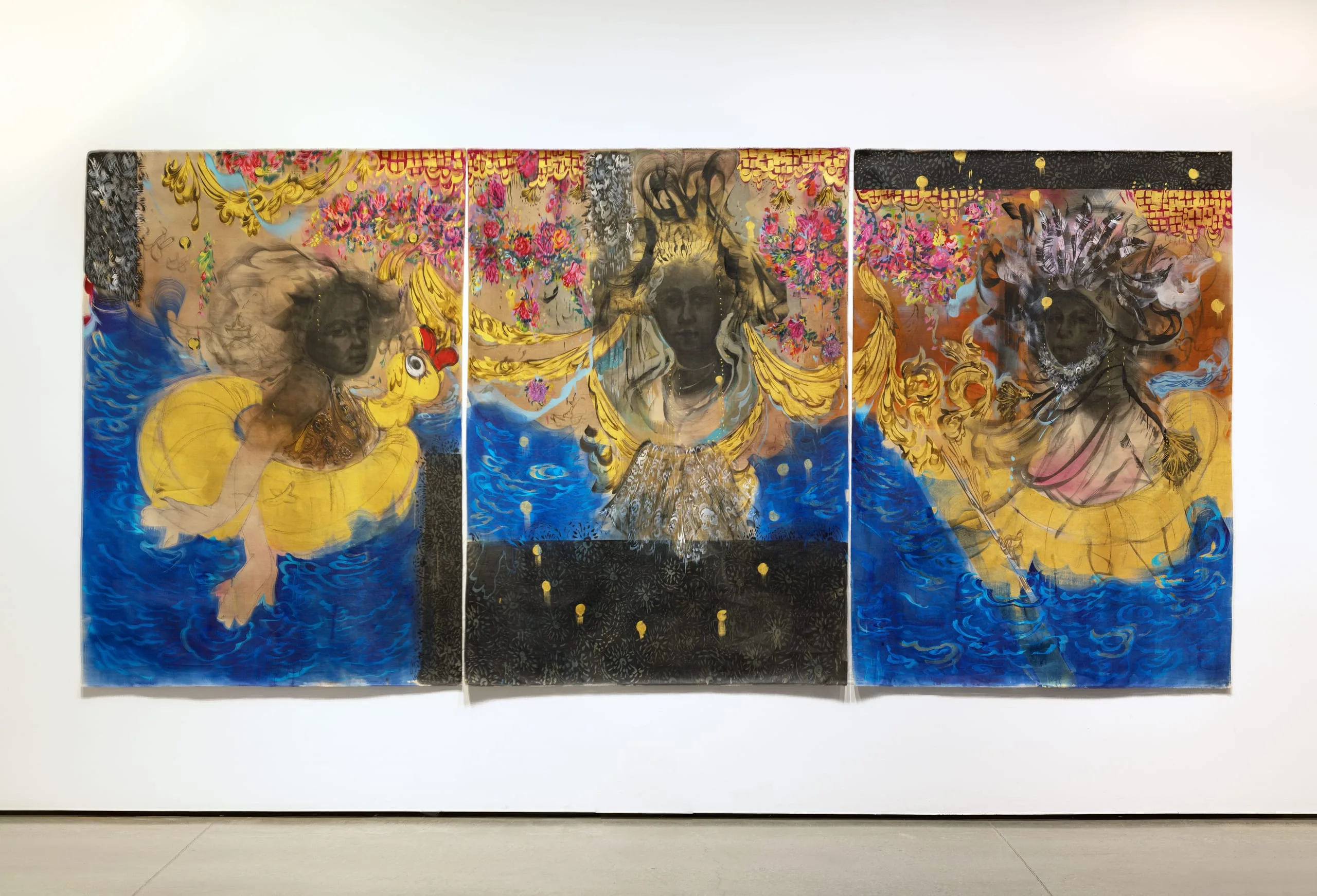
Scherezade García
Harvest of the Sea2023

On view:
Geffen Galleries, Earth and Water
Large-scale triptych painting on unstretched canvas, three dark-skinned figures emerging from blue water surrounded by gold baroque ornament and pink flowers
Artist or Maker
Scherezade García
Domican Republic, active United States, born 1966
Title
Harvest of the Sea
Date Made
2023
Medium
Acrylic, pigment, charcoal, ink on linen
Dimensions
82 1/2 × 162 in. (209.55 × 411.48 cm)
Credit Line
Purchased with funds provided by Contemporary@LACMA, 2023
Accession Number
M.2023.187
Classification
Paintings
Collecting Area
Latin American Art
Curatorial Notes

This monumental triptych is a brilliant summation of Scherezade García’s concerns with history, hybridity, migration, and memory. An interdisciplinary artist, García moved from the Dominican Republic to New York in 1986 to attend Parsons School of Design. Her dual identity as an islander has made her keenly aware of the role of the ocean to connect and divide people. Water becomes the stage of her exuberant, color-filled compositions, and a vector of the diasporic experience of her own community and beyond. This “liquid highway,” as the artist has described it, bridges people, their hopes, and their dreams. But the fluid medium has also enabled and hampered a long history of migration in the Americas—often violent and perilous—including the Transatlantic Slave Trade (which formally ceased in the nineteenth century) and in more recent times the sea journeys of countless Caribbean islanders to the United States in search of a better life. “I see water as an obstacle which we need to navigate and cross, as a mass of water that carries our history, memories, DNA,” García has said.

Throughout her career, García has been particularly interested in decoding the layering of history and people in Latin America, what she has pointedly described as a “hybrid salvation.” “Everything that I do and how I do it is very cohesive with the way that is my American experience, my Caribbean experience, García has said. “I am a consequence of something that was very bloody but also changed the world completely, transformed everything, hacked everything and made it anew.”

In this grand composition, the deep cobalt of the ocean links three ethereal yet resilient female figures adrift at sea. Anchored by a flotation ring, a motif that, along with lifejackets, appears in much of García’s work since the 1990s to symbolize the precariousness of modern migration, they embody the multiple cultures and geographies that have come to shape Latin America in postcolonial times. The figure on the left sailing on a duck float (a symbol of US capitalist consumerism and pop culture) stands for the African diaspora, the one in the center, with the peineta (hair comb) and mantilla (veil), for Spain and Europe with their long history of cultural blending. The decorative marks evoke Arabic calligraphy but resists any form of literacy—that is, they are not meant to be read. Finally, the figure on the right with a feathered headdress stands for the Americas. Though separate, they are entangled through a luminous, golden sash and the swirling waves.

This mixture of cultures is further embodied by the cinnamon hue of the figures, which according to the artist results from mixing specific colors—white, black, yellow, red, and brown—and is therefore highly symbolic. In other words, this is a color that subsumes all others and represents the sameness—not the differences—of humankind. The figures are neither portraits nor types but rather an amalgam of the important women in García’s life that she conjures through the act of memory.

Equally important is the meticulous method with which García builds her compositions, layer by layer, infusing them with energy and movement to echo the changing landscape of people—physical and metaphysical. The attention paid to pattern and color is in part indebted to her early training in fashion design in Santo Domingo, and to her fascination with colonial churches. The artist has often remarked on how the Catholic Church used surface ornamentation to enthrall people and get their message across; how she herself is not immune to this type of beauty and resorts to a parallel visual strategy of combining disparate elements to create a sense of, what she calls, “strange harmony,” bringing viewers to her universe. For her, this is a way of colonizing the colonizer.


Ilona Katzew, Department Head and Curator, Latin American Art, 2023

Selected Bibliography
  • Ilona Katzew, ""Liquid Highway": A New Acquisition by Scherezade García," Unframed, March 13, 2024, https://unframed.lacma.org/2024/03/13/%E2%80%9Cliquid-highway%E2%80%9D-new-acquisition-scherezade-garc%C3%ADa